Thursday, 6 January 2022

Oldest Masks on Earth, postscript: Michael Steinhardt, art trafficker and serial collector of stolen artifacts.

Coincidentally, just as I was about to publish my post on the Palestinian Stone Masks looted by locals from the Judean mountains and deserts, and sold on to Michael Steinhardt, news broke of his prosecution for art theft by the New York district attorney’s office, (Anon 2021a): “Manhattan District Attorney Cy Vance, Jr. announced on Monday that Michael Steinhardt, one of the world’s largest ancient art collectors, has surrendered 180 stolen antiquities valued at $70 million and received a first-of-its-kind lifetime ban on acquiring antiquities, following the resolution of a multi-year, multi-national investigation into his criminal conduct. The seized pieces were looted and illegally smuggled out of 11 countries, trafficked by 12 criminal smuggling networks, and lacked verifiable provenance prior to appearing on the international art market, according to the Statement of Facts summarizing the investigation.”

I give here the details of that Statement of Facts by the New York District Attorney’s Office (ibid.) “For decades, Michael Steinhardt displayed a rapacious appetite for plundered artifacts without concern for the legality of his actions, the legitimacy of the pieces he bought and sold, or the grievous cultural damage he wrought across the globe,” said District Attorney Vance. “His pursuit of ‘new’ additions to showcase and sell knew no geographic or moral boundaries, as reflected in the sprawling underworld of antiquities traffickers, crime bosses, money launderers, and tomb raiders he relied upon to expand his collection.

Even though Steinhardt’s decades-long indifference to the rights of peoples to their own sacred treasures is appalling, the interests of justice prior to indictment and trial favour a resolution that ensures that a substantial portion of the damage to world cultural heritage will be undone, once and for all. Accordingly, this agreement guarantees that 180 pieces will be returned expeditiously to their rightful owners in 11 countries rather than be held as evidence for the years necessary to complete the grand-jury indictment, trial, potential conviction, and sentence.

This resolution also enables my Office to shield the identity of the many witnesses here and abroad whose names would be released at any trial, to protect the integrity of parallel investigations in each of the 11 countries with whom we are conducting joint investigations, and to avoid over-burdening resource-scarce nations who would be called upon to provide witnesses in any grand jury or trial. Finally, this agreement establishes that Steinhardt will be subject to an unprecedented lifetime ban on acquiring antiquities.

I want to thank our Antiquities Trafficking Unit, our partners at Homeland Security Investigations, and the international law-enforcement authorities who collaborated with us on this case for their remarkable efforts in this extraordinarily complex and time-consuming investigation.

Steinhardt viewed these precious artifacts as simple commodities – things to collect and own. He failed to respect that these treasures represent the heritage of cultures around the world from which these items were looted, often during times of strife and unrest,” said HSI New York Acting Special Agent in Charge Ricky J. Patel. “The outstanding collaboration between the Manhattan District Attorney’s Office and Homeland Security Investigations revealed the breadth of Steinhardt’s plundering and this collaborative effort has yielded the remarkable results announced today.”

According to documents filed in court, the criminal investigation into Steinhardt began in February 2017. While investigating the Bull’s Head stolen from Lebanon during the Lebanese Civil War, the D.A.’s Office determined Steinhardt had purchased the multi-million-dollar statue then subsequently loaned it to the Metropolitan Museum of Art. Months after seizing the piece, the D.A.’s Office announced the formation of its Antiquities Trafficking Unit with the repatriation of the Bull’s Head and the Calf Bearer, a second multi-million-dollar marble statute seized from Steinhardt, to the Lebanese Republic in December 2017.

In the process of uncovering the Lebanese statues, the D.A.’s Office learned that Steinhardt possessed additional looted antiquities at his apartment and office, and, soon after, initiated a grand jury criminal investigation into his acquisition, possession, and sale of more than 1,000 antiquities since at least 1987. As part of this inquiry into criminal conduct by Steinhardt, the D.A.’s Office executed 17 judicially-ordered search warrants and conducted joint investigations with law-enforcement authorities in 11 countries: Bulgaria, Egypt, Greece, Iraq, Israel, Italy, Jordan, Lebanon, Libya, Syria, and Turkey.”

The same source (Anon 2021a), goes on “Of Steinhardt’s acquisitions, the D.A.’s Office developed compelling evidence that 180 were stolen from their country of origin. In addition to their universal lack of provenance, the pieces exhibited numerous other evidentiary indicators of looting. Prior to Steinhardt’s purchase, 171 of the 180 seized antiquities first surfaced in the possession of individuals who law-enforcement authorities later determined to be antiquities traffickers—some of whom have been convicted of antiquities trafficking; 101 first appeared dirty (or unrestored) in photographs; and 100 appeared covered in dirt or encrustations prior to Steinhardt’s purchase. Many of the seized antiquities were trafficked following civil unrest or looting.

The same source (Anon 2021a) gives a brief list of some of the pieces surrendered in this agreement. I have added quite a number to their list, using the information extracted from Vance (2021a and b).

The Stag’s Head Rhyton,

Depicts a finely wrought stag’s head in the form of a ceremonial vessel for libations, purchased from The Merrin Gallery for $2.6 million in November 1991. The item, which dates to 400 B.C.E., first appeared without provenance on the international art market after rampant looting in Milas, Turkey. In March 1993, Steinhardt loaned the Stag’s Head Rhyton to the Met, where it remained until the D.A.’s Office applied for and received a warrant to seize it. Today, the Stag’s Head Rhyton is valued at $3.5 million.


The Stag’s Head Rhyton or ceremonial drinking cup. Image credits Anon (2021b) and Anon (2021c).

The Larnax
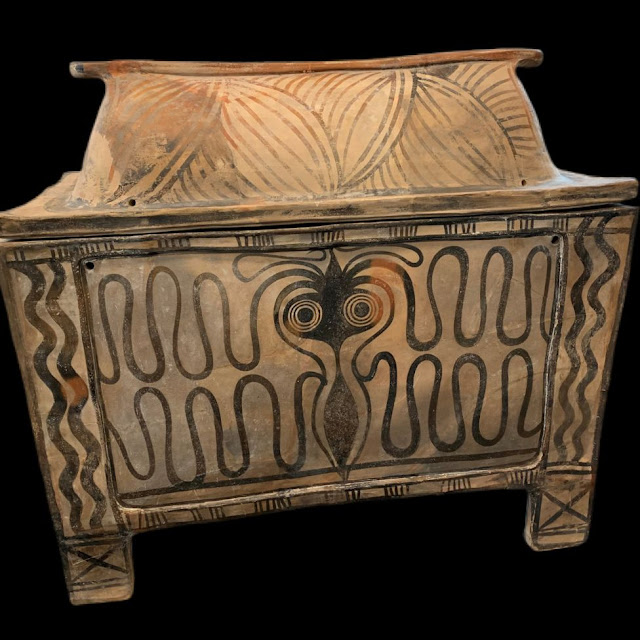

The Larnax. Picture credit: Anon (2021c).

The Larnax, a small chest for human remains, appears broken into several large fragments in a photograph recovered from Steinhardt’s files. See Exhibit 53A. The Larnax features painted aquatic figures and was crafted in the ancient workshops at Rethymnon in eastern Crete between 1400-1200 B.C.E. Over the last twenty years, Rethymnon has been subjected to widespread looting.

The Larnax first surfaced on the international art market immediately after these reports of looting on April 12, 2014, when Flavio Bertolin (b. 1965) a Munich-based restorer began reconstructing the Larnax from fragments. This is another example of the looting practice of “orphans” referred to earlier in which looters and smugglers often intentionally break large statues into smaller pieces to ease transport and avoid detection by customs and other law enforcement officials. The reconstruction work appears to have been completed by Bertolin on March 16, 2016. On April 22, 2016, Ralf Kotalla performed a Thermoluminescence test (TL)—a procedure done to evaluate the authenticity of an antiquity—in Haigerloch, Germany, concluding that the Larnax was Minoan and 3300 years old (+/-20%). Kotalla often conducted the same testing on looted antiquities for convicted antiquities-trafficker Giovanni Franco

Becchina.

On October 15, 2016, Steinhardt paid Seychelles-based FAM Services (via SATABANK as Alexander instructed) $575,000 for the Larnax. On May 31, 2017, during the investigation of the looted Calf Bearer that was ultimately seized and returned to Lebanon, Steinhardt was complaining to Special Agent John Paul Labbat about a subpoena from this

Office that was being served requesting provenance documentation. Scoffing at the subpoena, Steinhardt pointed to the Larnax, saying, “you see this piece? There’s no provenance for it. If I see a piece and I like it, then I buy it.” See Exhibit 53B for the most recent photograph of the Larnax. No verifiable provenance for the Larnax prior to the 2016 sale from Alexander to Steinhardt has ever been identified. Vance (2021b).

The Ercolano Fresco

The Ercolano Fresco purchased from convicted antiquities trafficker Robert Hecht and his antiquities restorer Harry Bürki with no prior provenance for $650,000 in November 1995. Depicting an infant Hercules strangling a snake sent by Hera to slay him, the Ercolano Fresco dates to 50 C.E. and was looted in 1995 from a Roman villa in the ruins of Herculaneum, located near modern Naples in the shadow of Mount Vesuvius. It first appeared on the international art market on November 10, 1995 when Hecht’s business partner wrote Steinhardt regarding a “crate being delivered to you soon” with the artifact inside. Today, the Ercolano Fresco is valued at $1 million.
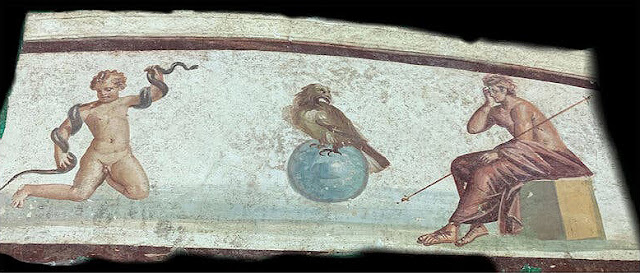

Ercolano (Herculanium) Fresco. Adapted from Mashburg (2021).

Depicting an infant Hercules strangling a snake sent by Hera to slay him, the Ercolano Fresco dates to 50 C.E. and was looted in 1995 from a Roman Villa in “Oliva dei Monaci” in Herculaneum, located near modern Naples in the shadow of Mount Vesuvius. Photographs recovered by Italian law-enforcement authorities depict the precise find spot for the Ercolano Fresco. On the photographs themselves, the looters made hand-written notes indicating the location of the looting pit relative to the sea and to Mount Vesuvius. Italian law-enforcement authorities had also received a letter containing eleven different photographs of the Ercolano Fresco and of a second looted fresco. The letter, translated from Italian to English, noted:

[t]hese pictures concern somebody you know, Pasquale, also known as the fat guy, who died some time ago and the pictures are related to the frescos that the professor from Taranto bought from Pasquale, now you have to find the frescos where they are located, in the United States of America.

The “fat guy” in the letter was Pasquale Camera, and the “professor from Taranto” is the well-known appellation for the prolific trafficker Raffaele Monticelli. Both the photographs and the letter were sent anonymously to Italian law-enforcement authorities in the port-city of Bari by tombaroli angered at being cheated out of their cut of the sale of the looted Ercolano Fresco.

The information proved accurate. Monticelli had purchased the Ercolano Fresco from Camera for approximately $120,000 in cash. Monticelli then smuggled the Ercolano Fresco out of Italy and sold it to Robert Hecht for approximately $240,000 in cash. The Ercolano Fresco first surfaced on the international art market on November 10, 1995, when Jasper Gaunt (Hecht’s business partner) wrote to Steinhardt regarding a “crate being delivered to you soon” containing the restored Ercolano Fresco. On November 22, 1995, Harry Bürki sent Steinhardt an invoice for $650,000 with no prior provenance. The invoice listed the same two frescoes that the anonymous tombaroli later sent to the Italian authorities. The first fresco was described as “One roman painting, c.a. 50 A.D.” with a hand-written note identifying it as “Herakles Strangling the Serpent,” i.e., the Ercolano Fresco. The second fresco on the invoice was described as “also Roman, ca. 50 A.D. ca. 43 cm wide and 107 cm high wich (sic) will be shipped soon.” A handwritten note on the invoice indicated that Steinhardt did not purchase this second fresco.

According to a letter dated February 17, 1999, from Harry Bürki to Steinhardt, recovered from Steinhardt’s files, Bürki noted:

I was surprised to learn that the Italian government had suggested that the wall-painting had been stolen from Herculaneum in May 1995.

This painting has been in my family for twentyfive (sic) years or so, and we acquired it from a Bulgarian medical doctor.

As discussed previously, Bürki often created fake provenance for Hecht by attributing works to his family’s “collection,” as he did here, falsely claiming on his invoice to Steinhardt that the Ercolano Fresco was “exported legally from [its] country of origin.”  No verifiable provenance for the Ercolano Fresco prior to the 1995 sale from Bürki/Hecht to Steinhardt has ever been identified. Vance (2021b).

Three Palestinian Death Masks

Three Death Masks purchased from known antiquities trafficker Gil Chaya with no provenance whatsoever for $400,000 in October 2007, less than a year after they surfaced on the international art market. The Death Masks (circa 6000 to 7000 B.C.E.) were crafted from stone and originated in the foothills of the Judean mountains, most likely in the Shephelah in Israel. They appear soil-encrusted and covered in dirt in photographs recovered by Israeli law-enforcement authorities. Today, the Death Masks are valued at $650,000.

These turned out to be the Grinning, Wondering and Chief’s Masks. (details derived from a visual inspection of the images provided in Vance 2021a). See previous post (here) for full-sized photographs of these Neolithic Stone Masks.


Three Judean (Occupied Palestinian territories), Neolithic Stone Masks, known as the Grinning, Wondering and Chief’s masks respectively. Picture credit: adapted from Hershman (2014).

Five Neolithic Stone Masks

Also from Palestine and known respectively as the Watching, Expressive, Large, Miniature, and Solid Masks. Vance (2021b): “Carved from limestone, the five Neolithic Masks depicting stylized human heads were accessioned by Steinhardt under A1991.23a, b, d, e, & f and date to circa 7000 B.C.E.”

Discovered as a single assemblage of finds, the Neolithic Masks originated from the Judean Desert. The Judean Desert lies in Israel and the West Bank, east of Jerusalem and descending to the Dead Sea. Following the discovery of the Neolithic Masks, noted trafficker Abu Ali Tawil smuggled them from their find spot to two different locations: two—A1991.23b and e — went to Brown’s gallery (at 10 King David Street in Jerusalem, Israel) and three — A1991.23a, d, and f — went to al-Rehani. As noted previously, Abu Ali Tawil not only found the Dead Sea Scrolls, but operated as a smuggler in the West Bank and was caught by Israeli authorities supplying metal detectors to looters on the West Bank. Initially, Brown examined the two masks — A1991.23b and e — in Israel. Then, he sent the two masks to al-Rehani as well. Al-Rehani, in turn, smuggled all five Neolithic Masks to Zurich. From Zurich, Brown shipped the Neolithic Masks to the United States.

The Neolithic Masks first surfaced on the international art market by February 1, 1991, when Steinhardt purchased them from Brown with no prior provenance for an unknown price. In a letter from Brown recovered from Steinhardt’s files, Brown writes, “on the following page you will find the descriptions of your recent acquisitions [including the subject Neolithic Masks] from Mr. [al-Rehani] of Jordan.” A handwritten note recovered from Steinhardt’s records for the Neolithic Masks contains the name, “Abuwali Twill.” To date, no invoice or proof of payment for any of the five Neolithic Masks has ever been recovered from Steinhardt’s records, and a note in Steinhardt’s records indicates “no record of purchase.” Vance (2021b). Again, see my previous post (here) for full-sized photographs of these Neolithic Stone Masks.


The other five, looted Palestinian, Neolithic Stone Masks recovered from Steinhardt. L-R Watching, Large, Expressive, Solid and Miniature Masks. Picture credit: adapted from Hershman (2014).


Proto-Corinthian Owl and Duck

Feuerherd (2018): “Manhattan, NY — Investigators on Friday raided the office and Upper East Side apartment of billionaire Michael Steinhardt and seized several works of ancient art, according to a search warrant reviewed by Patch. Steinhardt had several ancient antiques in his office and apartment that date to as early as the seventh century B.C., according to the warrant. Among them were Proto-Corinthian figures that depict a duck and owl that both date from the sixth century B.C.; an Apulian terracotta flask from the fourth century B.C.; and a Greek white-ground oil vessel from the fourth century B.C.” Details of each item follow below.


Pro-Corinthian owl and duck figurines. Picture credits: Anon (2021a).

Adapted from Vance (2021b). Dating to 650-625 B.C.E., the Proto-Corinthian Duck depicts a duck with its head facing backward.  The Proto-Corinthian Owl has the same date range. Both were looted from an Etruscan tomb in Central Italy. They first surfaced on the international art market when they were displayed at the Musée de l’Art etd’Histoire in Geneva from 1978-1981 and then at the Getty Museum from 1984-1996. On June 12, 1996, Symes sold the both Proto-Corinthian Duck and the Proto-Corinthian Owl to the Beierwaltes for $120,000 and $150,000 respectively. In 2006, the Beierwaltes consigned their entire collection, to include the Proto-Corinthian Duck, and Proto-Corinthian Owl to Phoenix Ancient Art. In 2009, Steinhardt purchased both figurines from Phoenix Ancient Art for a total of $250,000. Although Phoenix Ancient Art provided a warranty that it had “the right to sell” both objects, no verifiable provenance for either prior to the 1978 Musée de l’Art et d’Histoire exhibition has ever been identified.

Apulian African Head Flask


Apulian African Head Flask. Picture credit: Anon (2021a).

Crafted in Apulia in Southern Italy between 400-300 B.C.E., and featuring red and black paint, the Apulian African Head Flask first surfaced on the international art market when it was displayed at the same Musée de l’Art et d’Histoire exhibition in Geneva from 1978-1981 as the previous two items before being displayed at the Getty from 1984-1996. These were the same exhibitions (and in the same order) used by Medici to launder his looted antiquities as described above. Again, in 1996, Symes sold it to the Beierwaltes, who sold it on Phoenix Ancient Art. Steinhardt in turn, bought it in 2009. Although Phoenix Ancient Art provided a warranty that it had “the right to sell” the object, no verifiable provenance for the Apulian African Head Flask prior to the 1978 Musée de l’Art et d’Histoire exhibition has ever been identified. Vance (2021b).

The above three items appear in the ‘Medici Dossier’ a series of documents confiscated from Giacomo Medici, by Italian authorities from the eponymous looted antiquities dealer.

The following item is linked to another infamous ancient art smuggler, named Gianfranco Becchina .

Etruscan White-Ground Aryballos.


This is a vessel which is used to contain oil or perfume and is used during bathing. Noted by Feuerherd (2018), above as ‘Greek white-ground oil vessel from the fourth century B.C’.

From Vance (2021b): “The Etruscan White-Ground Aryballos appears in numerous photographs stapled to a single page in the Becchina archive. See Exhibit 25A. Depicting two women bathing, the Etruscan White-Ground Aryballos was crafted in Central Italy between 725-600 B.C.E. as a small accessory to contain fragrant oil or perfume. According to Becchina’s notes, between 1995 and 1997, he attempted to exhibit the Etruscan White-Ground Aryballos in museums and galleries to increase its value. In October 1998, the Etruscan White-Ground Aryballos first surfaced on the international art market when Fiorella Cottier-Angeli sold it to Phoenix Ancient Art. Dr. Cottier-Angeli worked for Swiss customs and was ultimately charged in Italy as a Medici co-conspirator for using her position in Swiss customs to facilitate the smuggling of trafficked antiquities. Steinhardt purchased the Etruscan White-Ground Aryballos from Phoenix Ancient Art for $55,000 in 2009. See Exhibit 25B for the most recent photograph of the Etruscan White-Ground Aryballos. Although Phoenix Ancient Art provided a warranty that it had “the right to sell” the object, no verifiable provenance for the Etruscan White-Ground Aryballos prior to the 1998 sale from Cottier-Angeli to Phoenix Ancient Art has ever been identified.”

 Iraqi Gold Bowl looted from Nimrud.


The Nimrud Bowl. Picture credit: Mashburg (2021).

Vance (2021b): “Crafted from gold with a scalloped flower design, the Gold Bowl was looted from Nimrud, a city in Northern Iraq that had its height in the modern Assyrian Age (911-612 B.C.E.). As previously discussed, an international investigation determined that more than 10,000 antiquities were stolen from Baghdad’s Iraq Museum in April 2003. During the course of the investigation, the team recovered and photographed many items from Nimrud identical to the Gold Bowl. Beginning in 2015, objects from Nimrud were again trafficked when the Islamic State in Iraq and the Levant (ISIL) targeted cultural heritage from Nimrud, Hatra, and Khorsabad, often documenting their efforts on YouTube. ISIL even established a Department of Antiquities to profit from the looting of antiquities from its territory and supplied locals with looting “permits.” According to a 2016 complaint filed by the Office of the U.S. Attorney for the District of Columbia, ISIL placed special emphasis on ancient objects made of gold or precious metal and demanded locals find such objects.

The Gold Bowl first surfaced on the international art market on October 22, 2019, when Customs and Border Patrol (CBP) Officer Christopher Foulkes notified this Office that Svatoslav Konkin was on a flight from Hong Kong to Newark, New Jersey, hand-carrying the Gold Bowl for Steinhardt. Konkin initially stated that he had purchased the Gold Bowl in 2011 and that it was of Tajik origin. He later admitted, however, that he knew the Gold Bowl would be stopped by customs officials if declared any antiquity as Iranian or Iraqi. As a result of the ongoing investigation into Steinhardt, this Office directed that the Gold Bowl be returned to Konkin so he could deliver it as planned. He did so. And on July, 10, 2020, Steinhardt purchased the Gold Bowl from Konkin with no prior provenance for $150,000. Although Konkin claimed in a letter to Steinhardt that the Gold Bowl “has clear history which goes back at least up to 1970 and earlier,” no verifiable provenance prior to Konkin’s 2019 arrival into the United States has ever been identified.

Neolithic stone figure of a female


Palestinian Neolithic Figurine. Picture credit: Vance (2021b).

Vance (2021b), The Neolithic Female figurine dates to circa 7000-6000 B.C.E. and originated from a site near Hebron. The Yellow Note recovered from Steinhardt’s files notes the Neolithic Female was found “near Hebron” in Israel. The Neolithic Female first surfaced on the international art market on February 1, 1991, when Steinhardt purchased it from Rafi Brown with no prior provenance.

Rafi Brown, a/k/a Rafael Braun (b. 1936), began his career as a conservator and researcher of antiquities. According to Israeli law-enforcement authorities, Brown began working at the Israel Museum in the mid-1960s and ultimately was responsible for cleaning, restoring, and analyzing new acquisitions of Judaica. Through his work at the museum, Brown often met suppliers of freshly discovered antiquities. For example, in 1974, Brown notified researchers at the Hebrew University in Jerusalem of an antiquity freshly discovered by someone in el-Arish, a town in the Northern Sinai.

On December 2, 2019, Israeli law-enforcement authorities interviewed Brown. On July 8, 2020, they executed a search warrant at Brown’s residence in Herzeliya, recovering documents and looted antiquities and conducting a second interview. Then, on January 14, 2021, they executed additional search warrants at Brown’s residences in Herzeliya, Petah Tiqwa, and Jerusalem, recovering looted antiquities, Polaroid photographs, and documents, including correspondence with Steinhardt’s curators.

In a letter from Brown recovered from Steinhardt’s files, Brown described the antiquity as: “Human Neolithic figure probably of a female.” As previously discussed, no record of payment for the Neolithic Female has ever been identified though Steinhardt’s records contain a note, “piece purchased from Rafi Brown in February, 1991 no invoice. No verifiable provenance for the Neolithic Female prior to the 1991 sale from Brown to Steinhardt has ever been identified.

This female, Neolithic figurine interests me greatly, as it is dated in the same time frame as the Neolithic stone face masks and was perhaps made by the same culture? Picture credit: Vance (2021a).

Sardinian Stone Idol


The Sardinian Stone Idol, after restoration and broken prior to restoration from the Medici papers. Picture credits: Albertson (2018). 

Adapted from Albertson (2018) and other sources: A little more than two weeks ago, following a second set of seizures at the residence and office of Michael Steinhardt in New York City, ARCA wrote a blog post outlining other antiquities from the billionaire's private collection that have raised concerns with illicit trafficking researchers. 

One of those objects was a marble Female Idol of the Ozieri Culture from Sardinia.

The Ozieri culture was a Neolithic culture that occupied Sardinia from c. 3200 to 2800 BC. The people lived in small villages of round huts with archaeological finds indicating that this was a society based around a hunter-gather lifestyle with a little pastoralism and early agriculture.  The Ozieri produced finely made ceramic pottery with complex patterns, incisions and surface decoration. Such ceramics were a novelty for prehistoric Sardinia, since up to that point they had been considered typical of the Cyclades and Crete. Finds of weapons within interments are rare, perhaps indicating, that this was a peaceful society. Figurines recovered indicate the Ozieri may have worshiped a mother goddess, with the most well known example being an alabaster statuette found at Ponto Ferro Tomb, Senorbì, and that confiscated from Michael Steinhardt. Its context and its exact origin on Sardinia, may sadly never be known. Picture Credits: Inf.news (2022)

This idol was seized on January 24, 2018 during the execution of a new search warrant carried out by law enforcement authorities working with the Manhattan District Attorney and HSI.  The artifact was removed from Steinhardt's New York City residence.

Three years earlier, on November 21, 2014, Christos Tsirogiannis, a stolen art sleuth, identified this marble artifact, dating from 2500-2000 B.C.E. when it came up for auction as part of Christie's December 11, 2014 sales event.  Listed as Lot 85 in the New York sale, the idol had an estimated bid price of $800,000 to $1,200,000 USD.

Tsirogiannis had matched the antiquity online via Christie's web version of its sale catalog to a photo contained in the confiscated archives of antiquities dealer Giacomo Medici.  Having made the ID, Tsirogiannis emailed his concerns to US Federal law enforcement and Italian law enforcement authorities working towards eventual repatriation should Italy file a claim.  Additionally he notified ARCA, in hopes of drawing further attention to potentially trafficked pieces that often resurface on the licit market but which omit passages through the hands of known dealers involved in the sale of illicit objects.

The sales catalog for the Christies auction is stored online here, although the photo of the idol has subsequently been removed from the object's accompanying Lot description.  Of note is the addition of a brief entry into the "Cataloguing & details" section of the listing, which states only that the object was withdrawn from the sale.

The artifact above matches perfectly with the image below which Tsirogiannis located in the dealer's archive.   In the art dealer's records the statuette appeared atop a turquoise background and broken in multiple pieces, prior to the object's subsequent restoration.

Before arriving in the collection of Michael and Judy Steinhardt in 1997, the Ozieri Culture idol, also known as the Turriga Mother Goddess figure, passed through Harmon Fine Arts and the Merrin Gallery, both of New York.  Once part of the collection of Leonard Norman Stern, the object had been displayed, but not photographed, in a 1990 "Masterpieces of Cycladic Art from Private Collections, Museums and the Merrin Gallery" event where both Steinhardt and Stern were present.

On November 27, 2014 when the contested object was pulled from the Christie's auction, it apparently was sent back to Steinhardt, where it was later re-identified as still being part of Steinhardt's collection when officers searched his New York City home on January 5, 2018 pursuant to an earlier search warrant. The Idol has now been returned to Italy.

Conclusion

I could continue detailing objects seized from Michael Steinhardt. I have barely scratched the surface as 180+ were seized and Steinhardt bought at least 1550 artifacts between 1986 and the 2018. Instead I will leave you with a couple of collages of some of the most interesting pieces, I haven’t had time to cover.


Top row L-R: Corinthian Lion Vessel, Etruscan 600-550 B.C.E.; Corinthian Bull’s Head, central Italy 580 B.C.E.; Ionian Ram’s Head, Etruscan 500-600 B.C.E.; Italo-Corinthian Duck Vessel, looted from Faleri, Italy 600-500 B.C.E.; Faliscan Askos (oil jug), Etruscan, 400-300 B.C.E.

Bottom row L-R: Etruscan Oinochoe (wine jug), 490-480 B.C.E.; Leagros Hydria (three handle pitcher), Etruscan, 510 B.C.E.; Attic African Head Aryballos, Etruscan, 500-400 B.C.E.; Attic Black Figure Amphora, Etruscan or Sicilian, ca. 550 B.C.E.; Attic Black-Figure Eye Kylix, Etrurian, 540 B.C.E. 


Top row L-R: Gold Masks, Israel (Palestine?), Chalcolithic 5000 B.C.E.; Griffin Lebes (cauldron) bronze, with stand, Lazio Italy, ca. 700 B.C.E.; Helmet, iron, silver and bronze, Pletena, Bulgaria, ca. 400-300 B.C.E.; Bronze Bird Rattle Malazgirt, Muş province, Eastern Turkey, 1000 to 500 B.C.E.; Glass Oinochoe, Rhodes, Greece, 400-300 B.C.E.

Bottom row L-R: Gold Brooch, Rhodes Greece cia.600 B.C.E.; Stone Skull, Arad Valley or Hebron Mountains, Palestinian, 7,000 B.C.E., featured in the exhibition Face to Face: The Oldest Masks in the World at the Israel Museum, Jerusalem between March and September 2014, along with the eight other Neolithic Stone Masks from Steinhardt.; Corinthian Helmeted Head Aryballos,  Etrurian 500 B.C.E.; Figulina Plate, Etruscan, dates to 540 B.C.E.; Gallo-Roman enamelled Situla (bucket), likely from Roman Gallia Cisalpina, the northern part of Italy between the Alps and the Apennines Dating to 100-200 C.E.


References

Albertson, L. (2018) New seizure at the residence of New York Collector Michael Steinhardt – January 24, 2018. ARCA (Association for Research into Crimes against Art), at: https://art-crime.blogspot.com/2018/01/january-24-2018-new-seizure-at.html

Anon (2021a). New York Billionaire Surrenders 180 Stolen Antiquities Valued At $70 Million. Archaeology News Network. At: https://archaeologynewsnetwork.blogspot.com/2021/12/new-york-billionaire-surrenders-180.html

Anon (2021b) Michael Steinhardt Surrenders 180 Stolen Antiquities Valued at $70 Million. Archaeology Wiki. At: https://www.archaeology.wiki/blog/2021/12/08/michael-steinhardt-surrenders-180-stolen-antiquities-valued-at-70-million/

Anon (2021c). Michael Steinhardt: US billionaire hands over antiquities worth $70m. BBC News. At: https://www.bbc.co.uk/news/world-us-canada-59543021

Feuerherd, B. (2018). Ancient Antiques Seized From Manhattan Billionaire's Home. Patch. At: https://patch.com/new-york/upper-east-side-nyc/ancient-antiques-seized-manhattan-billionaire-s-home

Hershman, D. (2014) Face to Face: The Oldest Masks in the World. Catalogue for the exhibition. The Israel Museum, Jerusalem. March–September 2014. Online at: https://museum.imj.org.il/exhibitions/2014/face-to-face/pdf/9.pdf

Inf.news (2022). American billionaire resells stolen cultural relics, and is now forced to hand over 180 pieces worth 70 million US dollars. Inf.news at: https://inf.news/en/world/effcbacb30e88c92cd6b837d61e9f2fe.html

Mashburg, T. (2021). Michael Steinhardt, Billionaire, Surrenders $70 Million in Stolen Relics. New York Times. At: https://www.nytimes.com/2021/12/06/arts/design/steinhardt-billionaire-stolen-antiquities.html

Vance, C. R. jnr. (2021a). In the Matter of a Grand Jury Investigation into a Private New York Antiquities Collector (Exhibits 1-92). District Attorney New York County. At: https://s3.documentcloud.org/documents/21141912/steinhardt-exhibits-1-92-filed.pdf

Vance, C. R. jnr. (2021b). In the Matter of a Grand Jury Investigation into a Private New York Antiquities Collector (Complete Agreement). District Attorney New York County.

https://images.law.com/contrib/content/uploads/documents/292/102693/2021-12-06-Steinhardt-Complete-Agreement-w-Exhibits-Filed.pdf


Wednesday, 22 December 2021

Funerary Masks Worldwide

During the research for my last post I came across numerous examples of cultural artifacts plundered from around the world, and now on display or the vaults of museums who should know better. Yes, a lot of cultural artifacts should, long have been returned to their countries of origin. Not just masks are involved, but almost every conceivable type of human-made object imaginable.

Ilama Gold Mask - Colombia


Original text from The Metropolitan Museum of Art (2021)

“Lifesize hammered masks are the largest objects produced in gold in the ancient Americas. While most masks were presumably made as burial offerings, this example, with its pierced eyes, cutout mouth, and additional holes for tying at the sides, could have been worn by an individual during life in a ritual or ceremony before being placed with his material wealth in a tomb. The mask comes from the Calima River region in southwestern Colombia, where abundant alluvial gold deposits prompted a distinguished goldworking tradition that lasted for at least 2,000 years. Hammered from a single sheet of metal of high carat gold (its alloy contains 86 percent gold, 13 percent silver, and one percent copper), Calima masks of the Ilama era are often flat, with generic details of the human face. On this example, the features are individualized with puffy bags beneath the eyes, a broad nose with flared nostrils, big, round, bulging cheeks, and a fat-lipped open mouth.”

No information on how the mask was ‘obtained’ – of course(!) and not even on display. A disgrace!

References

MET (2021). Funerary Mask. 5th–1st century B.C. At: https://www.metmuseum.org/art/collection/search/316699

The oldest human masks in the world

I first became aware of the Neolithic stone face masks from Palestinian occupied territories by reading a National Geographic article by Kristin Romey (2018) about the 16th mask found. The sheer beauty, and the artistic intent which it displays captivated me. As I delved deeper into subject, I found that there were more. Approximately 16 in fact. Additionally, their ‘otherness’ and varied expressions, imparting disparate emotions to the viewer, such as fear, shock and occasionally joy or laughter, drew me in and elicited in me a host of questions: “What did the artisans that made them mean to convey?” “What use were they put to and what in context?” and “Did they have some religious or ritual meaning?”   

You might, therefore, think that I am about to embark on a story of entralling archaeological excavations carried out under the scorching middle-eastern sun, by underpaid labourers or university undergraduate students and their archaeologist supervisors, but you’d be wrong. The truth is far darker and much more unsettling than that.

To frame the story in a scientific framework, I’ll begin my story with those masks whose origin and context is certain.

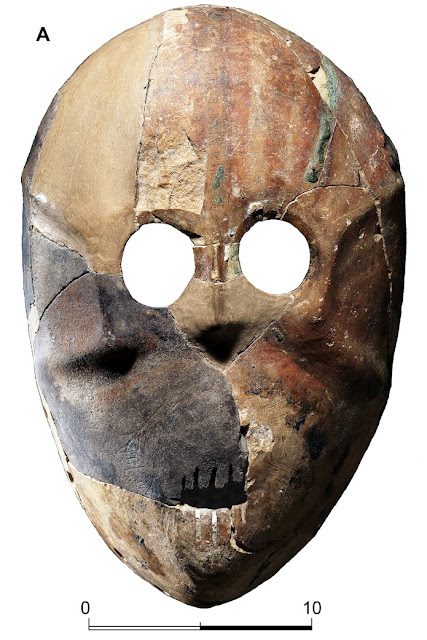
This is one of the 16 oldest masks ever made by man:


Nahal Hemar Cave Stone Mask, excavated in 1988 in the occupied west bank of Palestine by archaeologists of the occupying state. Image credit: adapted from Borrell et al. (2020). Original caption reads:

Fig. 3. Some of the outstanding objects found in Nahal Hemar Cave: A) stone mask.. [Photo A: Elie Posner].

Nahal Hemar Cave is a small chamber of about 4 × 8m, with a narrow entrance on the west bank of the eponymous dry gorge in the Judean Desert. It lies about 11km south of the town of Arad and at about 210m altitude. The cave, after being discovered by locals and partially looted, was excavated in 1983 by Bar-Yosef and Alon (1988), revealing one of the richest, Pre-Pottery Neolithic B (PPNB) assemblages ever found in Palestine and the Levant more widely.


Nehal Hemal Cave with the spoil from the 1983, excavations clearly seen below the entrance. Image credit: Borrell et al. (2020).

The mask, and the partial remnant of a second were dated by 14C dates, Bar-Yosef and Alon (1988) between 7900 and 7100 cal. BC, which puts it in the Middle/Late Pre-Pottery Neolithic for the region. The mask is therefore one of the earliest face-masks ever found from any site worldwide. As such, it, along with the 15 others found in the area, is of tremendous significance for humanity. At nearly 10,000 years old it, in my opinion rates as one of the greatest pieces of portable art from the period in question. It is now housed in the Israel Museum in Jerusalem.

In addition to the stone masks a myriad of unique and precious objects was also found: modelled skulls [that is skulls plastered in asphalt], remains of an anthropoid statue, bone figurines, well-preserved organic remains such as mats, wooden beads, basketry, knotted netting and twined fragments of linen. Flint tools, as well as numerous blades of a type unique to the cave: the ‘Nahal Hemar knife’ [large and pointed blades with two proximal opposed notches], a complete sickle, made from bone with flint inserts, beads of stone and plaster and seashells from the Red Sea and the Mediterranean.


‘Modelled’ skull from Nahal Hemar. The material used to cover the detached human skulls was asphalt. The bodies to which the three skulls recovered belonged, were also buried in the cave. Image credit: Yakar and Hershkovitz (1988).


Nahal Hemar ‘knives’. These stone tools, unique to the cave were often found broken and/or burnt, what their purpose is unclear, but ritual usage seems to be a strong possibility, considering the makeup of the assemblage overall.


The mask of second-most note is that from Horvat Duma.


 The Dayan Mask, ploughed up near Horvat Duma and subsequently sold to the then, eponymous Israeli defence minister. Image credit: Israel Museum.

It’s history is documented by Hershman (2014): “Our intriguing story of the most ancient masks in the world opens with the stone mask, [discovered and] purchased in 1970 by Moshe Dayan (who was Israel’s Minister of Defense at the time) in Kefar Idna, near Hebron. Shortly thereafter “the Dayan Mask,” as it is called, was exhibited at the Israel Museum. Following Dayan’s death in 1981, Laurence and Wilma Tisch, New York, acquired the Dayan collection of antiquities and donated it to the Israel Museum. Since then the mask has been part of the Israel Museum Collection and is one of the universal treasures displayed in the Museum’s permanent exhibition of prehistoric cultures.

This mask is officially known as the “Mask from Horvat Duma,” named after the place it was found, which is next to Hebron. However, based on evidence that reached us it appears that the mask was actually unearthed by a farmhand who had been ploughing a field north of Horvat Duma, on the outskirts of the village of el-Hadeb. In his book Living with the Bible, Dayan writes: “I was fortunate to acquire a ritual article from this region, a magnificent mask ... The marvel, apart from its age, lies in its facial expression. It has circles for eyes, a small nose, and prominent grinning teeth. It is a human face, but one that strikes terror in its beholder. If there is any power in the world able to banish evil spirits, it must assuredly dwell in this mask … Before handing it to experts at the government department of antiquities for their study and confirmation of the dating, I was anxious to inspect the site where it was found … I examined the ploughed soil and spotted bits of bone and fragments of stone vessels between the clods of earth in the furrows.”

Following in Dayan’s footsteps, a local antiquities inspector from Hebron, archaeologist Jibril Srur, set out for el-Hadeb. In the trial excavations he conducted there, flint and stone tools, bones, lumps of ochre, and the remains of early structures that had been damaged by the tractor came to light. The site’s area was estimated at around 2.5 acres. All these finds attest to the fact that in the Pre-Pottery Neolithic B Period, some 9,000 years ago, a large village existed at this site.” 

It is interesting to note that, like the masks from Nahal Hemar, the Horvat Duma example also comes from the occupied West Bank. All sites and museums in the occupied lands fell into the hands of the Israelis after the Six Days War. To understand the scope and completeness of the cultural appropriation that took place, it is worth taking a look at an academic study of the record of Israeli archaeologists post 1967.

Excepts, from Greenberg and Keinan (2009): “The six-day war of June 1967 marked the beginning of a process that was to revolutionize the archaeological investigation of the central highland regions, leading to the addition of thousands of sites to its inventory, hundreds to the list of its excavated places, and changing some of the central paradigms of archaeological interpretation of its history.

..In Israel, the fields of archaeology and historical geography had long been linked, and academics in both fields had an intimate and mutual relationship with military historians and with the Israeli Defence Force (IDF) itself. In 1956-7, during the brief conquest of the Sinai peninsula, limited surveys and excavations were carried out with IDF assistance by the pioneer of the archaeological survey in Israel, Yohanan Aharoni, this was to be a model for future work in Israel’s battlegrounds. In 1967, archaeologists entered the Palestine Archaeological Museum almost in tandem with the troops.

Immediately after the war, on the 15th of June 1967, the Archaeological Council was convened: at the top of its agenda were the protection of sites in the newly occupied areas and the fate of the Museum, which had recently been nationalized by Jordan shortly after the occupation of the West Bank in 1967, the “Emergency Survey” of the West Bank,  and the Golan (so called, in view of the impending return, as it was thought, of the occupied territories to Jordan and Syria) was put into motion. Within a few months the surveyors were able to submit a preliminary report, presented at a meeting in the residence of the President of Israel: This survey focused on sites already identified on maps or in the Mandatory Schedule of Sites as possible antiquities sites..

It was to be followed by a long line of surveys, many of which emerged from the crucible of Israeli survey methodology at Tel Aviv University.

These surveys, which dramatically transformed our knowledge of the archaeological resources of the West Bank, were initiated in 1978, after it became clear that Israeli presence in the West Bank was not a passing phase, this realization corresponded with political changes in Israel and the invigoration of the settlement policy in the West Bank. The surveys have recorded, to date, a total of approximately 6000 sites—a 600% increase in relation to the number of sites recorded in 1967…

Gradually, Israeli academics began to initiate research-oriented excavations, often merging with survey work. This trend reached its apex during the second decade of occupation, from 1978-1987, when funding for work in the West Bank became available due to the promotion of Jewish settlement activity by the Israel government.” 

Whilst the situation has been somewhat ameliorated between the Israelis and the Palestinians, since the 1993 Oslo accords, actual involvement of the Palestinians has been limited due to the chronic lack of funding imposed by the economic conditions brought about by the Israeli occupation. 

Greenberg and Keinan (2009) again: “The signing of the Oslo accords in 1993 introduced a new phase of activity: Because the Oslo accords, as negotiated in bilateral interim agreements, called for “[the transfer of] powers and responsibilities in the sphere of archaeology in the West Bank and the Gaza Strip… from the military government and its Civil Administration to the Palestinian side..  a sense of urgency arose regarding areas scheduled for withdrawal. The most visible of these pre-implementation activities was “Operation Scroll”, a Staff Officer for Archaeology SOA-IAA (Israel Antiquities Authority) collaborative effort conducted in late 1993-early 1994 in order to pre-empt possible looting (according to the initiators) or retrieval by Palestinian archaeologists (according to critics) of epigraphic material from Judean Desert caves in the area of Jericho and the northern Dead Sea shore.

After implementation, when parts of the West Bank were transferred to the authority of the Palestinian National Authority and its Department of Antiquities (the PDA), pressure on the archaeological sites within areas still controlled by the SOA did not abate. This was caused, on the one hand, by the closure policy that led to increasing economic hardship in the West Bank and the concomitant rise of subsistence looting. On the other hand, the construction of the Separation Barrier in the first decade of the new millennium threw dozens of archaeological sites in the way of destructive development, necessitating dozens of new salvage excavations. In April 2008, at the 34th Archaeological Congress in Jerusalem, the SOA characterized the members of his unit as the “last archaeologists” in the West Bank, signifying that — in his perception — few antiquities of significance would survive the disorder that would reign after the dissolution of the unit (presumably, in the event of Israeli withdrawal and the establishment of a Palestinian state), and that there was no significant Palestinian professional infrastructure that could take over the SOA’s responsibilities.

…the SOA has remained very active in the last decade of recorded work, carrying out more than 270 excavations at 190 sites. The total number of SOA licenses for excavation and survey issued between 1967 and 2007 was 1148, of which at least 820 were carried out by the unit.

A few words may be in order regarding archaeology in the Palestinian National Authority, although work carried out by its Department of Antiquities is outside the purview of this report. In a review of the emergence of a Palestinian school of archaeology, Ziadeh-Seely (2007) describes the ideological and institutional background to the creation (and

subsequent temporary demise) of the Institute of Archaeology at Birzeit University, emphasizing the attempt to create a multi-cultural approach to the past.

Al-Houdalieh (2009) has recently complemented this description with a thorough assessment of the present state of archaeological studies in the occupied West Bank. These publications establish the existence of an independent Palestinian approach to archaeology, initiated in the late 1970s and surviving, if not thriving, at the present.” 

It is therefore clear, that the Israeli’s have systematically sought to find, recover and remove to Jerusalem every antiquity they could discover. Not only that, by their policy of closure, of the West Bank in particular, they have deliberately made the Palestinians economically destitute thus fostering the subsistence looting highlighted above. Worse still, the narrative of whose ancestors were responsible for the creation of some of the greatest art of the Neolithic has been substantially re-written in favour of a group who are largely immigrants – the Israelis.

Of the 16 masks known to exist, three are in the possession of the Israeli state, one in a private collection within Israel (Tel Aviv), one in the offices of the Palestine Exploration Fund in London, one in the Musée Bible et Terre Sainte, Paris, one (partial) mask in a Jordanian museum.  The remaining 8 have been sold illicitly and are housed in a family home of Michael and Judy Steinhardt, in upstate New York.

Michael H Steinhardt is an interesting character with a chequered career in hedge fund management, and  a somewhat sordid, family background. Son of Sol Frank Steinhardt, also known as "Red McGee", allegedly New York’s leading jewellery fence. Whether he ever reached so high in the criminal fraternity, is a moot point. Whatever the true story, it is a fact that  Red Steinhardt was convicted in 1958 on two counts of buying and selling stolen jewellery, and was sentenced to serve two 5-to-10 year terms, to run consecutively. 

In a Forbes’ (2001) article, much more detail was revealed about the elder Steinhardt: “Sol was a compulsive high-stakes gambler and colourful New York nightclub patron. He was also New York's leading jewel fence, a convicted felon and pal to underworld figures such as Meyer Lansky and "Three Finger" Jimmy Aiello. The night before crime figure Joey Anastasia was rubbed out in the Park Sheraton barbershop in 1957, he and Sol were out on the town gambling together.

The next year, Sol was convicted on charges of buying and selling stolen jewelry and was sentenced to five to ten years in prison on each of two felony counts.

Michael Steinhardt visited his father in prison, but saw it as an obligation, since Sol had paid for Steinhardt's education at the University of Pennsylvania's Wharton School – most likely with ill-gotten gains, Michael Steinhardt suggests, in his autobiography, No Bull: My Life In and Out of Markets.

He also notes that when he was starting out on Wall Street, he was lucky no one identified him as the son of a convict serving time at Sing Sing and Dannemora, a maximum-security prison in upstate New York. Otherwise, such white-shoe firms as Calvin Bullock, a mutual fund group, and Loeb Rhoades, the brokerage firm that was a precursor to Merrill Lynch, would not have hired him. In addition to an education, Sol gave his son envelopes stuffed with $10,000 in $100 bills to put in the stock market. This helped Steinhardt build his net worth to $200,000 at a young age. In effect, his father was Steinhardt's first investment client.

Recent history, also reveals similarities between the two men. Like father, like son, Michael Steinhardt has also, had his own run in with the law. He and his firm were investigated, with Salomon Bros. and the Caxton Group, for allegedly attempting to corner the market for short-term Treasury notes in the early 1990s. In his autobiography he states "When you're a target of the government investigation, it is very unpleasant," he says. He personally paid 75% of the $70 million in civil fines that were part of settling the case with the Securities and Exchange Commission and Justice Department – a mere fraction of the $600 million his hedge fund made on the Treasury positions.

What did Michael Steinhardt, do with his dubiously acquired fortune? Well he bought antiquities. Many hundreds by all accounts. In the course of writing this blog post it has come to light that he now owns almost ALL the known masks found by “subsistence looting”!

His collection of these Palestinian Neolithic masks now numbers 8. Before we move on to those, several other masks discovered in the same period as that from Horvat Duma are worthy of note. The mask now on display in the Musée Bible et Terre Sainte, Paris, has an interesting history. Hershman (2014), details its discovery:

“Józef Milik, a Catholic priest of Polish origin and a biblical scholar, who was nicknamed “The Prodigious Priest,” was considered the brightest member of the École biblique et archéologique française de Jérusalem team working on the deciphering of the Dead Sea Scrolls. His single contribution to the prehistory of the Land of Israel is less well known, and it is doubtful that even he himself was aware of its importance.

During a field trip he took in the early 1960s, he purchased from Bedouin near Hebron in the southern Judean Hills a stone mask as well as several pottery vessels dating from the Middle Bronze Age, 3,600 years old. Since the mask was sold together with the pottery, he assumed that it also dated from the Middle Bronze Age and, consequently, that belonged to the Canaanite culture. He gave the mask to the Catholic French research organization, Bible et Terre Sainte, which was holding an exhibition in Paris at the time on the material culture of the Bible. Owing to its artistic qualities the mask became the star of the show. And indeed, in the publication that accompanied the exhibition we read: “The most important work in the group, which is unparalleled in any of the Palestinian collections, is the limestone mask, whose power of expression arouses spectators’ admiration.”

The first description of the mask, which documents its details while extolling the ancient stone carving, is still the most beautiful and comprehensive portrayal of its special characteristics. “The mask is of a rare perfection: An oval, youthful face, a broad forehead with prominent cheekbones pointed at a straight, short nose. Round spaces take the place of eyes, and the mouth is wide open as if to express deep, eternal astonishment. Above the eyes traces of black paint are visible, which the artist used to indicate eyebrows, since he could not carve them into the stone. The same makeup can be found on the upper lip and the chin. Finally, six holes on each side and two in the upper part (one is unfinished) were meant for suspending the mask. Nothing in the art of that period exhibits the artistic proficiency that this artist attained in stone. Even though it was believed at that time that the mask dated from the Bronze Age – a period thousands of years later than when the mask was actually, made – it was defined as a breathtaking artistic achievement.

Interestingly, Milik was indeed hard pressed to find parallels to the mask within the Canaanite material culture, and he noticed the differences between this mask and other masks from the Bronze Age, such as the clay mask from Hazor. At the same time he managed to recognize the similarities between the mask and the face of a Neolithic plaster statue head found in ancient Jericho. Nonetheless, he rejected this observation owing to his impression that the statue, with its eyes inlaid with shells, might represent a living person, whereas the stone mask, he believed, was used in funerary cults. In his opinion, its small size (18 x 14 cm) suggested that it did not cover the face of the deceased but was rather attached to a pole and fulfilled a ceremonial role.

The mask, along with the rest of the collection that Milik gave to the organization Bible et Terre Sainte, moved to a small museum by that name that opened in Paris under the auspices of Université Catholique de Paris. It quickly became the most famous exhibit in its Biblical and Second Temple Period collections, as it remains until today.

The French archaeologist Jean Perrot, who was well-acquainted with the artistic and cultic finds of the earlier periods in the Levant, determined that the mask was not Middle Bronze, but actually belonged to the Neolithic Period. In his book, Syria-Palestine, he noted the similarity between this mask, the Mask from Horvat Duma (discovered a year after the opening of the museum in Paris), and the modelled skulls from Tell Ramad in Syria and ancient Jericho, and he proposed that all these were portraits of the dead.”


The mask from the Musée Bible et Terre Sainte, Paris. Photo credit Hershman (2014). Original caption reads: Mask from the Musée Bible et Terre Sainte | Unknown site, probably in the Judean Desert Pre-Pottery Neolithic B Period, 9,000 years ago (?) | Limestone | 18 x 14 cm | Ca. 1 kg |.

The circumstances of the discovery of mask from er Ram north of Jerusalem, now in the possession of the Palestinian Exploration Fund, London are also described by Hershman (2014): “The purchaser of the mask, Dr. Thomas Chaplin, a physician for the “London Society for Promoting Christianity Amongst the Jews,” who directed the mission’s hospital in Jerusalem’s Old City in the nineteenth century, was also a collector of antiquities. In 1881 one of the women of the village of er-Ram northeast of Jerusalem sold him a stone mask. In the article that appeared almost ten years later in the Palestine Exploration Fund Quarterly Statement,54 he wrote that after he purchased the strange ancient mask from the woman, the villagers, armed with rifles, chased him, demanding that he return it, since they regarded it as a kind of amulet.”


The mask from er Ram, from Hershman (2014). OIriginal caption reads: “Mask from er-Ram | Er-Ram, northeast of Jerusalem | Possibly Pre-Pottery Neolithic B Period, 9,000 years ago. Chalk rich in iron mineral veins | Ca. 20 x 18 cm | 1.8 kg |. Stylistically different from the other mask, with features recalling a living human face instead of skulls, this mask may represent a different tradition of mask-making or an unfinished mask.

Mask in the collection of Oded Golan, Tel Aviv. This mask has an unknown provenance, but is very close in terms of material and style to the other masks of this group. Thus assumed to be ca. 9000+ years old, and made in the Neolithic, and obtained by illicit sale of materials from subsistence looting.


The Oded Golan mask. Picture credit, Hershman (2014), original caption reads: “Mask from a Private Collection in Israel | Provenance unknown | Pre-Pottery Neolithic B Period, 9,000 years ago Limestone | Dimensions unknown | Collection of Oded Golan, Tel Aviv.

Returning now to the remainder of the known masks, all in the possession of Michael Steinhardt, they are as follows:

The “Watching Mask”.


The Oded Golan mask. Picture credit, Hershman (2014), original caption reads: “Mask from a Private Collection in Israel | Provenance unknown | Pre-Pottery Neolithic B Period, 9,000 years ago Limestone | Dimensions unknown | Collection of Oded Golan, Tel Aviv.

Returning now to the remainder of the known masks, all in the possession of Michael Steinhardt, they are as follows:

The “Watching Mask”.


A slightly threatening mask with unsettling eyes. Hershman (2014). Original caption reads: “Watching Mask | Unknown site, southern Judean Hills | Pre-Pottery Neolithic B Period, 9,000 years ago. Chalk | 20 x 16 cm | 1.8 kg | Collection of Judy and Michael Steinhardt, New York.

The Large Mask


The Large mask with its almost expressionless face, seems to say “the only thing the dead know is that it is better to be alive”. Picture credit, Hershman (2014). Original caption reads: “Large Mask | Unknown site, southern Judean Hills. Pre-Pottery Neolithic B Period, 9,000 years ago. Chalk | 29.5 cm x 16 cm | 2.2 kg | Collection of Judy and Michael Steinhardt, New York.


Debby Hershman holds up the Large Mask in her laboratory, during the preparation for the exhibition of the masks. In interview Zion (2014) for the Times of Israel, she hazarded that “The people who created this artwork were among the first humans to abandon nomadic life and establish permanent settlements. Because the masks predate writing by at least 3,500 years, there is no record of their usage. Based on years of attribute analysis of their iconography, however, Hershman believes that the carved limestone masks were used as part of an ancestor cult, and that shamans or tribal chiefs wore the masks during a ritual masquerade honoring the deceased.”

Image credit: Zion (2014). Original caption reads: “Dr. Debby Hershman, curator of prehistoric culture at the Israel Museum, holds up a neolithic mask in the museum’s laboratories.”

The Expressive Mask


To me the Expressive Mask shows a laughing face. If these masks are meant to show the face of the deceased, then perhaps the person had a happy life and was one of those people that met each day with a smile? It makes me wonder whether the masks were made for individuals and if so did sculptor(s) attempt to embody some aspect of the deceased personality in the mask they carved? Picture credit Hershman (2014. Original caption reads: “Expressive Mask | Unknown site, southern Judean Hills | Pre-Pottery Neolithic B Period, 9,000 years ago. Finely crystalline limestone | 16.5 x 12 cm | 0.7 kg | Collection of Judy and Michael Steinhardt, New York

The Solid Mask


The Solid Mask recalls that from er Ram above. Whether, it too, represents a different, artistic tradition, is unknown. Picture credit Hershman (2014). Original caption reads: “Solid Mask | Unknown site, southern Judean Hills | Pre-Pottery Neolithic B Period, 9,000 years ago | Finely crystalline limestone | 21.8 x 13.2 cm | 2.9 kg | Collection of Judy and Michael Steinhardt, New York.”

The Miniature Mask


Another smiling mask, but this time of very small size. Once again, the mask triggers a cascade of thoughts and emotions. I wonder, does the face relate to an actual person? Considering its size and expression, perhaps it was a baby or small child? But with the context unknown and probably destroyed by the looters, I guess we’ll never know. It is so frustrating that people like the Steinhardts are willing to pay for these objects and thus be complicit in the destruction of irreplaceable Neolithic sites.

Were these unprovenanced masks found in a ritual setting like Nahal Hemar? If so what were the relationships between this mask and the other objects which, may have been found? Once again, the answer is we’ll never know.

Picture credit Hershman (2014). Original caption reads: “Miniature Mask | Unknown site, southern Judean Hills | Pre-Pottery Neolithic B Period, 9,000 years ago.”

The Chief’s Mask


Two views of the Chief’s Mask. The expression, like that of the Large Mask is rather bleak. Again, I wonder, what was the sculptor trying to convey? Additionally, the execution seems somewhat primitive. Is it older than some of the others? Also and the surface patina seems smooth: was it regularly handled as some sort of religious/cultic object?

Upper image credit Elie Posner, Israel Museum. This is in high resolution and it is worth opening and zooming in to see the polished toolmarks.

Lower image Hershman (2014). Original caption reads: “Chief’s Mask | Unknown site, Judean Hills or southern Judean Foothills | Pre-Pottery Neolithic B Period, 9,000 years ago Chalk | 19.5 x 15 cm | 1.3 kg | Collection of Judy and Michael Steinhardt, New York.”

The Wondering Mask


To me this masks looks more primitive in execution, than some of the others and seems very similar to the Chief’s Mask in material and the patina especially on the lower part of the face. Considering two masks were found at Nahal Hemar Cave, is it possible that these two masks came from the same site? Again, as the owner was unwilling to explain the circumstances of the mask’s acquisition, we will probably, never know.

Picture credit: Hershman (2014). Original caption reads: “Wondering Mask | Unknown site, Judean Hills or southern Judean Foothills | Pre-Pottery Neolithic B Period 9,000 years ago | Dolomitic limestone | 21 x 13.5 cm | 1.6 kg | Collection of Judy and Michael Steinhardt, New York.”

The Grinning Mask


A third, rather primitive mask, but this time with a more pronounced expression. Grinning? Yes, I’d go with that. Patina and ‘gut feeling’ put it close to the last two stylistically and in terms of the base material from which it appears to be made. Picture credit, Hershman (2014). Original caption reads: “Grinning Mask | Unknown site, Judean Hills or southern Judean Foothills | Pre-Pottery Neolithic B Period. 9,000 years ago | Chalk | 22.6 x 16 cm | 1.6 kg | Collection of Judy and Michael Steinhardt, New York.”

The 16th Stone Mask


I’ll let Romey (2018), take up the story as she seems to have got the best interview out of the team involved in the mask’s recovery:

“The stone mask was recovered several months ago by the authority’s Theft Prevention Unit. A subsequent investigation led archaeologists back to the “probable archaeological site in which the mask was originally found,” near the settlement of Pnei Hever in the southern West Bank. The results of an initial analysis of the mask were presented earlier this week at the annual meeting of the Israel Prehistoric Society by Ronit Lupu, of the IAA’s Antiquities Theft Prevention Unit, and Omry Barzilai, head of the IAA’s Archaeological Research Department.

The newly discovered mask shares many characteristics of the others found to date. These include a human-size face of soft, carved limestone with large openings for eyes, a defined mouth, and holes drilled around its circumference. The holes lead some researchers to suggest that the masks were designed to be tied to a face or an object.

“It’s amazing, it’s beautiful,” says Lupu, who was involved with the recovery of the mask and the identification of the site associated with its discovery. “You see it and you want to cry from happiness.”

Along with their aesthetic appeal, the Neolithic stone masks are scientifically important, created at a moment in history when people in the region began to organise in settled communities, according to Barzilai, who has analysed the find.

In this latest case, the unnamed person who discovered the mask led Lupu to the find site. Conflicting accounts make it unclear whether the artefact was voluntarily handed over to the Theft Prevention Unit or tracked down. A surface survey of the site revealed flint tools dated to between 7,500 and 6,000 B.C., Lupu says. A preliminary isotopic and mineralogical analysis of the mask shows that it came from that area.

Based on the hazy origins of the majority of the masks, Lupu understands questions about authenticity. But she’s confident that the new mask hails from the discovery site.

“I’m sure that this is the context for this find,” she says. “I think when we publish the [final analysis of the mask], it will be a done deal.”


Ronit Lupi in a variety of poses with the 16th mask, stolen from Palestinian lands by the Israelis. Picture credit: Anon (2018). Original caption reads: “Archaeologist Ronit Lupu told AFP it was an "amazing find".

Thoughts on the ‘recovery’ of the mask, from the Palestinian side paint a very different picture. A feature piece in Middle East Eye by Vidal (2021), is scathing of how the Israeli government continue to misappropriate items of Palestinian heritage: “In 2014, the two masks owned by the Israel Museum were exhibited together in Jerusalem with other masks from Michael Steinhardt’s private collections for the first time.

“This is a family reunion of the oldest surviving portraits of ancient man,” Debby Hershman, the Israel Museum curator who organised the exhibition and conducted research on the masks for a decade told the Israeli newspaper Haaretz. “We are bringing them back home,” she added.

But it wasn’t exactly “home”. Although the Israel Museum was built in the early 1960s on the lands of the Palestinian village of Sheikh Badr and was designed to resemble an Arab village on the hill over Jerusalem, most Palestinians are not allowed to visit it.

The majority of the residents of the areas where most of the masks were found and taken from - Palestinian towns and villages such as al-Ram, al-Hadeb, and the Hebron Hills - were unable to see the masks the only time they were on public display because of the restrictions placed on Palestinians entering Jerusalem.

The artists Basel Abbas and Ruanne Abou-Rahme were among those who weren’t able to easily access the exhibition. In 2014, they came across the Neolithic masks online while doing research for their work.

“We always had a fascination with masks and with anonymity, with being anonymous as a political act,” says Basel Abbas. When they googled “masks + Palestine”, they were expecting to find images of Palestinians wearing ski masks at protests, but photos of the ancient masks exhibited at the Israel Museum also showed up in the results.

“We were interested in how the museum was narrating these masks,” Abbas tells MEE. The exhibition referred to them as “our masks” from “the ancient Land of Israel”. In the exhibition’s catalogue, the borders of the West Bank are erased and only terms like “Judean Hills” and “Judean desert” are used, rendering Palestinians invisible.

“These masks don’t just pre-date Palestine and Israel, they pre-date all religions. So for a single entity to try to claim this as part of their national narrative is just taking mythology to a whole new level,” says Abbas..

In 2018, an Israeli settler found a mask [the 16th mask under discussion here] believed to be from the same period in the southwest of Hebron, in the occupied West Bank. Even though it’s against international law to remove cultural property from occupied territories, the mask was taken by Israel’s Antiquities Authority.

"We have documented only what Israel confiscated following the occupation of the West Bank in 1967," says Muhannad Sayel, director of the national registry at the Palestinian Ministry of Antiquities. "We have documented 20,311 artefacts [...] We are seeking to present a file to the International Criminal Court on this issue to demand the restoration of antiquities seized by Israel, and we are now at the stage of preparing this file."

MEE reached out to the Israel Antiquities Authority for comment but had not received one at time of publication.

The Israeli government maintains it is within its right to oversee archaeology in the areas it controls in the West Bank. The military has its own archaeological unit, which claims it is its responsibility to oversee excavations and “protect” archaeological sites from illegal digging and the smuggling of artefacts.

“The looting of Africa, the Middle East and Asia by Europe is ongoing, and this is part of that framework, a continuation of that mindset,” says Abbas. “Looting, whether it’s for material wealth and natural resources, or history and ownership over narratives, [is] an extension of what’s happening in Palestine today.”

I think those sentiments summarise the actions of the Israeli Government pretty accurately. I could add more, but the words of Palestinians, and how they feel about the theft of their cultural and material heritage, in the form of these Neolithic Masks is far more authentic than anything I could write. Enough said.

References

Anon (2018). Israel unveils 9,000-year-old mask from the West Bank. BBC News online at: https://www.bbc.co.uk/news/world-middle-east-46376993

Borrell, F., Ibáñez, J.J. and Bar-Yosef, O., (2020). Cult paraphernalia or everyday items? Assessing the status and use of the flint artefacts from Nahal Hemar Cave (Middle PPNB, Judean Desert). Quaternary International, 569, pp.150-167.

Gannon, M. (2014). World's Oldest Masks Show Creepy Human Resemblance. At: https://www.livescience.com/44078-stone-age-masks-israel-museum.html accessed 10.09.2021

Greenberg, R. and Keinan, A., 2009. Israeli archaeological activity in the West Bank 1967-2007: A sourcebook. Jerusalem: Ostracon

Griffiths, S. (2014). The world's oldest masks: 9,000-year-old stone 'portraits of the dead' go on show in Jerusalem. Daily Mail online at https://www.dailymail.co.uk/sciencetech/article-2573852/The-worlds-oldest-masks-9-000-year-old-stone-portraits-dead-Jerusalem.html

Hershman, D. (2014) Face to Face: The Oldest Masks in the World. Catalogue for the exhibition. The Israel Museum, Jerusalem. March–September 2014. Online at: https://museum.imj.org.il/exhibitions/2014/face-to-face/pdf/9.pdf

Lenzner, R. (2001). Michael Steinhardt's Voyage Around His Father in Forbes Magazine published online 8th Nov. 2001 at: https://www.forbes.com/2001/11/08/1108steinhardt.html?sh=4f696faf28b8

Romey, K. (2018). 9,000-year-old mask stuns archaeologists, raises eyebrows. National Geographic at: https://www.nationalgeographic.com/culture/article/neolithic-stone-mask-discovery-archaeology-forgery#:~:text=The%20stone%20mask%20was%20recovered,in%20the%20southern%20West%20Bank.

Steinhardt, M. (2001). No Bull: My Life In and Out of Markets. Wiley, New York.

Vidal, M. (2021). How the world’s oldest masks tell a story of Palestinian dispossession. Middle East Eye at: https://www.middleeasteye.net/discover/palestine-ancient-masks-dispossession

Yakar, R. and Hershkovitz, I., 1988. Nahal Hemar cave: The modelled skulls. Atiqot, 18, pp.59-63.

Zion, I. B. (2014). Israel reveals eerie collection of Neolithic ‘spirit’ masks. Times of Israel at: https://www.timesofisrael.com/eerie-neolithic-masks-to-make-israel-museum-debut/