Thursday, 15 June 2017

A 130,000-year-old archaeological site in southern California, USA – Pre-Clovis archaeological sites of the Americas VIII: The CALTRANS/Cerutti Mastodon site

The paper all Clovis-first and Beringian Standstill rejectionists have been waiting for. Finally, finally someone stuck their head above the parapet! Holen et. al. (2017) have published a rock-solid piece of evidence to support human presence in the Americas at a shockingly, early date of 130,000 BP right smack in the middle of the of the Pleistocene.

The route of the peopling of the Americas at that date, must have been via Beringia.  I have already and repeatedly talked about, when and for how long the Americas were connected to Asia [see Here, Here and Here].

The humans involved could have been, modern humans, Neanderthals, Denisovans, Homo erectus or Homo heidelbergensis depending on which narrative of human dispersals you subscribe to.

What exactly does the paper present? Well it’s all about the fractured and splintered bones and teeth of a Mastodon, Mammut americanum, the skeleton of which, from Crawford (2017) is shown below:


Anyway here’s the abstract:

The earliest dispersal of humans into North America is a contentious subject, and proposed early sites are required to meet the following criteria for acceptance: (1) archaeological evidence is found in a clearly defined and undisturbed geologic context; (2) age is determined by reliable radiometric dating; (3) multiple lines of evidence from interdisciplinary studies provide consistent results; and (4) unquestionable artefacts are found in primary context (1, 2). Here we describe the Cerutti Mastodon (CM) site, an archaeological site from the early late Pleistocene epoch, where in situ hammerstones and stone anvils occur in spatio-temporal association with fragmentary remains of a single mastodon (Mammut americanum). The CM site contains spiral-fractured bone and molar fragments, indicating that breakage occurred while fresh. Several of these fragments also preserve evidence of percussion. The occurrence and distribution of bone, molar and stone refits suggest that breakage occurred at the site of burial. Five large cobbles (hammerstones and anvils) in the CM bone bed display use-wear and impact marks, and are hydraulically anomalous relative to the low-energy context of the enclosing sandy silt stratum. 230Th/U radiometric analysis of multiple bone specimens using diffusion–adsorption–decay dating models indicates a burial date of 130.7 ± 9.4 thousand years ago. These findings confirm the presence of an unidentified species of Homo at the CM site during the last interglacial period (MIS 5e; early late Pleistocene), indicating that humans with manual dexterity and the experiential knowledge to use hammerstones and anvils processed mastodon limb bones for marrow extraction and/or raw material for tool production. Systematic proboscidean bone reduction, evident at the CM site, fits within a broader pattern of Palaeolithic bone percussion technology in Africa (3, 4, 5, 6), Eurasia (7, 8, 9) and North America (10, 11, 12). The CM site is, to our knowledge, the oldest in situ, well-documented archaeological site in North America and, as such, substantially revises the timing of arrival of Homo into the Americas.

Setting
A photomontage showing the dig at various stages gives an idea of how the excavation was carried out:


Top: The Cerutti Mastodon site borders state highway 54. From the San Diego Natural History Museum (2017) video on their website.  As far as can work out, the site is behind the banking on the left near the house with three windows.

Middle left: Initial stages of the rescue, excavation at the Cerutti Mastodon site from USA today (2017).
Original caption reads: Caltrans archaeologists Karen Crafts, Chris White, and Don Laylander excavating fossils found at the Cerutti Mastodon site off State Route 54 in San Diego.  San Diego Natural History Museum.

Middle Right: The rescue excavation funded by the National Geographic, was carried out in just a few short weeks between late November 1992 and the end of April 1993. Time pressure was a factor but the palaeontologists found so much material to excavate that an extension was granted for extensive recording of the site. Looking back, this was a very important and farsighted decision by The State of California, Department of Transportation (Caltrans), picture from Ritter (2017).
Original caption reads:
In this February 1993 photo provided by the San Diego Natural History Museum, San Diego Natural History Museum palaeontologists C. Paul Majors and Matt Colbert work at the Cerutti Mastodon site in San Diego, Calif. In a report released on Wednesday, April 26, 2017, researchers say the southern California site shows evidence of human-like behaviour from about 130,000 years ago, when bones and teeth of an elephant-like mastodon were evidently smashed with rocks. (San Diego Natural History Museum).

Bottom: After the emergency, excavation the site was backfilled on the 28th of April 1993, from Zimmer (2017). Original caption: A bulldozer refilling the Cerutti Mastodon site after excavation and salvage of fossils was completed in 1993. Credit San Diego Natural History Museum.

Evidence Presented

First of the all the stratigraphy was found to be intact, with the evidence for man’s presence found in situ, within a discrete layer. The authors state “Mastodon fossils and cobbles were found in a 20-30 cm thick sandy silt bed (Bed E) that was contained within a 12m thick sequence of Pleistocene sediments. The stratigraphic section consists of multiple upward-fining sequences of silt and fine-grained sand deposited in a low energy fluvial environment.
This is a key statement, basically it means that, in the opinion of the authors the fossil bone and cobbles were not washed there.

This is more than evident from the position of some of the bones:

The Femoral Heads: Two severed femur heads, one positioned vertically downwards and one upwards. Recall: this is a “low energy fluvial environment”, therefore these bones and their breakage are highly unusual. Low energy streams do not break femur heads off in this manner, and therefore human modification is the most likely explanation. Furthermore, they should settle according, to, the laws of gravity on their sides. Consequently, these positions are once again highly suggestive of placement by human hands.


The two femur heads in situ at the Caltrans site.
Photo: Greshko (2017) Original caption reads: Two mastodon femur balls, one face up and one face down, are among the remains found at the Cerutti site in San Diego.
PHOTOGRAPH BY SAN DIEGO NATURAL HISTORY MUSEUM
The concentration of bones and cobbles found during excavation at the Caltrans site, adapted from Holen (2017) extended data figure 3. Original caption reads: a, Oblique view of concentration 1 in grid unit E3. Note the position of anvil CM-281, spirally-fractured femoral fragments CM-288 and CM-292 and molar fragment CM-286.

The tusk: The position of this find is inexplicable. It was found penetrating several layers of sediment. It had an intrusive wedge of sediment from the upper layers, running down its length from above. This must have been done post-deposition of the layers, otherwise there would have been no infilling of the sediment down the side of tusk. It therefore cannot have just been buried by normal sedimentary processes. The only sensible conclusion, being that the mastodon tusk was shoved vertically through several layers of sediments by human hands.

This tusk diagram also appeared in Deméré (1995). Original 2017 caption reads: Extended Data Figure 7: Pleistocene land mammal excavation grid maps and stratigraphic profile of in situ tusk. c, Profile of vertically oriented mastodon tusk CM-56 recovered from grid unit B2. Note that the tusk extends from the level of Bed E into underlying Beds D and C through a caliche layer. Note the infilling of sediment from Bed D along the leading margin of the embedded tusk.


Spirally Fractured Femur: This specimen is a vital piece of evidence leading to the conclusion that humans were in California and indeed the Americas 130,000 years ago. The spiral bone breakage pattern only occurs when the bones are fresh. To break bones in this manner, the bones need to be de-fleshed while the carcass is fresh either by animal or human predators. As no carnivore tooth marks were found on the bones, hence, human hunters recovering meat seems the most likely explanation for the de-fleshing. Additionally, humans in African hunter-gatherer societies historically broke the long bones of elephant to obtain the fatty marrow. Patterns of breakage observed from these activities, and from experiments carried out by the authors match those found on the bones at the Caltrans archaeological site. Once again, the only logical explanation is that humans broke these bones.
Suspected human fractured femur shaft from the Caltrans site, from Holen (2017). The spirally fractured nature of the bones means they were broken when ‘green’ or fresh.
Original caption reads:
Extended Data Figure 4: Diagnostic anvil wear on CM bone.
a–e, Spiral-fractured femur segment CM-288. a, V-shaped projection with anvil polish (rectangle). b, Side view with V-shaped projection. c, Outer, cortical surface. d, Side view with impact surface and bulb of percussion (highlighted with a black dashed line) on opposite side from anvil wear. e, Enlarged area from a showing impact fracture marks (arrows) where the bone rested on the anvil. f, Spiral-fractured V-shaped cortical bone CM-329 with anvil polish (oval). g. Spiral-fractured bone CM-255 that refits with CM-329 (white rectangle showing the location of the close-up shown in h). h, Enlarged area from g showing anvil striations. Scale bars, 2 cm (a), 5 cm (b–d), 5 mm (e), 10 mm (f–h).


Close-up of panel a above, from Greshko (2017). Original caption reads:  A close-up view of a spirally fractured mastodon femur bone from the site. Photograph by Tom Deméré, San Diego Natural History Museum.


Shattered and flaked second femur

Found in Concentration 1, this shattered and flaked second femur was refitted and visualised using 3D surface models, much of the work carried out at the University of Michigan.

The authors go into great, detail about the taphonomic processes that could have formed this bone assemblage. In their opinion the bone was shattered by blows from the exact type of rounded river cobbles, or ‘hammerstones’ found in the same concentrations of artifacts. Although I am no expert in this area, being a physics graduate, their chain of reasoning seems undeniable. Consequently, these bones, based on decades of taphonomic work by dozens of scientists are human altered.
The assemblage is show in a kaleidoscope of views in Holen  Figure 2. Original caption reads: Percussion-modified bone specimens (illustrated by 3D surface models). a, b, Cone flakes CM-238a (a) and CM-230 (b). From left to right the images show the ventral, dorsal and lateral views (as defined in lithic technology). c, Impact flake CM-222. From left to right the images show the ventral, dorsal and impact surface views. d, Femur fragment CM-340. Images show the cortical surface (left) and longitudinal section showing cortical bone thickness (right). bp bulb of percussion; c, caliche remnant on bone surface; dfs, dorsal flake surface; hf, hinge termination; in, impact notch; is, impact surface; lm, lateral margin (ventral surface); nbp, negative bulb of percussion; udf, undetached flake; vfs, ventral flake surface. Impact surfaces that are external cortical surfaces are shown in a, b, d, whereas a fracture surface is shown in c. Scale bars, 1cm (a-c) and 5 cm (d).

A good close-up of part of the refitted assembly can be found in Bower (2017). This clearly shows the impact notch at the top centre border. Original caption reads: An unidentified Homo species pounded apart mastodon bones with large stones in southern California around 130,700 years ago, a new study concludes. Finds at what’s proposed as the oldest archaeological site in the Americas include this mastodon leg bone. T. Deméré/San Diego Natural History Museum.


The 3D visualisation used in the paper can also be viewed on University of Michigan (2017a) website. The image can be rotated or examined in extreme close-up using the zoom facility as shown below. 

Use wear on cobbles
To break Mastodon long bones (the femur) takes a huge effort. To do so requires a ‘tool’, something that can apply an extreme amount of force e.g. something heavy yet heftable. Large rocks or cobbles were historically used by African hunter-gathers to break elephant bones.
Such cobbles were found amongst the broken bones at the Caltrans archaeological site. Again I repeat: this was a ‘low energy fluvial environment’.

As Greshko (2017) says: “There’s also the matter of the stones’ placement. The site was entombed in siltstone, a type of sedimentary rock that forms from fine-grained sediments—the sort that would settle out only in very slow-moving, low-energy water. But the large stones that appear to be rudimentary tools are far heavier than the surrounding particles. One is roughly 30 pounds. If water didn’t move the rocks there, then perhaps people carried them to the site.”

So, what wear/usage patterns were found on the cobbles that indicate that they were used by humans to break the bones?

Well the authors found quite a lot of evidence:

Hammerstones. These the authors contend were used to break the Mastodon bones and teeth. For each stone tool found multiple signs of use/wear were identified, including for this specimen. Here is a complete, andesite one (CM-383) included in the paper, here illustrated from Joyce (2017). Original caption reads: A boulder discovered at the Cerutti Mastodon site in San Diego County thought to have been used by early humans as a hammerstone. Tom Démeré/San Diego Natural History Museum


Hammerstone with refitted flakes from Callaway (2017).
The authors conclude, that the modification of the Mastodon bones was accomplished using a ‘hammer and anvil’ technique’. This is where the bone being worked is placed between the two rocks and smashed. Original caption reads:
A 'hammer' stone — possibly shaped by ancient humans — found in California and dated to 130,000 years ago.  Image from A. Rountrey, C. Abraczinskas and D. Fisher/Univ. Michigan

As can be noted from the picture above the hammer stone was found in several pieces. It was refitted by scientists from the University of Michigan. They have a very nice animation of the refitting process on their website [here] 

This picture from The University of Michigan (2017b) shows a still from that animation. 


Original caption:  Rock assembly associated with the Cerutti mastodon. Includes CM 109, 254, 262, 283, 284, 304, and 423 (largest). CM 423 was found meters away from the refitting fragments.
Note: The caption read in conjunction with the ‘low fluvial energy’ environment that the authors establish in their paper basically means that the University of Michigan believe this rock was moved by humans and is indeed a hammer stone.

The in-situ Anvil
The purpose of an anvil in a Palaeolithic context, is much the same as its use in a blacksmith’s shop: You place objects on it when you want to hit them. In this case the authors believe the anvils found at the Cerutti Mastodon (CM) site were used to break bones/teeth for the extraction of marrow or to obtain raw materials for tool making.
Anvil CM-281 made of andesite, was found right, plumb in the middle of concentration 1 amongst many of the, bones which the authors contend were broken by humans. Here it is, centre picture, in situ from Holen (2017) Extended data figure 3:

Original caption reads:
Extended Data Figure 3: Bones and cobbles exposed during excavation. a, Oblique view of concentration 1 in grid unit E3. Note the position of anvil CM-281, spirally-fractured femoral fragments CM-288 and CM-292 and molar fragment CM-286.

Here is another view of it from the media release pictures showing it after its recovery, but still on site, from Adams State University (2017).


The import of the find was the tiny molar fragments found around and under the anvil. In a fluvial environment with enough energy to cause collisions between rock and these huge molars, and break them, one would expect small fragments to be washed away and lay scattered across the site. This was not the case. They were found only in concentrations near the anvil and hammerstones. Original caption reads: A researcher holds a mastodon molar fragment found under a rock anvil discovered at the California site.

I won’t go into the detail here, but the authors show in great, detail how each of the above rock specimens has use/wear consistent with their employment as tools to break the bones found at the site yet inconsistent with natural processes. Furthermore, they carried out experimental archaeological tests on elephant bones with cobbles of similar mass and rock types. The results showed that identical damage resulted when they were wielded by human hands.

The CM site dating
This is THE crucial piece of evidence. If the rocks and bones had dated to 14,500 BP for instance, they would be interesting to the archaeological community but unlikely to provoke the criticism and outrage shown by some academics.
It is the very ancient, paradigm challenging date of ca. 130,000BP that has caused the strong negative reaction. Let us look at how the artifacts and site were dated.

In the words of Holen, et al. (2017):

Initial attempts to date the CM site using radiocarbon analysis at two independent laboratories failed, because the samples lacked sufficient collagen. Several attempts to date the site with optically stimulated luminescence indicated that samples were near or beyond the upper limits of dose saturation, and that the depositional age of the sediment is greater than 60-70 thousand years (kyr) (Supplementary Information7). Subsequently, multiple bone fragments (Extended Data Fig 9e-g) were analysed by uranium-series disequilibrium methods (Methods and Supplementary Information 8)…
Results calculated using diffusion-absorption-decay modelling for profiles of multiple specimens (Extended Data Fig 10c) indicate a burial age estimate of 130 +/- 9.4 Kyr (weighted mean of three maximum likelihood ages determined for bone profiles; Extended Data Fig. 10d). Isotope data are consistent with diffusion of U into interior portions of cortical bone and show no evidence for post-burial U leaching that would yield erroneously old ages (Supplementary Information 8).

Here is their Extended data Fig 10d:

Original caption reads: Extended Data Figure 10: Results of U-series isotope analyses.
See also Supplementary Table 12.  d, Best estimate of burial age of 130.7 ka (solid horizontal line) and 2σ uncertainties (±9.4 ka; dashed lines) determined as the mean of DAD dates for profiles shown in c weighted by their respective uncertainties.

To me that’s a pretty watertight dating of the site and its artifacts. That being the case, the authors move closer to providing sufficient evidence to thoroughly support their claims of the antiquity of man in the Americas.

Now as this dating was carried out so assiduously by scientists independent of the excavators it seems that the scientific naysayers are reluctant to challenge this dating. However, as they fundamentally disagree with the possibility of humans in the Americas 130,000 BP many of the other aspects of the evidence are attacked. See further down this post for some naysayer reactions.

Other Evidence

A few brief, other points to consider:
1. The distribution of the bones, hammerstones and anvils.
If the bones and rock fragments/cobbles which caused the damage to them were moved through the agency of water, the bones should, by the laws of physics be more, or less evenly distributed across the site. They were not. They were found in concentrations as shown by Holen et al. (2017) Fig 1:

Original caption reads: Figure 1. Plan of CM excavation site. a, Distribution of complete and fragmentary bones, teeth and cobbles. Note the circular cross- section of the tusk (CM-56) in grid unit 2B. Red arrows indicate bones sampled for U-Th dating. b, Distribution of spiral- fractured bone, molar fragments and andesite anvils (CM-281, CM-114) in concentrations 1 and 2. c, Distribution of impact-fractured bone, cone flakes, impact flakes, bone refits and anvils in concentrations 1 and 2. Molar refits (yellow lines were distributed between grid units D3 and E3. Cone flakes (CM-438a, CM-438b) that were found when screening grid unit E3 cannot be precisely plotted. Impact flake CM-236 was found above anvil CM-281.

2. Large, thick bones with a lot of tensile strength, such as the femora were found fractured, flaked and splintered. Smaller lighter bones, such as ribs were found whole within a few inches of each other. If the bone breakage were due to fluvial transport, one would expect the pattern to be reversed, i.e. small bones would be broken, while large ones remained intact.

Overall the authors assert that these two pieces of evidence support their theory that the bones were modified by humans who had reached California by 130,000 BP.

Let us now turn to the conclusion of the paper:

Holen paper conclusions:
"We conclude that the reliably dated Cerutti Mastodon site constitutes an in situ archaeological association based on: comparative taphonomy; bone modification like those produced by Palaeolithic percussion technology and replicated by experimental archaeology; presence of hammerstones and anvils that exhibit use-wear and impact marks; and the presence of rock fragments that can be refitted to breakage scars. Bone breakage for marrow extraction and/or bone and molar tool manufacture is the preferred archaeological interpretation of the CM site, as there is no evidence of butchery. Concordant interdisciplinary lines of evidence from this study suggest the presence of Homo in North America during the last interglacial (MIS5e) and as early as 130 thousand years ago (ka) (Supplementary Information 9). This discovery calls for further archaeological investigation focused on North American strata of early late Pleistocene age."

Naysayer reactions
In the interests of ‘balanced reporting’ many websites elicited quotes/opinions about the paper from palaeontologists. I include some below:

From Zimmer (2017) in the New York Times:
Some experts were intrigued by the research, but many archaeologists strongly criticized it, saying the evidence didn’t come close to supporting such a profound conclusion.
“I was astonished, not because it is so good but because it is so bad,” said Donald K. Grayson, an archaeologist at the University of Washington, who faulted the new study for failing to rule out more mundane explanations for markings on the bones.
“They present evidence that the broken stones and bones could have been broken by humans,” said Vance T. Holliday, an archaeologist at the University of Arizona. “But they don’t demonstrate that they could only be broken by humans.”
Gary Haynes, an archaeologist at the University of Nevada, Reno, said the researchers should have ruled out more alternatives. Some of the bone fractures could have been caused by pressure from overlying sediment, he suggested.
“Extraordinary claims require unequivocal evidence,” Dr. Waters of Texas A&M said. Unlike the stone knife he and his colleagues found in Florida, the stones at the San Diego site are not indisputably human tools.


From Bower (2017)
The ancient southern California landscape also may have included streams. These could have washed broken mastodon bones and large stones from separate areas. They might simply have collected at the spot where they were eventually unearthed, says Vance Holliday. Also an archaeologist, he works at the University of Arizona in Tucson.
Perhaps hominids used stones found at the site to break bones, he says. Still, the new study doesn’t rule out other explanations. For instance, the bones might have suffered a trampling by animals at locations where the bones originated. “Making a case for [hominids] on this side of the Pacific Ocean at 130,000 years ago is a very heavy lift,” Holliday argues. “And this site doesn’t make it.”
Michael Waters is an archaeologist at Texas A&M University in College Station. Nothing at the mastodon site clearly qualifies as a stone tool, he argues. Indeed, he adds, mounting genetic evidence indicates that the first people to reach the Americas — the ancestors of present-day Native Americans — arrived no earlier than about 25,000 years ago.

From Letters and Kleske (2017), archaeologist Matt Tennyson had this to say:
I read your article on the Cerutti site (“Study revises time line on arrival of humans,” April 27). As an archaeologist, I wanted to write because while the mastodon is certainly a noteworthy find, I’m skeptical that this is an archaeological site. The hammers and anvils found at the site are dubious artifacts, at best. Not to mention that modern humans hadn’t even left Africa 130,000 years ago and other hominid species were nowhere near North America. This isn’t just pushing back the dates when people came to North America, this is re-writing human history.
Much of the reporting I’ve encountered on this story is all too ready to accept the findings. The recent March for Science stressed the importance of facts in today’s world. Right now, the facts don’t add up and the data shared to date are incomplete at best. To his credit, Dr. Deméré has indicated he welcomes debate about the site, so hopefully time will tell.”

From Callaway (2017):
Before invoking humans, however, the researchers need to better rule out the possibility that natural forces broke the rocks and bones, says David Meltzer, an archaeologist at Southern Methodist University in Dallas, Texas. “If you are going to push human antiquity in the New World back more than 100,000 years in one fell swoop, you’ll have to do so with a far better archaeological case than this one.”

From Wong (2017);
We need to leave our minds open. I admire these colleagues for sticking their necks out. They should be commended for doing that,” says archaeologist Tom Dillehay of Vanderbilt University, who fought for years to convince the archaeological community that remains from the controversial site of Monte Verde in Chile predate the Clovis culture. Today most scholars accept that Monte Verde dates, back to, around 15,000 years old, if not 18,000 to 20,000 years ago, as Dillehay would have it. “But more evidence is going to be needed” for something this early, he says of the claims for human activity at the Cerutti Mastodon site.

It is really, telling to note that NO criticism of the dating of the site has so far emerged. Instead the main, focus of the attack is whether the surface modification of the bones and cobbles (the anvils and hammerstones) is caused by natural processes or by their use by humans.
All I can say is that the likes of Dillehay, Meltzer and Waters should have known better than to voice negative comment shot from the hip in the immediate aftermath of the paper’s publication. Each has, had, involvement with controversial sites and so knows how distorting uninformed commentary can be. I say uninformed because I do not believe that any of them will have had enough time to study the use/wear evidence provided in the paper sufficiently well to make fact-based judgements.  In point of fact, none of these eminent scientists actually, gave evidence based reasons for their criticisms. They merely offered opinions. This is a great shame as it could, colour the argument going forward.

Conclusion
This is a fantastic, extremely thorough presentation of the evidence found at the site. The key points are:

1. The dating seems to be extremely thoroughly done. The Cerutti Mastodon site is therefore established as 130,000 years old.

2. Extensive analysis of the bones found at the site, including their surface taphonomy, secure stratigraphic position and proved modification while still fresh point towards humans being responsible.

3. The use/wear on cobbles from the site is consistent with their being the tools used to carry out the modification of the bones and teeth.

4. The authors carried out experiments on fresh (green) elephant femoral bones using similar cobbles to those found at the CM site. The analysis of which showed minutely similar damage to the bones and to the cobbles employed.

5. The in situ distribution of the bones and anomalous positions cobbles within a undisturbed well stratified geological context characterised as a low energy fluvial environment leave little room for argument that these specimens were left there by humans.

6. The low energy fluvial environment rules out water motion as a reasonable, alternate explanation for the damage to and placement of the bones, hammerstones and anvils. Therefore, humans almost certainly placed these materials there.

Taken together the evidence is pretty, strongly in favour of the fact, yes the fact, that humans were in the Americas by and probably for some time before 130,000 BP.


Overall the evidence is very strong for humans being in the Americas by or before 130,000 BP. As far as it goes.

However there are some unanswered questions and a lot of back-story to this site. Three questions that spring to mind, immediately are:

1. Why are there no cut marks from butchery on the bones? If processing of a mastodon carcass was taking place, why no scraping or notch marks at the usual places?

2. Why is no mention made of the conflicting dating found in the previous report by Deméré, T. A., Cerutti, R. A. & Majors (1995), which puts an even older date on site?

3. Who were the humans that were in the Americas 130,000BP? What species were they?

The main weakness of this post are that I have not had time to include details on the materials and methods used by the authors to prove the use/wear to stone artifacts and damage to the Mastodon bones is caused by human agency.

I will most likely update this post, when further information regarding these questions, and others surrounding the swirl of conspiracy theories, innuendo and rumour which have made the Cerutti Mastodon site such a controversial one over the years, come to light.

References

Adams State University, Colorado. 2017. Adams State professor contributes to ground breaking research. [ONLINE] Available at: https://www.adams.edu/news/apr1725.php. [Accessed 10 June 2017]

Bower, B. Science News for Students. 2017. America’s first settlers may have arrived 130,000 years ago Mastodon bones, stone tools place unknown Homo species in California surprisingly early. [ONLINE] Available at: https://www.sciencenewsforstudents.org/article/americas-first-settlers-may-have-arrived-130000-years-ago. [Accessed 13 June 2017].

Callaway, E. Nature.com.. 2017. Controversial study claims humans reached Americas 100,000 years earlier than thought - Broken mastodon bones hint that Homo sapiens wasn’t the first hominin to get to the New World.. [ONLINE] Available at: http://www.nature.com/news/controversial-study-claims-humans-reached-americas-100-000-years-earlier-than-thought-1.21886. [Accessed 12 June 2017].

Crawford, G. The Blog formerly known as... 2017. Peale’s “Barber Farm” Mastodon. [ONLINE] Available at: https://theclovissite.wordpress.com/2015/01/22/peales-barber-farm-mastodon/. [Accessed 13 June 2017].

Deméré, T. A., Cerutti, R. A. & Majors, C. P. (1995). State Route 54 Paleontological Mitigation Program: Final Report (San Diego Natural History Museum, 1995)

Greshko, M. National Geographic News. 2017. Humans in California 130,000 Years Ago?. [ONLINE] Available at: http://news.nationalgeographic.com/2017/04/mastodons-americas-peopling-migrations-archaeology-science/. [Accessed 4 June 2017].

Holen, S. R., et. al. (2017) A 130,000-year-old archaeological site in southern California, USA Nature 544, 479–483 doi:10.1038/nature22065

Joyce, C. The Two Way, Breaking News from NPR. 2017. New Evidence Suggests Humans Arrived In The Americas Far Earlier Than Thought. [ONLINE] Available at: http://www.npr.org/sections/thetwo-way/2017/04/26/525628056/new-evidence-suggests-humans-arrived-in-the-americas-far-earlier-than-thought.
[Accessed 4 June 2017].

Letters U. T and Kleske, A. The San Diego Union Tribune. 2017. Don’t draw conclusions from mastodon bones. [ONLINE] Available at: http://www.sandiegouniontribune.com/opinion/letters-to-the-editor/sd-mastodon-bones-conclusions-20170502-story.html. [Accessed 15 June 2017].

Ritter, M. WBZW online. 2017. Neanderthals in California? Maybe so, provocative study says. [ONLINE] Available at: http://1520wbzw.com/news/national/neanderthals-in-california-maybe-so-provocative-study-says . [Accessed 13 June 2017].

San Diego Natural History Museum. 2017. The Cerutti Mastodon Discovery. [ONLINE] Available at: http://www.sdnhm.org/exhibitions/the-cerutti-mastodon-discovery/. [Accessed 12 June 2017].

University of Michigan, Museum of Palaeontology, Repository of online Fossils. 2017a. Specimen: SDSNH 49926 Taxon: Mammut americanum Element: CM 340; bone fragment. [ONLINE] Available at: https://umorf.ummp.lsa.umich.edu/wp/specimen-data/?Model_ID=1245. [Accessed 14 June 2017].

University of Michigan, Museum of Palaeontology, Repository of online Fossils. 2017b. Specimen: SDSNH 49926. Element: Rock assembly. [ONLINE] Available at: https://umorf.ummp.lsa.umich.edu/wp/specimen-data/?Model_ID=1255. [Accessed 12 June 2017].

USA Today. 2017. Scientists claim humans reached North America 130,000 years ago. [ONLINE] Available at: https://www.usatoday.com/picture-gallery/news/2017/04/26/scientists-claim-humans-reached-north-america-130000-years-ago/100890426/. [Accessed 12 June 2017].

Wong, K. Scientific American online. 2017. Ancient Bones Spark Fresh Debate over First Humans in the Americas. [ONLINE] Available at: https://www.scientificamerican.com/article/ancient-bones-spark-fresh-debate-over-first-humans-in-the-americas/. [Accessed 16 June 2017].

Zimmer, C The New York Times.. 2017. Humans Lived in North America 130,000 Years Ago, Study Claims. [ONLINE] Available at: https://www.nytimes.com/2017/04/26/science/prehistoric-humans-north-america-california-nature-study.html?_r=0. [Accessed 15 June 2017].


Saturday, 20 May 2017

False Face Masks of the Iroquois: Form, meaning and academic interpretation


Introduction

This is my third, and regretfully, my final post concerning the False Face masks of the Iroquois. I say regretfully as I have enjoyed the research and the chance to reflect on the feelings the masks of the False Face society had on me as a child (see Here and Here).

As previously mentioned one paper by Fenton (1) which is regarded as the authoritative work on Iroquois masks forms a major part of this post. I had been unable to obtain a copy from the Smithsonian online archive as the particular year in which it was published has not been digitised, and I had, therefore to be content with secondary sources, such as Hendry (2), which refer to it. After completing my last post I became aware that a Canadian company called Iroqrafts had actually reprinted it twice in 1984 and 1991 and so I acquired a copy. It is a quite well considered academic work and as is usual, with this type of paper includes a preamble detailing the efforts of previous workers in the field. In particular he cites those who both collected Iroquois masks and wrote papers on them. I have therefore created an annotated chronological bibliography of the sources quoted by Fenton (1), and others which post-date his work at the bottom of this post.

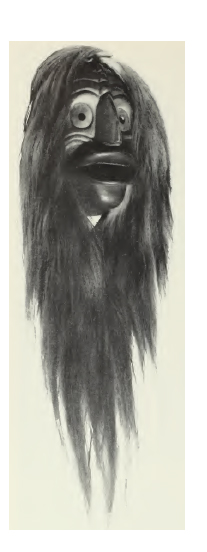
Fenton’s is an important work as it uses the criteria of the Iroquois themselves to define categories of masks and illustrates each type. These were crooked-mouth, hanging-mouth, straight-lipped, spoon-lipped, tongue-protruding, smiling, whistling or blowing, divided (red and black), and blind.

I also came across two further papers, both of which are extremely interesting. In the first work, by Arthur Parker (3), another thread of interest appears. This concerns his description of Medicine Societies other than the False Faces. These were Medicine Societies mentioned only in passing by Fenton (1). Parker, of part Iroquois heritage (see bibliography below) began studying the Seneca way of life in 1902 and lived amongst them, with his wife for two years 1905-1906. His ‘study’ of the pagan Iroquois was undertaken on behalf of the New York State Education Department and later New York State Museum. For two reasons, I believe his work holds some valuable insights not found in the work of other authors.  Firstly his period of interaction with the Iroquois was an extended one, and secondly because of his blood ties to two famous Iroquois families he may have been afforded special consideration by the Iroquois with whom he lived.

The third paper of interest is that by Joseph Keppler (31), a long-time friend of the Iroquois, Indian rights activist and co-worker with Converse. His single publication “Comments on Certain Iroquois Masks” is another important one, in that the information it contains was obtained over an extremely extended period of intimate personal association with the Iroquois.

It is significant that it uses the same terminology to name masks as that of Converse. It therefore stands in contradiction to the observations of Fenton (1). In point, of fact, Fenton plainly states that Converse’s nomenclature is dubious. Fenton states (p.5) “However, converse’s brief published utterances on masks (1899 and 1908) and the accession records which sometimes accompany her collections make me suspicious of her field work. There are poetic titles for the masks, suggesting fanciful roles, such as “war and scalp, clan, maternity, bird, pipe-smoker’s, sun-rise, dead chief, etc., that no field worker among the Iroquois since her time has substantiated.
M. R. Harrington who visited the Canadian Iroquois in the summer of 1907, turned over to the American Museum gratifyingly full accession records which suggest only a few rather general mask types that agree with the findings of Morgan, Smith, Parker and the writer. Even Parker himself, who had access to Mrs Converse’s notes and to some of her informants, found only four classes of masks based on function (3). We conclude, therefore, that Mrs Converse wrote into the records more than she was told, or that she posed leading questions to willing informants who politely assented.”

It is difficult to find the details of Converse’s nomenclature of False Face masks that Fenton found so dubious. Her two publications actually have, very little concerning categorisation of masks. Her two, accessible, published works (9 and 33) name the mask types illustrated and give their roles. However there is no formal scheme as such.

So why are the two accounts on the naming of masks so at odds? Here perhaps an explanation from Converse (9) on her interactions with the Iroquois, in their own language may illuminate the source of the discrepancy:

The Iroquois were a people who loved to weave language in fine metaphor and delicate allusion and possessed a language singularly adapted for this purpose. They were unconscious poets, and some of their tales seem to have been chanted in blank verse, the rhythm and swing of the meter in their estimation giving an added delight to the story. When the legends are told to white men the delicate word-weave is seldom revealed, and never if the legend is told in English. The translation robs it of much of its intended charm and grace, for the Indian seems to think that the pale invader may laugh at his metaphors or deride him for revealing that such fine emotions exist within a stoic's breast. Thus it is that so many legends appear puerile and without pertinency which in the vernacular are strong and full of meaning.”

Furthermore, Converse was acutely aware of how difficult a task, recording an interviewee’s exact meaning was in relation to cultural beliefs. She has this to say on the ‘lost in translation’ effect:

There are several ways in which folk tales may be recorded, as indeed there are several purposes for which they are written. To satisfy strictly scientific requirements, the method employed by the Smithsonian Institution and other progressive ethnological institutions, is undoubtedly the best. The native text is recorded with an exact translation interlined, word beneath word. This method is most satisfactory to the student of languages but from the -"Standpoint of literature it falls short. The resulting English is extremely awkward as it must necessarily be in an attempt to parallel two radically different systems of grammar and word compounding. No idea of the native beauty is preserved in such translations, which are often inelegant and difficult to read and understand. To remedy these defects the whole translation must
be rewritten in accord with current methods of expression. Another method of preserving a myth is to record it exactly as told, in the broken English of its narrator. The most poetic conception is thus sometimes reduced to grotesque caricature, and
the value of the record lies not so much in its subject-matter as it does in the estimation which is formed of the narrator's ability of expressing in our tongue the thoughts of his own.”

From which we gather two facts. Firstly, Converse, unlike Fenton communicated with her informants in their own language. Secondly she was especially concerned with actually, faithfully, recording the true meaning of what she was being told.

Perhaps here lies the root of the discrepancy between Fenton’s and Converse’s accounts of the Iroquois’ own understanding of the meaning and naming of their own masks.

Further corroboration that Converse is closer to the essence of how the Iroquois understood the meaning of their masks is given by Parker (3) who said “There are three divisions of the False-faces, and four classes of masks - doorkeeper or doctor masks, dancing masks, beggar masks, and secret masks. The beggar and thief's masks form no part of the paraphernalia of the true society, and the secret masks are never used in public ceremonies in the council- 'house at the midwinter ceremony.”

These categories, whilst they fit into Fenton’s scheme of naming are wider and more expressive and actually, tend to, rather support the nomenclature of Converse. It therefore seems that Fenton misrepresented Parker’s work when he said: Even Parker himself, who had access to Mrs Converse’s notes and to some of her informants, found only four classes of masks based on function”. I know I’ve used this quote twice but it does seem pivotal, so it bears repeating.

It is also noteworthy that although Fenton (1), while denigrating Converse’s work makes no mention of the fact that it was published six years after her death and edited by Parker! Hence, the categories of masks from Fenton while useful do not tell the whole story. In fact Fenton, himself (p.8) admits as much “Thus if there are formal distinctions between mask types, [as Fenton is himself proposing], based on myths, the members of the society may not consistently use the same mask always to portray the same being, or to perform a consistent function in a ceremony.”

I have found it extremely difficult to track down the exact details of Converse’s nomenclature of False Face masks as it seems her 1899 publications (34 and 35)) are unavailable online. It is therefore difficult to assess exactly what Fenton found so objectionable about Converse’s mask, naming scheme. The only source I managed to find is one by Beauchamp (10) who states his source as “Iroquois Masks; an illustrated article in a New York city paper of 1899” and  quotes her directly:

“..the Senecas attach to masks many meanings which are not found elsewhere. Mrs Converse found among them some of which the Onondagas know little or nothing. This seems the case in Canada. Any society of False Faces would partially develop its own ritual and symbols, and, in studying these, Mrs Converse had the advantage of adoption by the Senecas and membership in a medicine society. In procuring the valuable collection of masks which she made for the State Museum, possession of the article was subordinated to the question of its use. What did it mean? How and when was it used?
The answers will not be uniform, for ceremonies and meanings vary. In a New York newspaper of 1899, Mrs Converse describes corn husk, night, laughing, wind, winter and summer, war and scalp, good and evil, bird, fish and game, medicine or doctor, exerciser, clan, small and large maternity, and women masks, and adds : “These are but a few of the varieties of the Iroquois masks, but they serve as illustrations of the service.” The names of the 10 masks illustrating her paper are the cornhusk or doorkeepers, Canadian beggar, exerciser or witch, laughing, dancing buffalo, maternity with small mask, mystery, wolf, guardian of the harvest, and big breath or wind masks. Her accounts of these are of great poetic interest at least. She adds:
“Among the Iroquois of today there are several mask carvers, but these fail to reproduce the singular features of the ancient mask. Their delineations are grotesque only, and the old art of mask carving has passed away with the passing Iroquois. There are but few of the old masks left, and the State Museum has secured the largest numbers of these old relics of the Iroquois carvings.”

Looking at the evidence from the False Face Masks themselves
Perhaps the best way to come closer to an understanding of the true meaning of the False Face masks for the Iroquois is to study the pictorial records of the various authors with a view to deciding for ourselves who is closer to the truth Fenton or Converse.

So let us first look at that idea that the Iroquois did not consistently use their masks to portray the same being or for the same function.
Studying the various published works, this phenomenon is well seen, particularly in the following masks:


Straight-lipped mask functioning as a doorkeeper in Fenton’s plate 24 (1). Original caption: The Doorkeeper. Shagodywéhgơwaˈ permits no one to enter or leave during the ritual. The mask from Cattaraugus Reservation is the property of Rochester Museum Arts and Sciences.


Straight Lipped mask used as a Doorkeeper mask from Fenton (1) plate 3/1. Original caption: Black mask with red lips and spines on forehead. New York State Museum


Spoon Lipped mask used as a Doorkeeper mask from Fenton (1) plate 3/2. Original caption: Red mask with grey hair, Rochester Museum of Arts and Sciences


Overall caption: Straight-Lipped and Doorkeeper masks from the Senecas of Newtown, Cattaraugus Reservation, N. Y.

The diverse types of mouth type which may be used as a doorkeeper can also be seen in the hanging mouth section below.

The trend continues with Doctor masks a good example of different types appearing in the illustration from Keppler (31) below:


Doctor or Medicine masks from Keppler (31). Note the different mouth types: Crooked Lipped right), Smiling (centre) and Straight Lipped (left).


It therefore seems that any type of mask, except Beggar/Thief, may be used in any of the roles involved in the ceremonies of the False Face Society and that therefore using Fenton’s (1) categories is the most pragmatic approach. However, in his work Keppler details and most importantly illustrates other types of masks that Fenton (1) did NOT discuss but dismisses with broad statements about the categories/nomenclature of Converse and by extension Keppler. Keppler, in fact addresses this point in his 1941 work (31), explaining that much of the testimony collected that led to his and Converse’s naming of masks was obtained in the period 1881 to ca. 1900 when an older generation of Indians with a deeper and older body of knowledge were still alive and hence he believes that their explanations of Iroquois mask meaning, naming and function are more authentic. In the work of Parker too, there are masks which do not fit Fenton’s scheme. I will therefore return to these problematic masks later.
Below I therefore, I look at the new examples of masks as per Fenton’s nomenclature and give examples from his paper plus all the others gathered from my research.

Crooked-mouth masks


Fenton (1) plate 2. Crooked-mouth mask from the Onondaga New York reservation. Original caption: Carved by Elijah Hill, of Onondaga reservation, N. Y. Museum of the American Indian, Heye Foundation.


Fenton (1) plate 2. Crooked-mouth mask of the Onondaga of the Six Nations Reserve, Grand River, Ontario. Original caption: Black wry-mouth mask characteristic of the Iroquois of Grand River. New York State Museum.


Boyle 1898 (8) Crooked-mouth mask. This is one of the earliest depictions of a False Face mask. Original caption: Red mask.


Crooked mouth masks from Beauchamp (10). Original captions read:
143 A fine mask of the older types
144 Mask with mouth much awry. This feature is connected with a legend in both Canada and New York.


Crooked moth mask, Rogers 1966 (28). Original caption: Masks which portray the "Great World-Rim Being" frequently show a broken nose and grimace of pain—reminders of his prideful struggle with the Great Creator.


Crooked Mouth masks from Keppler plate 2 (31). Original caption: Crooked-Face masks.


Hanging Mouth masks


Hanging Mouth mask Fenton (1) Original caption: The Hanging Mouth like the Muse of tragedy is an old mask type with the Iroquois.. 2. An old red doorkeeper mask with white hair. New York State Museum.
It may be pointed out that although terms like “Doorkeeper” have been applied to certain masks by authors such as Converse (9), as any individual of the False Face Society may serve as a doorkeeper so in fact any mask owned by the individual may end up being termed a doorkeeper! - See above.


Hanging Mouth mask Fenton (1). Original caption: an early mask that travelled to Canada ca. 1775. New York State Museum.


Two hanging mouth masks (left and centre) from Parker 1909 (3). Original caption: Typical False-face Company masks, from the collection of Mr Joseph Keppler, New York City.


Hanging Mouth mask Rodgers (28) - is this mask in fact a mislabelled Tongue-Protruding mask?


Straight-Lipped masks

A good example is seen in the image above from Parker (3). Further examples from other sources are shown below:


Above and left two Straight-Lipped masks from Rodgers (28). Original captions: Left, Straight-lipped mask may have been worn by a Doorkeeper. Right, Ethnologists have classified some False Face masks by the shape of the mouth. ..Straight-Lipped mask.


Straight-Lipped mask from Keppler (31). Original caption: Seneca Genesse Valley New York, height 11 ¾ in. Colour: Black.
Keppler describes this as a “Completing mask”, on which he has to say:
The Completing mask officiated at the end of the feast of the Falseface society. Its black colour suggests the mysteries of the night and the silences of its shadows.
That illustrated is a venerable falseface dating back to the occupation of the Genesee Valley by the Seneca [around 1600]. It was originally a Maternity mask which officiated at the consummation of a successful birth. It is probable that because this particular mask had gained an especially notable reputation for beneficent achievement, it was chosen as a powerful mediator toward the culmination of decisive events as a powerful aid to their successful conclusion."


Thus we see that a mask was capable of changing its use category, based on its perceived performance during other rites. Interestingly unlike Keppler’s other “Maternity Masks” (all Spoon-Lipped) it is Straight-Lipped, again reinforcing the notion that form of mask was NOT linked to function.


Straight-Lipped mask from Keppler (31). Original caption: Iroquois, Grand River Reservation, Canada. Height 10 in. Colour: Black. Designated a Doorkeeper mask, again showing the variation in mask type to mask role, see comments on mask above and other in this post.


Spoon-Lipped masks


Three Spoon-Lipped masks from Keppler (31). These Keppler described as Maternity masks. Original captions: Left Seneca, Cattaraugus Reservation New York Height 10 5/8 in. Middle Seneca, Cattaraugus Reservation New York Height 11 3/4 in. Right Left Seneca, Cattaraugus Reservation New York Height 10 3/8 in.


Of maternity masks Keppler (31) writes: “Early in pregnancy, the expectant mother was presented with a small maternity mask,of wood, owengeahgaysgahdo gagohsa, or of stone, gatsgahyiegoh gagohsa (pl. xiii), during ritualistic incantations for her strength and wellbeing. This she thenceforth wore between her breasts as a talismanic charm, close to the new life it protected to avert evil influences and insure a safe delivery.
During the entire period of her pregnancy the woman meditated upon the richness of the privilege that she was soon to enjoy and directed her thoughts to the beauties of nature, to the birds and the flowers, to the agility of the fleet and the power of the strong, and to the virtues of an ideal life so that these might all become a part of her
child's nature. As Indian women would sometimes be alone through the actual ordeal of delivery, ceremonies pertaining to the birth occurred prior and following parturition.
Through incantation of the Maternity mask prior to and during actual birth, the spirit of evil was propitiated, and upon promises or vows made by the expectant mother, the mediators of the Great Spirit were asked to bless the new life and to invest it with all that is brave and good. At the pre-birth ritual, the talismanic infant falseface was taken from the mother and attached, with the bag of sacred tobacco, to the forelock of the officiating mask, that it, too, might absorb its potency. This masquette, together with the umbilical cord, was later attached to the cradleboard through the child's infancy and preserved throughout the life of the individual. The lips of the true maternity mask were expanded at either corner into hollow discs, a feature most characteristic of this class of falseface. At the actual time of birth the Spirit of Life rested with that of Death in these hollows or "cradles." and the supremacy of one over the other was considered to be an immediate matter of the spiritual strength or weakness of the orenda of the woman. The magic power of the gagohsa and the strength of its secret medicine decided the issue in that crucial hour.

Maternity mask from Beauchamp (10) Original caption reads: 142 This is what Mrs Converse called a maternity mask, from the small mask attached. Both the broad lips and projecting chin are modern features.


Spoon-Lipped mask from Parker (3). Original caption: The Great Wind mask, a medicine or Doctor Mask of the False-Face Society. Notice this is the same mask as the middle one, from the group of 3 illustrated above from Keppler (31) who calls it a maternity mask! It therefore seems that as Parker reported on it in 1909 and Keppler in 1941 its usage may have changed. However, as Keppler was writing up his notes from prior to 1900, which account of its name cannot be easily, deduced as which informants gave the first account to which of the authors is unknown.
Additionally the role of the mask or its ownership and hence the story that the authors informant(s), told about this mask and its usage may have changed - see introduction section above.


Spoon-Lipped mask from Rodgers (28). Original caption:  This spoon-lipped mask belonged to a Doorkeeper who guarded the longhouse entrance during False Face ceremonies. Once again a different mouth type used as a doorkeeper.


Tongue-Protruding masks


Tongue-Protruding mask from Rodgers (28). Original caption: Inspired by the evil spirits which control disease, an Iroquois carved this mask to wear in the curing rites of his tribal False Face Society. It is said to have been made on the Six Nations Reserve near Brantford, Ontario, and was collected by David Boyle in 1899.


Tongue-Protruding mask from Morgan 1901 (4), only the second illustration of a False face mask. Original caption: Gä-gó -sä, or False Face,


It is interesting to see what commentary Morgan attached to the mask: “FALSE FACES - There is a current belief among the Iroquois, that these demons are banded together in a secret and systematic organization, which has subsisted for ages; that they have periodical meetings, an initiation ceremony, and a novitiate fee. These meetings were held at night, and the fee of the neophyte was the life of his nearest and dearest friend, to be taken with poison, on the eve of his admission.
The tendency of the Iroquois to superstitious beliefs is especially exemplified in their notion of the existence of a race of supernatural beings whom they call Falsefaces.
This belief has prevailed among them from the most remote period, and still continues its hold upon the Indian mind. The Falsefaces are believed to be evil spirits or demons without bodies, arms or limbs, simply faces, and those of the most hideous description. It is pretended that when seen they are usually in the most retired places, darting from point to point, and perhaps from tree to tree, by some mysterious power ; and possessed of a look so frightful and demoniacal as to paralyze all who behold them. They were supposed to have the power to send plagues and pestilence among men, as well as to devour their bodies when found, for which reasons they were held in the highest terror. To this day there are large numbers of the Iroquois who believe implicitly in the personal existence of these demons. Upon this belief was founded a regular secret organization called the Falseface band, members of which can now be found in every Iroquois village both in this State and Canada, where the old modes of life are still preserved. This society has a species of initiation, and regular forms, ceremonies and dances. In acquiring or relinquishing a membership their superstitious notions were still further illustrated, for it depended entirely upon the omen of a dream. If anyone dreamed he was a Falseface, it was only necessary to signify his dream to the proper person, and give a feast, to be at once initiated; and so any one dreaming that he had ceased to be a Falseface, had but to make known his dream and give a similar entertainment to effect his exodus. In no other way could a membership be acquired or surrendered. Upon all occasions on which the members appeared in character they wore false faces of the kind represented in the figure, the masks being diversified in color, style and configuration, but all agreeing in their equally hideous appearance. The members were all males save one, who was a female, and the Mistress of the Band. She was called
Gä-gó -sä Ho-nun-nas-tase-ta, or the keeper of the Falsefaces; and not only had charge of the regalia of the band, but was the only organ of communication with the members, for their names continued unknown.


Tongue-Protruding mask from Fenton (1) plate 6/1. Original caption: Made at Grand River about 1829 by John Styres and collected by David Boyle, 1899. Royal Ontario Museum of Archaeology. The same as the mask from Rodgers above?


Tongue-Protruding mask from Fenton (1) plate 6/2. Original caption: The first Iroquois mask collected by an ethnologist, L. H. Morgan. Onondaga of Grand River, ca. 1850. New York State Museum.


Overall caption for these two images: Heavy carving and lolling tongue are common features in masks from the Onondaga of Grand River.

Smiling masks

Smiling mask from Fenton (1) plate 7/2. Original caption: A heavy mask with thick, smiling lips, from Grand River. Museum of the American Indian, Heye Foundation, New York.


Smiling mask from Fenton (1) plate 7/1. Original caption: Smiling beggar mask by Jonas Snow, a Seneca of Coldspring. Museum of the American Indian, Heye Foundation, New York.


Overall caption for the last two masks: Not all masks are wry-faced; some are smiling.


Smiling mask from Boyle (7). Original caption: False Face Dancer's Black Mask.


Smiling mask from Keppler (31). Original caption: Iroquois Grand River Reservation, Canada. Height 10 ¾ in. Colour: Black.


Smiling mask from Keppler (31). Original caption: Iroquois Grand River Reservation, Canada. Height 13 ½ in. Colour: Black. Both, this and the one above were described as Doorkeeper masks.


Smiling mask from Rogers (28). Original caption: Iroquois Grand River Reservation, Canada. Height 10 ¾ in. Colour: Black.


Whistling or Blowing masks


Whistling or Blowing mask from Rodgers (28). Original caption: Ethnologists have classified some False Face masks by the shape of the mouth. ..whistling mask.


Whistling or Blowing mask from Fenton (1) plate 8. Original caption: Red-faced whistler from Towanda (?) has a pock-marked face and long black hair. New York State Museum


Whistling or Blowing mask from Fenton (1) plate 8. Original caption: A black mask from Grand River; probably a likeness of the Whistling God. Royal Ontario Museum.


Overall caption for previous two images: The whistling Masks are likenesses of forest spirits who merely want tobacco.


This interesting mask illustration and the one that follow it are the first known images recorded by ethnographers. Drawn in 1888 from life by DeCost Smith (5), I identify these as Blowing or Whistling masks. Original cation:  Onondaga mask. Said by former owner to be about twenty years old. 11 inches in length, red, with teeth and eyes of tin. Front and profile.


Blowing or Whistling mask, again from DeCost Smith (5). Original caption: Onondaga mask. 11 ¼ inches long; color, red, with small moustache, eyebrows, and a small spot on end of chin painted in black; tin eyes. Said by former owner to be about thirty years old. Front and profile. 


Possible Whistling or Blowing mask from Keppler (31), who labelled it as a counsellor mask. Original caption: Counsellor mask, Seneca, Genesee Valley New York. Height 12 ½ in. Red over black. 


Again Fenton’s terminology seems to be able to be applied here to the type of mask, but the role of its wearer was counsellor. Keppler (31) explains its usage thus:

The Counsellor in time of war warned the people of the possible approach of an enemy; in council it quelled any disturbance arising from oratorical harangues, discussions or disputes that might have led to serious controversy or possible rupture; in peace it advised quiet, calmness and dignity of manner; in pleasure it counselled a moderation in the display of joy and gratitude, and cautiously warned against excesses among a people some of whom were given to quick and ebullient ecstasies.

What I interpret as a whistling or blowing mask from Beauchamp (10) plate 32. Original caption reads: 141 Iroquois false face or mask. The wearers take their name from this. This one has no hair, and the contracted and projecting mouth is a modern feature.


Divided (red and black) masks
Not really a False Face mask, this unusual mask type originated in the Grand River area. As Fenton explains (1): “The divided mask represents a god whose body is riven in twain (dehodya’tgai.’ew ęʔ). According to Hewitt, who learned of him through Joshua Buck, his body is half human and half supernatural; hence his face id divided between red and pure black, symbolising the east and the west and he is free to roam at large even among the people.” How this mask was used I have been unable to discover.

Divided mask illustrated (same mask) by both Fenton (1) and Rodgers (28). Original captions:
Fenton (1): He whose body is riven twain. Divided mask, black and red, in typical Grand River style, by Jake Hess, Cayuga. Royal Ontario Museum of Archaeology.
Rodgers (28): Some masks were painted black on one side of the face and red on the other. They represented a spirit "whose body is riven in twain'.


Blind masks
Again not a False Face mask. This type of mask was worn by the I’dos Medicine Society (see comments by Parker below).


Blind mask from Fenton (1) plate 12. Original caption: I’dos Society mask from Seneca of Grand River Reserve, Ontario, Canada. Museum of the American Indian, Heye Foundation.


Other Masked Medicine societies
The other two masked medicine societies are the I’dos and the Society of Husk Faces.
Parker (3) explains their purpose thus: “I’dos oä' no', [the] Society of Mystic Animals I’dos Company is a band of "medicine" people whose object is to preserve and perform the rites thought necessary to keep the continued good-will of the " medicine " animals. According to the traditions of the company, these animals in ancient times entered into a league with them. The animals taught them the ceremonies necessary to please them, and said that, should these be faithfully performed, they would continue to be of service to man- kind. They would cure disease, banish pain, displace the causes of disasters in nature, and overcome ill luck.”


I’dos Society Masks from Parker (3) fig 25. Note the lack of metal edging surrounding the eyes - this is a constant feature of I’dos Society masks. Original caption: Masks used by the I'dos Company. 1, Dual-spirit's mask. 2, Witch's mask. 3, Conjurer's mask. [in order left to right].


The Husk Faces
A basic description of some of their functions is again given by Parker (3):
“Gaji"s" sho'o', The Husk-Faces
This society seems rather loosely organized among the Seneca, but its chief members act as water doctors. They endeavour to cure certain diseases by spraying and sprinkling water on the patients. Two Husk-faces are admitted with the False-faces in their midwinter long-house ceremony, and act as door-openers. As a company they also have a ceremony in which the Grandfather's Dance is featured. The grandfather is attired in rags, and, holding a cane stationary, dances in a circle about it, using the cane as a pivot. The company dance is one in which all the members participate.
Non-members may partake of the medicine influence of the ceremony by joining in the dance at the end of the line when the ceremony is performed in the council-house at the midwinter festival.”

Although only tangentially connected to the Society of False Faces, about which all authors on the Iroquois write, when presenting masks in papers most are tempted to include some Husk Face masks, and who am I to buck the trend? Therefore I have included below the wide variety of Husk Face masks I have come across in the course of my research. Another reason I include them is my own visceral fascination with them which I have had since boyhood (see my post Here).

Husk Masks from Fenton (1). Original caption reads: Grandmother and grandfather Bushy-Head from Cattaraugus Senecas. Royal Ontario Museum of Archaeology, Cat. Nos. HD 8125 and 8126.


Husk Masks from Fenton (1). Original caption reads: Left, twining commences at the mouth or nose; right, a braided bushy-head with puffy cheeks and red mouth. Senecas of Cattaraugus. New York state Museum, Cat. Nos 36924 and 36922.


Female Husk mask from Rogers 1966. Note the tobacco bags hanging from the forehead. Original caption reads:
The Husk Face Society was another Iroquois curing society which sometimes joined in performances with the False Faces. One of its members made this ''grandmother" mask of corn husks.


Corn husk masks from Keppler (31). Original captions read (left to right): 2/9582 Seneca. Cattaraugus Reservation. New York; 20 2335 Seneca. Allegany Reservation. New York; 10 2853 Seneca. Oklahoma. Diam: 14}1/2 in.


More Husk Masks from Fenton (1). Original caption reads: The rougher looking ones are old men, usually they have small, round mouths. Laidlaw Collection from Grand River, Royal Museum of Archaeology, Cat. Nos. 43347 and 21468. Husk Faces or “Bushy-Heads” resemble braided foot mats.


Corn Husk masks with basketry weave faces(?), from Beauchamp fig. 33 (10). Original caption reads:
145 Mask made of corn husks, worn by doorkeeper. The looser husks represent hair
146 Another husk mask, with a braid around the face, but with no suggestion of hair.


Clan Masks
This class of masks was described as fanciful by Fenton, and indeed very few have been recorded as such or, it seems collected. To understand what clan masks may have looked like, a little background on the structure of the Iroquois confederacy and the change in the clan system that it engendered are necessary. According, to Polsky, (32) “Just as the Iroquois Confederacy had six nations, each nation was made up of different clans. A person's clan is the same as their mother's clan. The members of each clan are all related to each other through their mothers. This is called a matrilineal system. Each clan is represented by a different animal.  There are nine clans, divided into animals from three earth elements: Land, Air & Water.  The land creatures are Deer, Wolf and Bear. The water creatures are Turtle, Beaver & Eel. The creatures of the sky are Hawk, Heron & Snipe. Before the Iroquois Confederacy was created, there were many more clans but after the Peacemaker, only these nine remained.”
In form, the clan masks may have had the image of animal concerned or have been stylised to a lesser or greater extent.
According to Keppler (31) “Clan masks represented their respective divisions at certain lodge convocations and at important ceremonies to the Honotschinnogä – the spirits of the animals. Although, obviously, there must have been, a number of, such falsefaces, to my knowledge that illustrated is the only such mask in existence.
It is a Wolf Clan mask collected in Canada..”

The  mask is illustrated below:


Wolf Clan mask from Keppler (31). Original caption reads:PLATE XI 6/1104 Mohawk. Canada.
Height: 11% in. Color: Black. CLAN MASK


Parker (3) writes
“It is quite possible that the author of "Van Curler's" Journal of 1634-'35 mentions a false-face when he writes: "This chief showed me his idol; it was a head with the teeth sticking out; it was dressed in red cloth. Others have a snake, a turtle, a swan, a crane, a pigeon for their idols. . . ." The Seneca at present drape their false-faces when they hang them up for safe keeping, and use them as well as turtle and snake charms as bringers of good fortune.”
Thus one of the earliest written accounts of a European viewing Iroquois masks shows their probable historical diversity with an emphasis animal forms.

Also illustrated by Keppler is this mask which may also be a clan mask:


Original caption reads:
Plate IX. Seneca Cattaraugus reservation, New York. Height: 10 ½ inches. Colour: Reddish brown. Bird Mask


Last, but not least, one final illustration from Keppler:


Iroquois False face masks from Keppler (31). Original captions, clockwise from the top: Happy Hunter Mask 6/334. Seneca, Cattaraugus Reservation, New York.Height (to top of hat) : 121/4 in; Avenging Scalp Mask 2/9599 Seneca, Cattaraugus Reservation, New York. Height: 9 1/2 in; Female Mask 2/9605. Seneca, Cattaraugus Reservation,New York. Height: 11 in.


Conclusions:

1. False Face Masks, as explained by American Academics such as Fenton can be clearly classified and have set categories. These were crooked-mouth, hanging-mouth, straight-lipped, spoon-lipped, tongue-protruding, smiling, whistling or blowing.

2. The masks took part in several types of ceremonies but particularly at the Midwinter festival. The masks of took on specific roles, but the different types of mask could take on most of the roles.

3. Other commentators, such as Converse and Keppler use entirely different descriptors for the False Face masks at odds with Fenton’s nomenclature.

4. The dichotomy of views may be explained by the means, by which the information was obtained from the Iroquois. While Fenton spent a period of several months, spread over several years among the tribes observing and interviewing individual members, the period he did so was long after Converse and Keppler gathered their ethnographic information.

5. The writings of Parker (3) tend to support Converse’s position rather than Fenton’s.
Indeed, Parker (9), writing in the preface to Converse’s posthumously published masterpiece on the Iroquois says of Converse: “The people you have been visiting have never been understood nor fully comprehended. I say that to study them satisfactorily needs a life time and at the end of life one has hardly begun the study. The study of the race is extremely kaleidoscopic. Your opportunities have been grand and rare. You have improved them well, and today are the best informed woman on Indian lore in America.

Verdict:
It seems, from studying all these published accounts that the most probable explanation for the differences between Fenton’s and Converse’s interpretations False Face masks is based on two fundamental differences in the circumstances of the data collection process the two authors used:

  •      Converse from an Iroquois generation retaining oral folk memory of the masks form, function and naming and carried out in their own tongue

  •        Fenton from a later generation carried out in English


I therefore come down on the side of the poetess who dedicated her later life to understanding and aiding the Native American people: Harriet Maxwell Converse.


Iroquois False Face Masks - An annotated chronological bibliography
- Note dates are those bracketing the authors’ publications, not their lifespan.
  • Joshua Clark 1849 (3), made observations on the False Faces as they appeared at the Midwinter festival of the Onondaga in 1841
  • Lewis Morgan 1851 (4), published a line drawing of a mask acquired from the Onondaga of Canada along with a brief description on their beliefs relating to the False Faces; a description of their curing rites [such as the prevention of a Cholera epidemic at Tonawanda in 1849] and a description of the False Faces appearing in the Midwinter Festival. The masks and Morgan’s drawings of them were donated to the American Museum of Natural History which also acquired part of his remaining collection upon his death, the remainder being donated to the Museum of the American Indian, Heye Foundation.
  • Harriet Maxwell Converse 1884-1909, poet, journalist honorary chief of the Onondagas and later fully adopted member of the snipe clan of the Senecas, initially became interested in the six nations after becoming aware of the relatively elevated position of women within tribal organisation, compared to her own within American-English society. Her poetic nomenclature for masks was roundly derided by Fenton (1) as no Iroquois with whom any previous or subsequent observers discussed masks used anything like her descriptions. However Also extensively collected masks. Converse’s masks are in the following institutions: New York State Museum Albany (100+ masks), Peabody Museum at Harvard, and the American Museum of Natural History New York, her successor amongst the Seneca, Joseph Keppler deposited his collection in the Museum of the American Indian. Published The Ho-de-no-sau-nee: The Confederacy of the Iroquois (34), The Religious Festivals of the Iroquois Indians (33), Mythology and Folk Lore of the North American Indians (35) and had her Myths and legends of the New York Iroquois (9) posthumously published in 1909. Also published a number of papers on Iroquois religious ceremonies in the American Anthropologist. Her final publication, during her lifetime was on Iroquois silver brooches (36).
  • DeCost Smith, artist 1888 (5 and 6), collected Iroquois masks, and published articles on their cultural functions, illustrated those in his collections and later donated them to museums. Also presented masks to Beauchamp.
  • David Boyle, 1898 (7 and 8), working in Canada made collections of, and published observations of Iroquois ceremonies in which masks were used and details of his mask collections. Boyles mask collection resides in The Royal Ontario Museum of Archaeology in Toronto along with the Chiefswood collection of Pauline Johnson, the Mohawk poetess.
  • Edward Hale Brush, 1901. Iroquois past and present. Baker, Jones & co. Buffalo, New York.
  • William W. Canfield 1902. The Legends of the Iroquois: Told by "The Cornplanter". A. Wessels Company. New York.
  • Rev. William Beauchamp 1905 (10) on the prompting of Smith, included some detail on maskmaking in his work on Aboriginal uses of wood. The masks presented to Beauchamp by Morgan are now housed at the Onondaga Historical Society in Syracuse
  • Mark Harrington 1909 (11), visited the Canadian Iroquois in 1907 and wrote a paper on his observations, also worked with the Lanape or Delaware and explored their mask rituals in two papers published in the 1920’s and 1930’s
  • Arthur Parker 1909 (3), was an archaeologist, historian, folklorist, museologist and noted authority on American Indian culture and was of Seneca and Scots-English descent. A gifted communicator and academic, he attained high position in the world anthropology/archaeology, holding a succession of positions of influence. In 1935, Parker was elected the first President of the Society for American Archaeology. Researched and wrote about Iroquois culture from an insider’s perspective. Friend and confidant of Converse.
  • Alexander Goldenweiser 1912 (12), along with F. W. Waugh studied the carving process of Iroquois masks
  • John Hewitt 1918-1930 (13-16). Worked for many years amongst the Iroquois and was regarded as the pre-eminent authority on general Iroquois culture. Neither his published works, or manuscripts conserved in the Smithsonian support Mrs Converse’s categorisation of the False Face masks but rather support Fenton’s.
  • Kroeber 1920 (17) was a cultural anthropologist and archaeologist who did work amongst the Iroquois collecting cultural data in the late teens of the 20th century with Catherine Holt. He went on to do work preserving information about California tribes appeared in Handbook of the Indians of California. Kroeber served early on as the plaintiffs' director of research in Indians of California v. the United States, a land claim case. Kroeber's impact on the Indian Claims Commission may well have established the way expert witnesses presented testimony before the tribunal.
  • Kenneth Macgowan and Herman Rosse 1923 (18), discussed the relationship between masks and theatre.
  • Clark Wissler 1928 (19), included Iroquois material, in particular masks in his exploration and subsequent definition of what culture is
  • William Fenton 1937-1987 (1 and 20-23) began work amongst the Seneca to understand their culture and religion and in particular the true meaning and function of the False Face masks and published a general interest piece on the subject (17). Continued to do field work and publish until 1951
  • Joseph Keppler, was an associate of Harriet Maxwell Converse and was elected as, an honorary chief and given the name Gyantwaka by the Iroquois upon Converse’s death in 1903. He worked with her and the Iroquois to understand their culture and religion. Joseph Keppler was a political cartoonist for Puck Magazine, and an avid collector of Indian artifacts as well as being an Indian activist. He actively promoted Iroquois lacrosse teams, and his connections with the railroad enabled him to procure discount railroad passes for New York Indians, especially those travelling to Canada on Confederacy business. On the national scene, Keppler worked with others to defeat or substantially modify proposed legislation to allot the New York State reservations. He was beloved of the Iroquois and perhaps had the longest association with them of any white commentator. He finally published a single memoir based on his knowledge in 1941 (31)
  • Frank Speck 1950 (24), examined the diffusion of masking complex from the Eskimo of Eastern Labrador to the Cherokee of North Carolina and commented its significance in the cultures in which it occurred. He paid particular attention to Iroquois masks.
  • Annemarie Shimony 1961-1994 (25 and 26) did field work amongst the Iroquois between 1953 and 1961 and then intermittently until her death in 1995. Her 1961 publication, (updated edition published in 1994) is considered the most comprehensive ethnography of the largest extant traditional Iroquoian community. Some of the material discussed includes the social organization, the system of hereditary chiefs, the beliefs and practices of the Longhouse religion, the events of the Iroquoian life cycle, and the extensive medicinal and witchcraft aspects of the culture
  • Jean Hendry 1964 (27), spent two years 1950-51 attempting to study the process of mask making at the Onondaga reservation near Syracuse New York. Although hampered by her gender and lack of native language, she provided fresh insights into how this nation’s views on and knowledge of mask making were changing in the mid twentieth century
  • Edward Rogers 1966 (28), a Royal Ontario Museum anthropologist did ethnographic fieldwork among the Round Lake Ojibwa of north-western Ontario. Published one work on the Iroquois.
  • Harold Blau 1966 (29), published one paper on the False Face masks
  • Joanne Danford 1989 (30), published a cultural perspective on the False Face masks through time

 References
1. Fenton, William N. 1941. Masked medicine societies of the Iroquois. Ann. Rep. Smithsonian Inst, for 1940, pp. 397-439.

2. Hendry, J 1964. Iroquois Masks and Maskmaking at Onondaga. Smithsonian Institution, Bureau of American Ethnology Bulletin 191 Anthropological Papers, No. 74

3. Parker, Arthur C. 1909. Secret medicine societies of the Seneca. Amer. Anthrop., n.s., vol. 11, No. 2, pp. 161-185.

4. Morgan, L. H. 1901. League of the Ho-dé-no-sau-nee or Iroquois. Vol 1 p157-160, 204-205. Dodd, Mead and Company New York.

5. Smith, De Cost. 1888. Witchcraft and demonism of the modern Iroquois. Journ. Amer. Folklore, vol. 1, No. 3, pp. 184-194.

6. Smith, De Cost. 1889. Additional notes on Onondaga witchcraft and HON-do′-Ĭ . The Journ. Amer. Folklore vol. 2, No. 7, pp. 277-281

7. Boyle, D. 1898. Society of the False Faces, Annual Archaeological Report, being part of the appendix to the Report of the Minister of Education, Ontario. Warwick Brothers and Rutter, Toronto. PDF download from:

8. Boyle, D. 1899. Iroquois Medicine Man’s Mask, Annual Archaeological Report, being part of the appendix to the Report of the Minister of Education, Ontario. Warwick Brothers and Rutter, Toronto.

9. Maxwell Converse, H and Parker A. C., ed. 1909. Myths and Legends of the New York State Iroquois. New York State Mus. Bull. PDF download from: https://ia800202.us.archive.org/14/items/cu31924055492973/cu31924055492973.pdf


10. Beauchamp, W. M. 1905. Aboriginal uses of wood in New York. New York State Mus. Bull. 89. Viewable online at: http://babel.hathitrust.org/cgi/pt?id=nyp.33433081680757;view=1up;seq=20


11. Harrington, M. R. 1909. Some unusual Iroquois specimens. Amer. Antrop., vol 11, no.1. PDF download available from: https://ia801700.us.archive.org/25/items/jstor-659741/659741.pdf

12. Goldenweiser, A. A. 1912. On Iroquois work. Summ. Rep. Geol Surv. Canada for the calendar year 1912.

13. Hewitt, J. N. B. and Curtain, J. 1918. Iroquois fiction, myths and legends. 32rd Ann. Rep. Bur. Amer. Ethnol. p37-819 PDF download from:

14. Hewitt, J. N. B. 1928. Iroquoian Cosmology. 43rd Ann. Rep. Bur. Amer. Ethnol.

15. Hewitt, J. N. B. 1929. The culture of the Indians in eastern Canada, Explorations and Field-work of the Smithsonian Institution for 1928 p182.

16. Hewitt, J. N. B. 1930. The culture of the Indians in eastern Canada, Explorations and Field-work of the Smithsonian Institution for 1929 p201-206. PDF Down load from: https://ia800304.us.archive.org/33/items/explorationsfiel193032smit/explorationsfiel193032smit.pdf

17. Kroeber, A. L. and Holt, C. 1920. Masks and moieties as a culture complex (with Catherine Holt). The journal of the Royal Anthropological Institute of Great Britain and Ireland, vol. 50, July to December, pp. 452-60. London.

18.  Macgowan, K. and Rosse, H. 1923. Masks and Demons. Harcourt, Brace and co.

19. Wissler, C. 1928. The Lore of the Demon Mask. Natural History 28, pp. 339-352.

20. Fenton, W. N. 1937. The Seneca Society of Faces. Scientific monthly vol 44 pp 215-238.

21. Fenton, W. N. 1947. Iroquois Indian Folklore. Journal of American Folk-Lore vol. 40, pp. 383-397, Boston and New York.

22. Fenton, W. N. 1951. The Concept of Locality and the Program of Iroquois Research in Symposium on Local Diversity in Iroquois Culture. W. F. Fenton ed, Bureau of American Ethnology Bulletin no. 149, pp1-12.

23. Fenton, William N. 1987. The False Faces of the Iroquois. Norman and London: University of Oklahoma Press.

24. Speck, F. G. 1950. Concerning iconology and the masking complex in eastern North America. Univ. Pennsylvania Mus. Bull., vol. 15, No. 1, pp. 6-57.
America. Univ. Pennsylvania Mus. Bull., vol. 15, No. 1, pp. 6-57.

25. Shimony, A. A. 1961. Conservatism Among the Iroquois at Six Nations Reserve: Yale University Publications in Anthropology, Volume 65

26.  Shimony, A. A. 1994. Conservatism Among the Iroquois at Six Nations Reserve: Reprint of Yale University Publications in Anthropology, Volume 65. Syracuse University Press.

27. Hendry, J 1964. Iroquois Masks and Maskmaking at Onondaga. Smithsonian Institution, Bureau of American Ethnology Bulletin 191 Anthropological Papers, No. 74

28. Rodgers, E. S. 1966. The False Face Society of the Iroquois. Royal Ontario Museum series no. 10. University of Toronto. PDF download available from:

29. Blau, H. 1966. Function and the False Faces: A Classification of Onondaga Masked Rituals and Themes. The Journal of American Folklore  Vol. 79, No. 314 (Oct. - Dec., 1966), pp. 564-580

30. Dandford, J. 1989. Will the ‘Real’ False Face please stand up? The Canadian Journal of Native Studies IX, 2 (1989):253-272.

31. Kepller, J. 1941. Comments on Certain Iroquois Masks. Contributions from the Museum of the American Indian, Heye Foundation, Vol. XII, No. 4

32. Polsky, D. 2017. Alberta Education. Clans of the Iroquois Confederacy. [ONLINE] Available at: http://projects.cbe.ab.ca/fishcreek/Grade6/Social_Studies-IroquoisClans.html. [Accessed 13 May 2017].

33. Maxwell Converse, H. 1884. The Ho-de-no-sau-nee, The confederacy of the Iroquois [the six nations] A poem By Harriet Maxwell Converse. G. P. Putnam's sons Knickerbroker Press New york & London.

34. Maxwell Converse, H. 1899 The Religious Festivals of the Iroquois Indians.
[probably published in Frank Leslie's illustrated newspaper New York, N.Y. :Frank Leslie]

35. Maxwell Converse, H. (1899?)  Mythology and Folk Lore of the North American Indians. [probably published in Frank Leslie's illustrated newspaper New York, N.Y. :Frank Leslie]

36. Converse, H. Maxwell. (1902). The Iroquois silver brooches. Albany, N.Y.: University of the State of New York.