Showing posts with label Homo floresiensis. Show all posts

Saturday, 10 August 2019

Homo luzonensis – another member of the human family found in southeast Asia.


Callao Cave lies within what was initially, the Callao Cave National Park. It was first set up during the American colonial period of the Philippines (1898-1946). The then, American Governor-General Theodore Roosevelt, Jr., (son of the American president), created the Philippines, National Park system with the passing of Act No. 3195. Callao Cave became one of the earliest national parks of the country when it was established on July 16, 1935. The park has been enlarged several times since, and now forms part of the Peñablanca Protected Landscape and Seascape.
Prior to the archaeological interest of the cave being established, it was a show cave with 11 chambers. The cathedral-like first chamber is the largest room with a width of about 50 m (160 ft) and a height of 36 m (118 ft). This chamber has been turned into a chapel by the local people with the alter a natural rock formation lit by a stream of light from an opening in the roof.


Callao cave from Tayag (2019)
Excavations in 2007 by Armand Salvador Mijares discovered the first human fossil: a metatarsal, tentatively assigned, at the time to Homo sapiens. Excavations continued and further fossils were uncovered.
Based on the metatarsal found in 2007 and other more recently discovered bones a new species of human was announced in April 2019, by Détroit et al. (2019).
Named Homo luzonensis for the island of its discovery in the Philippines, the bones have been dated to 67,000BP by the U/Th method. The fossil collection consists of an additional 12 bones and teeth. From the paper: “Continued excavations in Callao Cave that originally yielded the hominin third metatarsal (which we here call CCH1 for ‘Callao Cave Hominin 1’) have produced another twelve hominin elements from the same stratigraphic layer (layer 14): seven postcanine maxillary teeth (CCH6-a to CCH6-e, CCH8, CCH9); two manual phalanges (CCH2 and CCH5); two pedal phalanges (CCH3 and CCH4) and a femoral shaft (CCH7). CCH1 and CCH6-a are directly dated by U-series analysis to minimum ages of 67 thousand years (kyr) and 50 kyr, respectively. Crown morphology, grade of occlusal wear and exact correspondences of interproximal contact facets demonstrate that five of the upper right teeth belonged to a single individual (CCH6-a to CCH6-e).


The molars and pre-molars of Homo luzonensis from Margaritoff (2019). These are the fossils named as CCH6a-e.
These teeth along with two others (a L P3/4 and an additional R M3), do not match those of any known hominin species. Put simply: their varied morphology and small sizes do not match any human ancestors. As Détroit et al (2019) point out: “the overall pattern of morphology seen in the dental remains of H. luzonensis is easily distinguishable from all previously described hominin species.”
Pruitt (2019) on the proximal phalanx recovered: “The foot bones identified as Homo luzonensis also stand out for their combination of primitive and developed features, which indicates members of the species might have had a distinctive way of walking. The proximal phalanx (which forms the base of the toe) is curved, with highly developed insertions for the muscles involved in the flexion of the foot.” She also interviewed Détroit: “These characteristics do not exist in Homo sapiens,” he said. In fact, the foot bones found in Callao Cave are more similar, to Australopithecus, which was known to live only in Africa some 2-3 million years ago. This suggests Homo luzonensis might (like Australopithecus) have had the ability to easily climb trees as well as walk upright on two legs, though it’s not clear whether they did so.


Proximal phalanx excavated from Callao cave, from Pruitt (2019). Original caption reads: “A proximal foot phalanx of Homo luzonensis, showing the longitudinal curvature of the bone.”
The remainder of the pedal and manual phalanxes also showed affinities to Australopithecines.
The final fossil found was a femoral shaft. Again from Détroit: “The referred specimen, CCH7, is a partial left femur from which both the proximal and distal ends are missing. Transverse slices of micro-computed tomography (micro-CT) scans show a high density of Haversian canals in the cortical bone that is characteristic of a growing juvenile individual.“ Due to its incomplete nature it was of little diagnostic value, except to show that the species was probably of short stature.
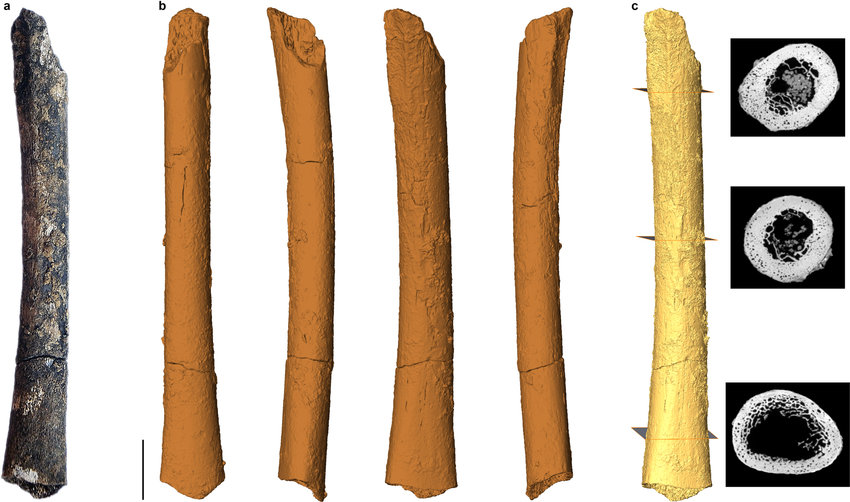

Finally Détroit et al. conclude: “The presence of two right upper third molars (M3; CCH6-a and CCH9) and a juvenile femoral shaft (CCH7) indicates that at least three individuals are represented. On the basis of the unique mosaic of primitive (that is, Australopithecus-like) and derived (that is, H. sapiens-like) morphological features observed on these specimens, we assign them to a new species, H. luzonensis.”

Whilst these remains put archaic humans, possibly related to Australopithecines, in Luzon as recently as 50,000 years ago when they arrived is an open question. However, other definite, evidence of occupation of the island has been published recently.
Ingicco et al. (2018) excavated a site in the Cagayan valley of northern Luzon, only 30km from Calao Cave. This site (Kalinga) has yielded 57 stone tools and remains of megafauna (Rhinoceros philippinensis): an almost-complete disarticulated skeleton, which shows clear signs of butchery. Other fossil faunal remains found are attributed to stegodon, Philippine brown deer, freshwater turtle and monitor lizard. All finds originate from a clay-rich bone bed that was dated to between 777 and 631 thousand years ago using electron-spin resonance methods that were applied to tooth enamel and fluvial quartz.
Regionally both east and west of the Wallace line there are a number, of equally old or slightly younger finds. The map below shows some of the most important sites:


Important south east Asian regional hominin sites adapted from Soares et al. (2008). Dark grey: current coastline; light grey: sea level at LGM -120m, here assumed to be similar to low stands during previous glaciations. It is noteworthy that all sites occupied between 700,000 and 50,000BP were at one time or another, within easy reach of Sundaland.

These include:
The original Homo erectus material from Trinil and further discoveries made on Java. Dating on these fossils is still contentious, with dates ranging from as recent as ca. 70,000BP to as old as ca. 550,000BP.
The 110,000-200,000 year old stone tools from Sulawesi I covered in an earlier post (see here).
The Homo floresiensis material from Liang Bua Cave on Nusa Tunggara East (“Flores”). This is another small bodied, possibly Australopithecine, related hominin which survived to approximately 50,000BP.
From the same island is the Mata Menge jawbone, predating Homo floresiensis by a full 650,000 years, yet still hypothesised to be the ‘Hobbit’s’ ancestor. Whilst the huge time span of these dates seems to make this hypothesis far-fetched a recent paper by Argue et al. (2017) based on morphometric comparisons has found that: “H. floresiensis is sister either to H. habilis alone or to a clade consisting of at least H. habilis, H. erectus, Homo ergaster, and H. sapiens. A close phylogenetic relationship between H. floresiensis and H. erectus or H. sapiens can be rejected; furthermore, most of the traits separating H. floresiensis from H. sapiens are not readily attributable to pathology (e.g., Down syndrome). The results suggest H. floresiensis is a long-surviving relict of an early (>1.75 Ma) hominin lineage and a hitherto unknown migration out of Africa, and not a recent derivative of either H. erectus or H. sapiens.”
Lastly there are the Acheulian stone tools from the Air Tawar in southern Sumatra excavated by a French team – see Forestier (2007). These are between 400,000 and 200,000 years old and are some of the largest bifaces found outside of Africa being over 30cm long.
Acheulian biface discovered at Air Tawar, southern Sumatra from Forestier (2007).
Whilst the original finding of Homo floresiensis seemed at the time of its discovery a one-off fluke survival, the further discoveries in south east Asia have begun to paint a picture of far greater Middle Pleistocene, hominin diversity in the region than previously suspected.

Indeed, if we consider the unexplained fossils from nearby mainland Asia, such as those of the Red Deer People, Maba, Dali and Jinniushan we can see that the history of human migration and evolution in the region is far more complex than previously believed.
Personally, I think that true version of the human story in south east Asia has yet to be even dreamed of by current scientists. If I have a Damascene moment and come up with something paradigm-shattering, I’ll let you know.
References
Argue, D., Groves, C.P., Lee, M.S. and Jungers, W.L., 2017. The affinities of Homo floresiensis based on phylogenetic analyses ofácranial, dental, and postcranial characters. Journal of Human Evolution, 107, pp.107-133.
Détroit, F., Mijares, A.S., Corny, J., Daver, G., Zanolli, C., Dizon, E., Robles, E., Grün, R. and Piper, P.J., 2019. A new species of Homo from the Late Pleistocene of the Philippines. Nature, 568(7751), p.181.
Ingicco, T., van den Bergh, G. D., Jago-On, C., Bahain, J., Chacón, M. G., Amano, N., Forestier, H., King, C., Manalo, K., Nomade, S., Pereira, A., Reyes, M. C., Semah, A., Shao, Q., Voinchet, P., Falgueres, C., Albers, P. C.H., Lising, M., Lyras, G., Yurnaldi, D., Rochette, P., Bautista, A. & de Vos, J. (2018). Earliest known hominin activity in the Philippines by 709 thousand years ago. Nature, 557 233-237.
Forestier, H., 2007. Les éclats du passé préhistorique de Sumatra: une très longue histoire des techniques. Archipel, 74(1), pp.15-44.
Margaritoff, M (2019) “Meet The Hobbit-Like Early Human Ancestor Known As Callao Man” from https://allthatsinteresting.com/callao-man-homo-luzonensis accessed 05.08.19
Pruitt, S. (2019) “Previously Unknown Human Species Discovered in the Philippines” A and E Television Networks at https://www.history.com/news/new-hominin-homo-luzonensis-discovery-philippines accessed 04.08.19
Soares, P., Trejaut, J.A., Loo, J.H., Hill, C., Mormina, M., Lee, C.L., Chen, Y.M., Hudjashov, G., Forster, P., Macaulay, V. and Bulbeck, D., 2008. Climate change and postglacial human dispersals in Southeast Asia. Molecular Biology and Evolution, 25(6), pp.1209-1218.
Tayag, Y. (2019). “A New Species of Ancient Human Was Discovered in a Cave in the Philippines” from Inverse at https://www.inverse.com/article/54763-new-species-of-human-is-called-homo-luzonensis accessed 05.08.19

Wednesday, 5 July 2017

Which species of humans were in southern California 130,000 years ago?


Ever since the Holen (2017) paper, that I covered here I have wondered which species of humans could possibly have migrated to America during this era. Yes, who were the humans that left the modified bones, teeth and cobbles at the Cerutti Mastodon (CM) site? In their Supplementary information, section 9. “Asian origins of early humans on the west coast of North America” Holen et al. engage in some discussion on the matter (from their Supplementary Information, Section 9. Asian origins of early humans on the west coast of North America):

“Hominins in Eurasia during MIS 5 include Homo sapiens, Homo neanderthalensis, Homo sp. (Denisova), Homo floresiensis and Homo erectus80, 81. These taxa, except Homo floresiensis, could have dispersed into northeastern Asia as temperatures increased at the end of MIS 6 and during the Last Interglacial MIS 582. Plausible dispersal routes for hominins to arrive on the west coast of North America at the end of MIS 6 include a land route across Beringia prior to 135 ka83 and a coastal water route along the coasts of Asia, Beringia and North America…
The continuous presence of hominins beginning ~300 ka in southern Siberia at the end of the Lower Paleolithic, although many of the sites are not well-dated84, provides a potential source of populations that could disperse eastward. By adapting to conditions in southern Siberia, hominins could have extended their range further northeast to cross Beringia during interglacial intervals. The southern edge of the Beringian land bridge at its maximum extent is estimated to have been close to 63° N, about 200 km further north than the Diring Yuriakh site situated at 60° N in Siberia. The best age estimate for the lower level of the site containing stone tools is based upon TL dates of 267-366 ka85. However, the geoarchaeological position and age (especially of the oldest stone artefacts) have been questioned86. It is noteworthy that fossil remains of a cold-adapted female hominin, possibly an archaic Homo sapiens, have been discovered in Manchuria, China (40° 34ʹ N). Animal teeth at the site were dated to ~ 260 ka by electron-spin resonance and uranium series dating87. It is not yet known how far north these cold-adapted hominins dispersed, but they may be responsible for archaeological sites like Diring Yuriakh and other Early Paleolithic sites in southern Siberia.
At Denisova Cave (51.4° N) in southcentral Siberia, Homo neanderthalensis is first evidenced by the appearance of Middle Paleolithic stone tools in Stratum 22 with bracketing radio thermoluminescence (RTL) ages of 282 ± 56 and 171 ± 43 ka88. Biostratigraphic and paleomagnetic data (Blake polarity episode) correlate more recent Denisova Cave Middle Paleolithic stone tool industries with MIS 586. Thus, there are several possible hominin candidates (late Homo erectus, Neanderthals or archaic Homo sapiens) resident in eastern Asia that could have entered North America via Beringia and dispersed to the west coast of North America at 130 ka. Another possibility is that the little-known Denisovans, related most closely to Neanderthals89, and known only from DNA studies at Denisova Cave, were the first hominins to reach North America.

The authors then examine the evidence for sea-faring in ancient hominids and the possibility that the Skoglund (2015) “population Y” were the humans that were in California 130,000 years ago and conclude:
The CM site currently is the only locality in North America that supports such an early hominin dispersal. This speculative discussion poses the challenge to initiate archaeological research in MIS 5e and MIS 6-age geological deposits in North America.

From the whole section, some of which I have not quoted, the, authors have therefore established:

1. The climate in California 130,000 years ago was wetter and milder in comparison to other eras of the Pleistocene, by reference to the relevant literature.  For example, the wider distribution of mammals, including mastodon and sloth above the arctic circle and at higher altitudes in the Rocky Mountains and as witnessed by fossils found at the CM site such as a capybara (Hydrochoerus) tooth, far north of its usual range.

2. Food was therefore, plentiful for any incoming human migrants from Beringia to the Panamanian isthmus and beyond during the timeframe in question (MIS5e).

3. The humans could be candidates: “Hominins in Eurasia during MIS 5 include Homo sapiens, Homo neanderthalensis, Homo sp. (Denisova), Homo floresiensis and Homo erectus80, 81. These taxa, except Homo floresiensis, could have dispersed into northeastern Asia as temperatures increased at the end of MIS 6 and during the Last Interglacial MIS 5.”

4. Although they discount archaic modern humans (AMH), given the recent findings of much older, ca. 300,000BP archaic modern humans from Jebel Irhoud (Richter, et al. 2017) and the 120,000BP Chinese teeth from Fuyan Cave in Daoxian, province (Lui et al. 2015) there seems at least a possibility that Homo sapiens were the species that came to America 130,000 years ago.

The candidate species therefore are:

  • Homo erectus

  • Homo neanderthalensis
  • Homo sp. “Denisovans”
  •  Archaic Homo sapiens

Here are a few mug shots:

Clockwise from top left:
Homo erectus from Wikipedia (2017). Original caption reads: Dmanisi skull 3, Fossils skull D2700 and D2735 jaw, two of several found in Dmanisi in the Georgian Caucasus.
Homo neanderthalensis from North Carolina School of Science and Mathematics (2017). Original caption reads: Hominid Skull - Homo neanderthalensis La Chapelle-aux-Saints 1 "The Old Man". Estimated Age: 60,000 years. Location: La Chapelle-aux-Saints, France
Homo sp. “Denisovans” from Discover magazine (2016). Original caption reads: A molar that belonged to an ancient Denisovan. Max Planck Institute for Evolutionary Anthropology
Archaic Homo sapiens from Peter Brown Palaeoanthropology (2017). Original caption reads: Dali is reasonably complete and well preserved, with damage restricted to postdepositional crushing and displacement of the palate and left maxilla. A large section of the right parietal is missing, as are the maxillary teeth and left zygomatic arch. Wu (1981, 1989) found that most of the cranial dimensions and morphological features of Dali were intermediate between Homo erectus and H. sapiens, with Dali assigned to archaic H. sapiens.

In future posts, I will consider each of the above species of human and what the possibility/evidence of them reaching the Americas 130,000 years ago is.

References
Discover magazine (2016), retrieved from:

Holen, S. R., et. al. (2017) A 130,000-year-old archaeological site in southern California, USA Nature 544, 479–483 doi:10.1038/nature22065
And the Supplementary information can be downloaded from here:

Liu, Wu, et al. "The earliest unequivocally modern humans in southern China." Nature 526.7575 (2015): 696-699.

North Carolina School of Science and Mathematics (2017), retrieved from:

Peter Brown Palaeoanthropology (2017). Retrieved from:

Richter, Daniel, et al. "The age of the hominin fossils from Jebel Irhoud, Morocco, and the origins of the Middle Stone Age." Nature 546.7657 (2017): 293-296.

Skoglund, P. et al. Genetic evidence for two founding populations of the Americas. Nature 525, 104-108 (2015).


Thursday, 18 February 2016

Being Human IV: Homo floresiensis: Not us


A paper published online, on Monday this week (1) brings us closer to an understanding of who the diminutive humans, Homo floresiensis were.

The tiny hominids, popularly known as the ‘Hobbits’ died out between 19,000 and 17,000 on the island of Flores in Indonesia.


Homo floresiensis female reconstruction by John Gurche. Photo by Chip Clark (3).

Here’s the abstract:

Cranial vault thickness (CVT) of Liang Bua 1, the specimen that is proposed to be the holotype of Homo floresiensis, has not yet been described in detail and compared with samples of fossil hominins, anatomically modern humans or microcephalic skulls. In addition, a complete description from a forensic and pathological point of view has not yet been carried out. It is important to evaluate scientifically if features related to CVT bring new information concerning the possible pathological status of LB1, and if it helps to recognize affinities with any hominin species and particularly if the specimen could belong to the species Homo sapiens.

Medical examination of the skull based on a micro-CT examination clearly brings to light the presence of a sincipital T (a non-metrical variant of normal anatomy), a scar from an old frontal trauma without any evident functional consequence, and a severe bilateral hyperostosis frontalis interna that may have modified the anterior morphology of the endocranium of LB1. We also show that LB1 displays characteristics, related to the distribution of bone thickness and arrangements of cranial structures, that are plesiomorphic traits for hominins, at least for Homo erectus s.l. relative to Homo neanderthalensis and H. sapiens. All the microcephalic skulls analyzed here share the derived condition of anatomically modern H. sapiens. Cranial vault thickness does not help to clarify the definition of the species H. floresiensis but it also does not support an attribution of LB1 to H. sapiens. We conclude that there is no support for the attribution of LB1 to H. sapiens as there is no evidence of systemic pathology and because it does not have any of the apomorphic traits of our species.
 

Micro-CT scan of LB1 showing thickening of the frontal bone, from Balzeau and Charlier, et. al et al 2016 (1)


The authors Balzeau and Charlier, et. al. used high-resolution images recently generated in Japan to compute maps of bone thickness variation, study skull morphology and look for any abnormalities such as microcephaly, as postulated by Vannuccia et. al. (2).
 
Overall the authors concluded that:
 
  • The species is completely distinct from humans Homo sapiens. In other words they are not a small version of us
  • The individual studied and by inference, Homo floresiensis as a species is not a human suffering from microcephaly
  • The individual studied (LB1) had Hyperostosis frontalis interna. This is interesting as this is a common, benign thickening of the inner side of the frontal bone of the skull. It is found predominantly in women after menopause and is usually asymptomatic. Perhaps therefore, this condition is an ancient one occurring in a number of species on the Homo line?
  • The studied individual had suffered a healed scar from a frontal skull trauma that had apparently not caused any functional consequence


In an interview for Agence France-Presse, Balzeau said he could not exclude the possibility that the "hobbit" was a scaled-down version of Homo erectus, which arrived on the neighbouring island of Java some million years ago, nor could they be sure that H. floresiensis was not a species it its own right.


Comparison of Homo floresiensis (L) and modern human (R)
Photo credit: Professor Peter Brown/University of New England
 
References
1. Balzeau, A and Charlier P. 2016 What do cranial bones of LB1 tell us about Homo floresiensis? Journal of Human Evolution Volume 93, April 2016, Pages 12–24
2. Vannuccia, C. et. al. 2011. Craniometric ratios of microcephaly and LB1, Homo floresiensis, using MRI and endocasts. Proceedings of the National Academy of Sciences of the United States of America vol. 108 no. 34