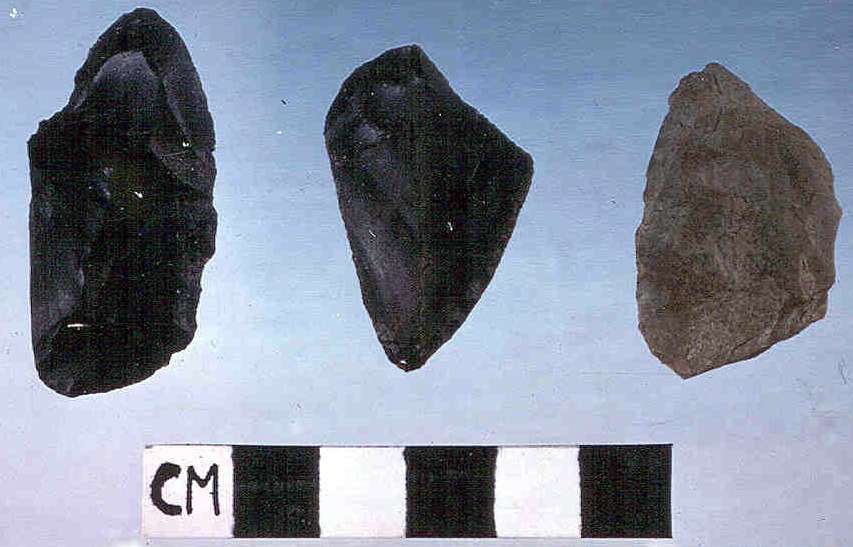
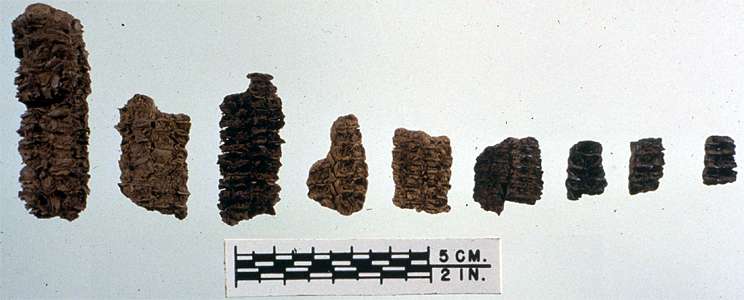
Key findings:
·
The site has at last been accepted as pre-Clovis
due to assiduous work carried out by Bourgeon
et. al. (2017)
·
Site now firmly established as 24,000 BP, exceeding by at least 5000
years any other accepted site in the Americas
·
Cinq-Mars’ samples used in the analysis proved
to be of the dates and to exhibit the human-made, cut-marks he originally
contended, thus vindicating his long-held contention of the antiquity of the
site
This post is a follow-up to the
first long piece I wrote on this site: Pre-Clovis Archaeological Sites of the
Americas 6: Blue Fish Caves - Old Crow Basin, Canada. See here.
The site location is:

This is an extremely important
paper. I would say a seminal paper, but only time will tell.
Here’s the abstract:
“The
timing of the first entry of humans into North America is still hotly debated
within the scientific community. Excavations conducted at Bluefish Caves (Yukon
Territory) from 1977 to 1987 yielded a series of radiocarbon dates that led
archaeologists to propose that the initial dispersal of human groups into
Eastern Beringia (Alaska and the Yukon Territory) occurred during the Last
Glacial Maximum (LGM). This hypothesis proved highly controversial in the absence
of other sites of similar age and concerns about the stratigraphy and
anthropogenic signature of the bone assemblages that yielded the dates. The
weight of the available archaeological evidence suggests that the first
peopling of North America occurred ca. 14,000 cal BP (calibrated years Before
Present), i.e., well after the LGM. Here, we report new AMS radiocarbon dates
obtained on cut-marked bone samples identified during a comprehensive taphonomic
analysis of the Bluefish Caves fauna. Our results demonstrate that humans
occupied the site as early as 24,000 cal BP (19,650 ± 130 14C BP). In addition
to proving that Bluefish Caves is the oldest known archaeological site in North
America, the results offer archaeological support for the ªBeringian standstill
hypothesisº, which proposes that a genetically isolated human population
persisted in Beringia during the LGM and dispersed from there to North and
South America during the post-LGM period.” Bourgeon et. al. (2017).
Why is this paper SO important?
Firstly, it answers,
unequivocally, a basic question in archaeology:
“What is the earliest date we
have so far for when were the Americas were first peopled?”
Secondly, it illustrates that
science, although it (meaning the scientific community), presents itself as
even-handed and unbiased, is riven by vested interests, self-serving small minded
people and bigotry just like the rest of society. As such, this sorry, slow
burning episode in archaeology reminds us all, to go back to basics and follow
the evidence as good scientists should.
Stepping back a minute, to fully answer the above question, however, requires a, thorough and detailed, examination of the background context to the events surrounding these archaeological discoveries and subsequent claims made by the chief excavator.
This is the story of
one scientist’s fight for the acceptance of the facts he had brought to light
through his excavation of three small caves in the Yukon territory of Canada.
That scientist was Jacques Cinq-Mars and this paper is a vindication of his
work which offered firm evidence, that man first colonised the Americas way
before the Clovis people.

Jacques Cinq-Mars excavating at
the Bluefish caves, from Pringle (2017). Original caption reads: While
excavating at Bluefish Caves in northern Yukon during the 1970s and 1980s,
Canadian archaeologist Cinq-Mars found cut-marked horse bones and other traces
of human hunters that seemed to date to 24,000 years ago—thousands of years
before the Clovis people. Photo by Ruth Gotthardt
As Pringle (2017) explains:
“In three hollows known as the Bluefish Caves, he [Cinq-Mars] and his
team had discovered something remarkable—the bones of extinct horses and woolly
mammoths bearing what seemed to be marks from human butchering and toolmaking.
Radiocarbon test results dated the oldest finds to around 24,000 years before
the present.
Bluefish Caves directly challenged mainstream scientific thinking.
Evidence had long suggested that humans first reached the Americas around
13,000 years ago, when Asian hunters crossed a now submerged landmass known as
Beringia, which joined Siberia to Alaska and Yukon during the last ice age.
From there, the migrants seemed to have hurried southward along the edges of
melting ice sheets to warmer lands in what is now the United States, where they
and their descendants thrived. Researchers called these southern hunters the
Clovis people, after a distinctive type of spear point they carried. And the
story of their arrival in the New World became known as the Clovis first model.”
“Cinq-Mars, however, didn’t buy that story—not a bit. His work at Bluefish
Caves suggested that Asian hunters roamed northern Yukon at least 11,000 years
before the arrival of the Clovis people..”
“But relatively few of Cinq-Mars’s peers shared his confidence..”
“..rather than launching a major new search for more early evidence,
the finds stirred fierce opposition and a bitter debate, Cinq-Mars, however,
was not intimidated. He fearlessly waded into the fight. Between 1979 and 2001,
he published a series of studies on Bluefish Caves.”
“It was a brutal experience, something that Cinq-Mars once likened to
the Spanish Inquisition. At conferences, audiences paid little heed to his
presentations, giving short shrift to the evidence. Other researchers listened
politely, then questioned his competence. The result was always the same” [rejection
and/or denial].
“At Bluefish Caves, the crucial evidence consisted of animal bones that
were dated to around 24,000 years ago and seemed to be cut, shaped, or flaked
by humans. So critics focused on those. They dismissed Cinq-Mars’s
identification of butchery marks and tools, and offered alternative
explanations. Rockfall from the caves, they suggested, had fractured the bones,
leaving splinters that merely looked like human artifacts. Or large carnivores
had chomped on a carcass, producing grooves that resembled cut marks or
fragments mirroring artifacts. Some skeptics even suggested that living
mammoths could have taken bad tumbles nearby, accidentally splintering limb
bones. Other critics wanted to see multiple lines of evidence for the presence
of early humans at Bluefish Caves, including dated hearths with stone tools in
close association.”..
“Stung as he was by the criticism, Cinq-Mars refused to back down. None
of the explanations for splintered bones, he noted, could account for the
complex chain of steps that produced the mammoth-bone flake tool his team
found. But by then, serious doubts about the Bluefish Caves evidence had been
sown, taking firm root in the archaeological community: hardly anyone was
listening. Cinq-Mars couldn’t believe it. At one presentation he gave, “they
laughed at me,” he says angrily today. “They found me cute.” Embittered by the
response, he stopped attending conferences, and gave up defending the site
publicly. What was the point? To Cinq-Mars, the Clovis first supporters seemed
almost brainwashed”
“When Jacques proposed [that Bluefish Caves was] 24,000 BP, it was not
accepted,” says William Josie, director of natural resources at the Vuntut
Gwitchin First Nation in Old Crow. In his office at the Canadian Museum of
History, Cinq-Mars fumed at the wall of closed minds. Funding for his Bluefish
work grew scarce: his fieldwork eventually sputtered and died.”
Looking back at the
archaeological establishment’s reaction to Cinq-Mars’ work two comments
summarise how the prevailing attitudes and entrenched orthodoxy then, is viewed
now:
“The scientific atmosphere, recalls Dillehay [excavator and –
eventually - vindicated, discoverer of Monte Verde see here and here] was “clearly toxic and clearly impeded
science.””
““one of the most acrimonious—and unfruitful [episodes] —in all of science,” noted the journal
Nature.”
How does the current paper establish the date of the site and avoid the
same criticisms as the original investigator?
Clearly, entering the debate by
studying the most contentious bone artifacts attributed as human-modified from
Bluefish Caves, could be counter-productive, as it could undermine the authors
aim: to re-evaluate the physical evidence gathered and unequivocally date the
site.
Therefore, whilst the authors
examined a huge number of the specimens collected at Bluefish Caves by
Cinq-Mars, some of the oldest and most controversial samples were not included
in their analysis.
For example, the unpublished
Mammoth limb bone and its attendant re-fitted bone flake (RIDDL-224 and
RIDDL-225 respectively) whilst mentioned, were perhaps, wisely not given
prominence in the current paper.
However, as we will see later,
there may be another reason for this glaring omission. Let’s park that for a
minute.
The authors begin by giving an
exhaustive explanation in their Materials
and Methods section, on the taphonomic processes that affected the bone
samples collected and how non-cultural and cultural bone modification can be
differentiated. It is worth looking at the criteria they use in detail to
underscore how well founded their conclusions are:
·
“A full
taphonomic analysis is required, in order to, contextualise and thus correctly
identify culturally modified bone. The sedimentary and geological context of an
archaeological site affects the taphonomic signature of the faunal assemblages
it contains.
·
The faunal
material from Bluefish Cave derives from wind-blown (aeolian) loess, which
should not produce scratches on bones but can lead to polished surfaces.
·
Cryoclastic
debris incorporated into the loess], however, may have abraded the bone
surfaces.
·
Rockfall
can also modify bone, producing striations and patterns of bone breakage
·
In some
cases, these natural traces can mimic cut marks, raising the spectre of
equifinality (Equifinality is the principle that in open systems a given end
state can be reached by many potential means). This has led some researchers,
in the past, to question the cultural
origin of some of the bone modifications reported in the literature.”
The authors go on to detail other
processes that may mimic human modification of bones:
·
“..large
canids, which are capable of applying static pressure on bone resulting in the
production of spiral bone fractures and bone flakes similar to the ones
produced by human marrow extraction.”
The authors are at pains to point
out the co-indicators for this type of bone-modification in ALL samples
studied:
·
“Carnivore
activity is also usually accompanied by the presence of digested bone, as well
as pits, punctures, scoring and furrows altering the bone surface
·
Carnivore
teeth produce traces with characteristically “U” shaped profiles when viewed in
cross-section and which are wider and shallower than cut marks, making them
easily distinguishable from human modifications”
The authors are strict in their
categorisation of bone modification:
·
“The
frequency of tooth marks, spiral fractures and bone flakes were recorded; tooth
marks were noted as “certain” or “probable” when the identification couldn't be
confidently assessed.”
Further factors affecting the
taphonomic state of the bones sample are also considered:
·
“The
climatic context of a site is also important because weathering and freeze-thaw
cycles can lead to cracks and desquamation of bone surfaces, potentially
removing or altering traces of cultural activities.
·
Damage due
to climatic factors (e.g., weathering) but also due to biological agents (e.g.,
root etching, trampling and rodent gnawing) were carefully recorded and
quantified”
Next the authors selected those
bone samples, most likely to be human-modified for further analysis,
highlighting the morphological and morphometrical features used to distinguish
human modification from animal (carnivore) and other environmental causes of
bone modification:
·
“Shape:
cut marks made with stone tools are usually V-shaped (narrow \/ or wide \_/)
while carnivore tooth marks or even metal tools will produce grooves with more
parallel walls (U or |_|). The cross-sectional shape of a cut mark can be
symmetrical (\/) or asymmetrical (√) depending on the inclination of the tool
relative to the bone surface. Morphometrical analyses allow us to quantify the
profile of potential cut marks by measuring the breadth at the top and at the bottom
of the groove
·
Trajectory:
cut marks are commonly straight but can sometimes be curved; they are rarely sinuous,
as in the case of trampling or root etching
·
Number of
striae, size and overlapping: butchering activities can produce multiple striae
that should be parallel in orientation and roughly the same size a scraping
motion to remove meat may produce overlapping striae; trampling marks will not
be oriented in this fashion.
·
Shoulder
effect and shoulder flaking: shallow striations along the main groove and edge flaking
can sometimes be observed under the microscope at high magnifications in marks produced
by butchering; they are rarer in marks created by trampling
·
Internal
microstriations: microstriations are common on the inner walls of marks
produced by stone tools during butchery; they may also be produced by trampling
but will not be observed in cases of root etching or tooth mark scoring
·
Anatomical
location and orientation: the anatomical location and orientation of cultural bone
modifications must be consistent with the marks produced by specific butchery
tasks described in the literature; marks produced by natural processes,
however, will not reflect any predetermined intention. Assigning a precise
function to a cut mark is subject to equifinality since marks resulting from
skinning, defleshing and dismembering can occur in very similar locations and
because variability exists in the placement and orientation of butchery marks.
Keeping this in mind, we noted the anatomical location and orientation of each
cut mark and we proposed a potential butchery task based on comparisons with
ethnozooarchaeological data.”
The authors give further
explanation of the diagnostic value of one morphometrical measurement, in
particular:
“The breadth ratio (the ratio between the
breadth at the top and the breadth at the bottom of the cut mark) better
illustrates the shape of the groove (\/ or |_|) and is a good criterion for
distinguishing between cut marks made with stone tools and modifications
produced by other effectors. Small ratios are associated with grooves with
parallel walls while large ratios are associated with narrow \/ or wide
\_/-shaped grooves such as the ones produced by stone tools..”
Finally from the 36,000 bone
samples collected by Cinq-Mars and analysed by Bourgeon and her team 6 were
deemed unequivocally human-modified and sent for radio-carbon dating:
“In summary, in order for, a bone modification to be identified as a
cut mark in this study, all of the above criteria had to be met. If one of the
criteria couldn't be confidently assessed, the mark was consigned to a,
”probable” category of human bone modification.
We selected six bone samples bearing indisputable evidence of butchery
activity for radiocarbon dating. The samples were sent to the Oxford
Radiocarbon Accelerator Unit (ORAU) for analysis.”
The 14C BP dates and
the calibrated age BP are given in the following table:

The authors therefore come to
some firm conclusions in their Discussion
section:
1. “While the Yana River sites indicate a human presence in Western Beringia ca. 32,000 cal BP [14, 15], the Bluefish Caves site proves that people
were in Eastern Beringia during the LGM, by at least 24,000 cal BP”
2. Our results, therefore, confirm that Bluefish Caves is the oldest known archaeological site in North America.
Emphasis in bold my own.
The two oldest bone samples are
shown below:

The oldest specimen, a horse
jaw-bone dated to between 23,314 and 24,033 years BP Fig 1 from Bourgeon
(2017). Original caption reads: Fig 1.
Cut marks on a horse mandible from Cave II. The specimen (# J7.8.17) is dated
to 19,650 ± 130 14C BP (OxA-33778). The bone surface is a bit weathered and
altered by root etching but the cut marks are well preserved; they are located
on the medial side, under the third and second molars, and are associated with
the removal of the tongue using a stone tool.
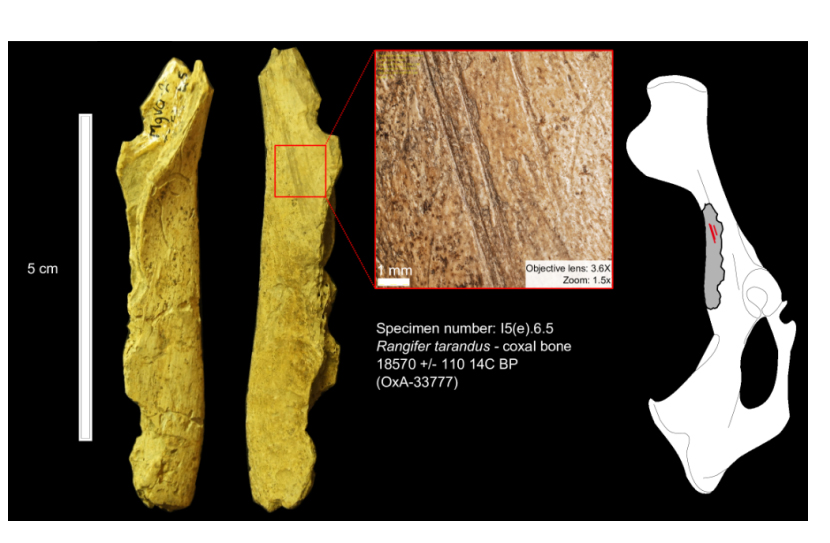
The second oldest specimen, a caribou pelvic bone dated to between 22,176 and 22,731 years BP Fig 2 from Bourgeon (2017). Original caption reads: Fig 2. Cut marks on a caribou coxal bone from Cave II. The specimen (# I5.6.5) is dated to 18,570 ± 110 14C BP (OxA-33777) and shows straight and parallel marks resulting from filleting activity.
Unfortunately, the authors chose to conflate their results with the Beringian standstill theory. In this hypothesis, humans were isolated, physically and genetically, in Beringia from about 23,000 B.P. to 15,000 cal. B.P. and then continued their migration further into the rest of the Americas as an ice-free corridor formed between the Laurentide and Cordilleran ice sheets opened:
(our results) “thus providing long-awaited archaeological
support for the “Beringian standstill hypothesis”
Why the authors, feel the need to
hang their paper off the coat tails of the current orthodoxy is inexplicable
and ironic considering they have just, effectively put the last nail in the
coffin of the Clovis-first paradigm!
A good, simple explanation of why
this new ‘line in the sand’ rejecting the pre-Ice Age peopling of the Americas,
is being drawn was written recently by Marnie Dunsmore (2017), in a blog post
with provocative title “Trading One Zombie Model for Another: Why I am Fed Up
with the Beringia Standstill Model and the journals and conferences that don't
consider alternatives”.
Here are a couple of quotes to
give you a different perspective:
“The distribution of mitochondrial DNA haplogroups in the Americas,
namely haplogroups A, B, C, and D, according to Behar[3], split from the
mitochondrial tree earlier than 30,000 thousand years ago (before the last Ice
Age). Given the distribution for these
haplogroups[4][5], it is equally likely that the branching of these
mitochondrial haplogroups occurred in the Americas, as in Asia or Beringia.
Given that Beringia and Siberia were cold, while many areas in the Americas
were temperate [2], during the Ice Age, the likely expansion of the A, B, C and
D haplogroups during the Ice Age was in the Americas south of the glaciers, not
Beringia or Siberia (as proposed in the Beringia Standstill Model.”
..“There
is ample evidence that Modern Humans were in Siberia and Beringia tens of
thousands of years before the Ice Age.
Given that sea level data indicates that there were long periods before
the Ice Age (when Modern Humans were in Beringia) when there was an easily
walkable path from Beringia to Florida, to the American Central Plains, to the
American East Coast and to points further south, it is highly improbable that
highly mobile large game hunters over tens of thousands of years would not
easily have moved back and forth between the Americas and Eastern
Eurasia[5][8][9][10].”
If you want to check out the
timings of the existence of Beringian Land Bridges I put together a detailed
post on that here.
An inconvenient truth..
Something really, bothered me
about this paper. I read it and re-read, scrolled the screen for several
minutes, up and down, up and down. Frustratingly, nothing jumped out. Finally,
I went away and thought about something else. Of course THAT did the trick! It
was a sin of omission I was missing. Consider the following adapted version of
Bourgeon’s table 1:

Notice anything? Two of the
oldest specimens, RIDDL-224 and 225 (remember them?) from the Mammoth tibia and
the associated refitted flake, are of comparable dates to those determined in
the current paper aren’t they? Nothing to see here – move along.
Wrong. Dead wrong. They are
radiocarbon (14C) dates and therefore need calibrating to give
actual calenderic ages, i.e. cal. BP years as has been done with the bone
samples in this paper.So let’s calibrate them! I used the Monrepos Museum online Calpal resource (Danzeglocke 2007). Also included is the oldest specimen, a butchered caribou tibia.
Wow now that is quite a bit older
isn’t it. So why this omission?
I gave Cinq-Mars’ explanation of how
the flake (RIDDL-224) was made from the core (RIDDL-225) by human agency in a
previous post, see here.

Although the specimens (RIDDL-224
and RIDDL-225) were described in a peer reviewed journal in 1990, their publication
history is quite complex. From the outset, based on contextual, bone taphonomic
and sample comparison criteria, Cinq-Mars insisted these bones were pre-Ice
Age. It could be argued, that at first, he did not have sufficient high quality
evidence to support this assertion. This caused resistance from the
archaeological establishment, who firmly rejected this timeframe for the
peopling of the Americas and publication problems, after his initial paper
appeared. For clarity sake I will summarise the publication history and the
radiocarbon ages below:

Looking at the initial date of
publication (Cinq-Mars 1990) and the first time, firm dates are attributed to
the samples we find they are different. Checking the Canadian Archaeological
Radiocarbon Database (CARD) we find the dates of submission for AMS radiocarbon
dating are on the same day in April 1997 (Anon 2017 a and b).
And that’s the problem that Cinq-Mars caused.
Whilst the argument of how they were produced is detailed and robust, (see here), and Cinq-Mars’ refutation of all
published objections, for example Beebe (1983), to these and other specimens is
unassailable, he simply did not follow scientific convention. He therefore left
himself open to justifiable scientific criticism. This coupled with the extremely
old dates, ensured then, and still does today, that Cinq-Mars oldest specimens
remain unaccepted.
Image comparisons of
RIDDL-224 and RIDDL-225

RIDDL-224 and RIDDL 225 from Harington and Cinq-Mars (2008)

RIDDL-224 and RIDDL 225 from Cinq-Mars (2001)
We can therefore see that these bone
artifacts, given their proven human manufacture and most particularly their
pre-Ice Age dating would cause Bourgeon et al. great difficulties were they
included in their paper. This is because, the authors draw a firm dating ‘line
in the sand’ when they link their results so strongly to the Beringian ‘standstill
hypothesis’, in their closing discussion.
Conclusions
1. A seminal paper as
Bourgeon et al. (2017) prove conclusively that people were in the Americas by 24,000 BP
2. Disappointingly they see the evidence they have gathered
as support for the current orthodoxy (the Beringian Standstill hypothesis).
3. Evidence from their own paper regarding the true dates of
the peopling of the Americas is ignored.
4. The date of the
peopling of the Americas, from data presented above should be at a minimum 27,000 cal BP and perhaps as old as
ca. 30,000 cal BP.
Lastly a couple of quotes to which summarise my feelings on
the Bluefish Caves saga.
Dunsmore (2017) again:
“I note that prominent conferences such at the Paleoanthropology
Conference in Vancouver, British Columbia at the end of March (by the way,
to be held on never ceded Salish territory in downtown Vancouver),
continue to entertain papers supporting only the Beringia Standstill
model, but not alternatives. Given the weight of evidence, this
cannot be seen as objective, and the unlevel funding supporting the Beringia
Standstill Model can only be seen as another example of formerly Clovis First
too cozy ancient DNA researchers, archaeologists, and their supporters, feeding
at the trough.”
The last word should be Cinq-Mars’ (1999), quoting Morlan:
“A program of AMS dating was undertaken on bone cores and flakes “to determine
whether the distribution of ages would be random or grouped in time. A random
distribution, including ages beyond the limits of radiocarbon measurement,
could be explained by the action of one or more long-term natural processes of
bone alteration, whereas a restricted distribution younger than the limits of
measurement would require the onset of a new process of bone alteration”
(Morlan et al. 1990:75). The resulting ages were found to be restricted to “a
15,000 year time span, beginning around 40,000 BP. and ending around 25,000 BP.
Since we believe that our measurement methods would have allowed us to measure
samples 10,000 years older than those encountered here, this implies that a new
agency or process enters into the taphonomic histories of large vertebrates in
the Old Crow Basin around 40,000 BP” (Morlan et al. 1990:86).”
Translation: Morlan and Cinq-Mars
believe man arrived in the Americas 40,000BP. Enough said.
References
Anon (2017a). Canada / YT / MgVo-2 (Bluefish Cave II) /
RIDDL-224. [ONLINE] Available at: http://card.anth.ubc.ca/samples/4593.
[Accessed 12 April 2017].
Anon (2017b). Canada / YT / MgVo-2 (Bluefish Cave II) / RIDDL-225.
[ONLINE] Available at: http://card.anth.ubc.ca/samples/4592.
[Accessed 12 April 2017].
Bourgeon, L. (2015). Humans
and Carnivores at the Bluefish Cave ii (Northern Yukon, Canada): Interpretation
of the faunal remains [Poster]. Exhibited at Society for American
Archaeology 80th Annual Meeting, Session 357: Peopling of the New World and
Archaeology of Paleoindians. Hilton Hotel, San Francisco. 18th April
2015.
Download available at: https://www.academia.edu/24719435/Humans_and_carnivores_at_the_Bluefish_Caves_II_Yukon_-_SAA_San_Francisco_2015
Beebe, B.F., 1983, Evidence of
carnivore activity in a Late Pleistocene/Early Holocene archaeological site
(Bluefish Cave I), Yukon Territory, Canada, in Lemoine, G.M., and MacEachern,
A.S., eds., Carnivores, Human Scavengers, and Predators: A Question of Bone
Technology, Proceedings of the 15th Annual Conference of the Archaeological
Association of the University of Calgary, University of Calgary, p. 1–14.
Bourgeon L, Burke A, Higham T (2017). Earliest Human
Presence in North America Dated to the Last Glacial Maximum: New Radiocarbon Dates
from Bluefish Caves, Canada. PLoS ONE 12 (1): e0169486. doi:10.1371/journal.pone.0169486
Cinq-Mars, J,
1990. La place des grottes du Poisson-Bleu dans le Préhistoire béringienne. Revista
de Arqueología Americana, No. 1, 9-32.
Cinq-Mars, J. 2001.
Canadian Museum of History, Significance of the Bluefish Caves in Beringian
Prehistory. [ONLINE] Available at: http://www.historymuseum.ca/learn/research/resources-for-scholars/essays/significance-of-the-bluefish-caves-in-beringian-prehistory/.
[Accessed 12 April 2017].
Cinq-Mars,
Jacques and Richard E. Morlan. 1999. “Bluefish Caves and Old Crow Basin: A New
Rapport,” in Ice Age Peoples of North America, ed. by Robson Bonnichsen and
Karen L. Turnmire, pp. 200-212. Corvallis: Oregon State University Press for
the Center for the Study of the First Americans.
Download
available from: https://www.academia.edu/5521801/Bluefish_Caves_and_Old_Crow_Basin_A_New_Rapport._Cinqmars_et_al._1999_
Danzeglocke, U 2007. CalPal
Online. [ONLINE] Available at: http://www.calpal-online.de/index.html.
[Accessed 11 April 2017].
Dunsmore, M.
2017. Trading One Zombie Model for Another: Why I am Fed Up with the
Beringia Standstill Model and the journals and conferences that don't consider
alternatives. [ONLINE] Available at: http://linearpopulationmodel.blogspot.co.uk/2017/03/why-i-am-fed-up-with-beringia.html.
[Accessed 12 April 2017].
Harington, C. R., 2011, Quaternary Cave Faunas of Canada: A
Review of the Vertebrate Remains: Journal of Cave and Karst Studies, v. 73, no.
3, p. 162-180.
Harington, C.R., and Cinq-Mars, J., 2008, Bluefish Caves –
fauna and context, Beringian Research Notes, no. 19, p. 1–8.
Download
Available at: http://www.tc.gov.yk.ca/publications/Blue_Fish_Caves_2008.pdf
Morlan, R,E,, et al. 1990
Accelerator mass spectrometry dates on bones from Old Crow basin, northern
Yukon Territory, Canadian Journal of Archaeology 14:75-92.
Pringle, H.. 2017. From Vilified to Vindicated: the Story of Jacques
Cinq-Mars. [ONLINE] Available at: https://www.hakaimagazine.com/article-long/vilified-vindicated-story-jacques-cinq-mars.
[Accessed 12 April 2017].