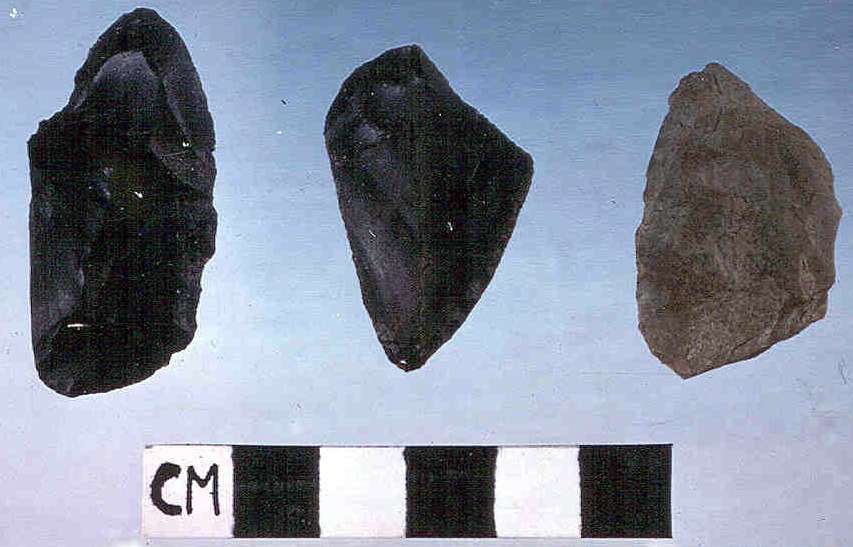
Saturday, 26 December 2015

Pre-Clovis archaeological sites of the Americas 5: Nugget Gulch, Klondike, Yukon Canada


Pre-Clovis archaeological sites of the Americas 5 Nugget Gulch, Klondike, Yukon Canada
 
An interesting paper from Harington and Morlan from 2002: Evidence for a Human Modification of a Late Pleistocene Bison (Bison sp.) Bone from the Klondike District, Yukon Territory, Canada1
 
Abstract
A 31000BP Bison limb bone from Nugget Gulch near Dawson City, Yukon, shows a “ring crack” considered to be a human-made impact mark resulting in exposure of marrow. This bone is approximately contemporaneous with wolf, horse, and Dall sheep specimens found on ancient Mid-Wisconsinian terrain surface at this locality. Similar ring cracks, also interpreted as human-made, have been noted on late-glacial bison bones from Engigstciak, Yukon, and Lost Chicken Creek, Alaska.
 
Here’s the bone in question:

 
The site was discovered when Harington, acting on information received by placer miners had reported what turned out to be Pleistocene mammal bones in the same area, the previous summer to Harington. He noted that the first find of bones lay on what appeared to be an ancient grassy surface lying at approximately 9m below present ground level. Also noted was the fact that those bones lay close to an extensive volcanic ash layer of unknown relationship with the land surface. The bone in the current paper was discovered when Harington returned the following summer to survey the area in more detail.
 
The ancient land surface was exposed when heavy jets of water had been used to remove approximately 9m of frozen organic silt (locally known as “muck”) form the gold-bearing gravels lying on the bedrock, just below the ancient land surface.
Fortuitously 100m downstream, an outcropping of a thin layer of volcanic ash lay some 10cm below the, ancient ground surface. The authors also give the chemical  composition of the tephra/volcanic ash from the site and show the stratigraphy of the site fits with known, dated volcanic layers in the region. This was radiocarbon dated to approximately 50000BP. Thus a lower limit in age was established for the bone.

Bone description:
“The Bison bone is the proximal end of a right radio-ulna near the semilunar notch. Presumably it represents a steppe bison (Bison priscus), a species that was relatively common in the Yukon and Alakka during the mid-wisconsinian interglacial.
The bone has a complex taphonomic history. We believe it was broken by dynamic loading, because it exhibits an oval ring-crack on the anterior surface of the radius adjacent to the proximal epiphysis (Figs 2, 3). Helical fractures radiating distally from the ring crack travelled 14cm along the radius shaft and passed through the ulna that is firmly fused to the radius. Despite the proximity of the ring crack to proximal end,, the fracture did not initially pass through the epiphysis, as the cancellous tissue absorbed the shock. The fracture surfaces form acute and obtause angles with the outer surfaces of the bone, and they exhibit no peturbations caused by split lines. The fracture surfaces are the same colour (pale brown,..) as the outer surface of the bone. These characteristics indicate that the bone was fresh when the fracture occurred.
Also when the bone was fresh, the proximal border of the olecranon process was removed, leaving a continuous row of short chipping scars and a scooped out area of cancellous tissue. Thereafter the bone was buried in the active layer for some time, during which plant roots etched the surface in a few scattered locations. Once deeply buried, the bone became premineralised, probably through the absorption of manganese and iron.”

The authors then explain how the bone was quite fragile when exposed by mining activity and became somewhat cracked and bleached by sunlight.
 
The authors then explain why the marks found on the bone, are, in their opinion of human origin. They say the simplest explanation for the marks on the bone might be that it was gnawed by a large carnivore, however many features of the damage make it much more likely that it was altered by humans. Their explanation consists the following points:

·         The chipping and scooping of the olecranon process lacks any tooth marks

·         The ring crack represents dynamic loading, i.e. a blow, whereas application of force carnivore by biting is a static force

·         The ulna-radius assemblage had an 8cm span, thus the gape of the carnivore would have to encompass this area, it the damage was caused by gnawing there must be concurrent marks on the bone from other teeth. There are none. Even a Short-Faced Bear (the area’s largest Pleistocene predator) could not have caused the damage

·         The size of the ring crack at 32x25mm is too large for the canine of any predator and too small for hoof trampling

·         To cause the damage on the anterior (rear) surface of the bone, an unusual position for a break of this type, the limb would have to be held by the attacker and struck with cobble, presumably to reach the bone marrow.  This also accounts for the loss of the lower portion of the bone.
 
The authors admit that there are no archaeological remains to support the attribution of the bone damage to human agency, but in support of their argument, cite other examples of identically fractured bone from the region that have been accepted as the work of humans.
 
Verdict: Man hunted Mammoth 31000BP in northern North America.
 
Reference
1. Harington, C.R. and Morlan, R.E. 2002. Evidence for Human Modification of a Late Pleistocene Bison (Bison sp.) Bone from the Klondike District, Yukon Territory, Canada. Arctic Vol. 55 No. 2 (June 2002) P. 143-147.

Sunday, 20 December 2015

Monte Verde update - Conversion of Radiocarbon dates to calendar years suggest Monte Verde MV-I close to 40000BP


As mentioned in a previous post (see here) I have been scouring the internet for information on any further excavations of the MV-I portion of the Monte Verde site. Whilst I did not find any references to MV-I having been further excavated to confirm the 33000BP radiocarbon dates from his 1997 report1 I did come across an extremely interesting piece by Ruth Gruhn in the Mammoth Trumpet, from 2007.
 
Among other things, the piece had some pictures of the lowest levels excavated at MV-I and the actual artifacts.


Photo Credit Tom Dillehay
Original caption: Ash smear and charcoal fragments exposed on the Monte Verde I occupation level, with a lithic artifact associated. Charcoal from this occupation level was dated ca. 34,000 RCYBP.


Photo Credit Tom Dillehay
Original caption: A basalt core tool, 9.4 cm long, from the Monte Verde I occupation level.


Photo Credit Tom Dillehay
Original caption: Two hammerstones from the Monte Verde I occupation level, showing marks of use as battering tools. Each is about 13 cm in diameter.


The section of the article relating to Monte Verde read thus:


“The Monte Verde project involved detailed geological research in the area. Accordingly, geological test pits were excavated on a terrace of Chinchihuapi Creek ca. 20–30 m across the creek from the Monte Verde II settlement; and in a different stratum (basal MV-7), at a depth of ca. 1.5 m below the level of the Monte Verde II occupation, lithic artifacts turned up. Excavation in this area was expanded. In all, 26 lithic artifacts were recovered from a restricted zone in the compact grey sand deposit, including a basalt core tool, two hammerstones with battering marks, three percussion-struck flakes, and six utilized fractured pebbles. The basalt core tool features 10 prominent flake scars on the face, and small use-wear flakes have been detached from one acute edge. Blood residue identified as possibly proboscidean was detected on the piece.
The lithic artifacts were recovered in direct association with three small shallow clay-lined lenses with ash streaks and charcoal fragments, possibly remains of hearths.
Dates of 33,750 ± 520 RCYBP and >33,020 RCYBP from samples of burnt and charred beech wood correspond with previously published radiocarbon dates on the particular geological stratum (basal MV-7) in which the artifacts and features were found. Geomorphological reconstruction indicates that the Monte Verde I artifacts and features were situated on a promontory overlooking an ancient marsh or pond. Charred seeds of the reed Juncus sp., a wetlands plant with edible stalks and seeds, were recovered in the hearth-like features. Usually, severe critiques follow reports of really early archaeological sites; but few questions have been raised about the quality of the Monte Verde I evidence. Dillehay himself believes that some of the recovered evidence is valid, but by itself it is insufficient at the present time to establish conclusively a human occupation of the Americas this early.”


The most interesting part however was the dates ascribed to the charcoal fragments they were in Radiocarbon Years! So they convert to OLDER dates!

I therefore used the Columbia University Radiocarbon age to calendar age conversion curve3 to look at the ACTUAL date in calendar years. I adapted their graph and added lines and grids to show the Dillehay 1997 Radiocarbon age of 33750RCY.

Monte Verde MV-I Radiocarbon years before present (RCYBP) to Calendar Years Conversion. N Barden.
 

The age of the site turns out to be a stunning 39000BP or 39500BP if the upper limit of the error is added. STUNNING!

 References
 
1. Dillehay TD. Monte Verde: A Late Pleistocene Settlement in Chile. Volume II: The Archaeological Context. Washington, D.C.: Smithsonian Institution Press; 1997.
 
2. Gruhn R. The Earliest Reported Archaeological Sites in South America. The Mammoth Trumpet, Volume 22, Number 1. January, 2007 Center for the Study of the First Americans, Department of Anthropology, Texas A&M University
 
3. Chiu, T-C, R. G. Fairbanks, Li Cao, Richard A. Mortlock, 2007. Analysis of the atmospheric 14C record spanning the past 50,000 years derived from high-precision 230Th/234U/238U and 231Pa/235U and 14C dates on fossil corals. Quaternary Science Reviews, 26, 18-36


Update 29/12/15
 
Where these dates originate: Dillehay, states1 “The two ages for stratum MV-7 (33370 +/-530 B.P., Beta-6754 and greater than 33020 B.P., Beta-7825) were excavated on the unconforming plain of SCH-4 (the base of MV-7). The two samples were collected from two different, but spatially contiguous, charcoal scatters in direct association with modified stones at a depth of 2.0m below the present surface at the Monte Verde site and 8m below the top of the intact Salto Chico Formation elsewhere in the area. The age of this stratum thus represents a geologic, or possibly a cultural, event (Dillehay 1986:3362)..”
 
I will obtain the 2nd reference and report further.
 
1. Dillehay, T.D. Early Rainforest Archaeology in Southwestern South America: Research Context, Design, and Data at Monte Verde. In: Wet Site Archaeology Purdy, Barbara A. 1990 Wet Site Archaeology CRC Press
 
2. Dillehay, T. 1986 The Cultural Relationships of Monte Verde: A Late Pleistocene Settlement Site in the Sub-Antarctic Forest of South-Central Chile. In New Evidence for the Pleistocene Peopling of the Americas. Edited by A.L. Bryan Center for the Study of Early Man. University of Maine, Orono. p319-337.


Tuesday, 15 December 2015

Pre-Clovis archaeological sites of the Americas 4: Buttermilk Creek, the Debra L. Friedkin site


Buttermilk Creek, Bell County is situated in the hills of Central Texas, 40 miles northwest of Austin.
 
The site has been excavated by Dr. Michael R. Waters and graduate and undergraduate students from Texas A&M University since 2006. It was discovered when Walters was involved in excavating the Gault Site 250 upstream. This Paleo-Indian site excavated in 1998 was found to have deeply stratified deposits including a Clovis horizon. Walters therefore decided to investigate the area further and discovered the new Buttermilk Creek sometimes referred to as the Debra L. Friedkin site.
 
As Pringle1 noted in 2011

“Early humans would have been attracted to the area surrounding Buttermilk Creek due its favourable climate, abundance of food resources, a year-round water source, but most importantly because the area was a source of very high quality Edward’s Chert.”


Graduate and undergraduate students excavating at the Debra L. Freidkin site. Photo credit: Michael Waters, TAMU
 

Reporting on the excavation Waters’ et al2 begun thus:

“Nearly 80 years ago, Clovis was identified as the oldest archaeological horizon in
North America [~12.8 to 13.1 thousand years ago (ka)]. Decades of subsequent research have advanced our understanding of Clovis chronology, adaptations, and technological organization. Whereas genetic studies indicate that the first Americans hailed from northeast Asia, no fluted Clovis points or other diagnostic characteristics of Clovis have been identified there. Additionally, fluted points in Alaska are rare, are technologically different, and postdate Clovis. These lines of evidence suggest that, although the ultimate ancestors of Clovis originated from northeast Asia, important technological developments, including the invention of the Clovis fluted point, took place south of the North American continental ice sheets before 13.1 ka from an ancestral pre-Clovis tool assemblage.”
 
Basically the authors were saying “We have a Pre-Clovis site to explain to you based on a simple toolkit that is a pre-cursor to Clovis points.”
 
To make an unassailable case the authors needed to demonstrate an uninterrupted stratigraphy and date their finds.
 
To address the first of these issues the authors excavated with extreme care and evidenced the stratigraphy in a number of ways.
Firstly they characterised it thus:
“..The high clay content and pedogenic characteristics—including slickensides, surface cracking, and evidence of subsurface microlow and microhigh topography—indicate that the floodplain deposit containing the Buttermilk Creek Complex artifacts is a Vertisol.. Although Vertisols were once thought to be well mixed by argilliturbation processes, more recent pedologic studies show this is not true and that Vertisols are minimally mixed. At the Friedkin site, the vertic features of the soil are weakly expressed.”
A vertisol is a soil in which, the high proportion of heavy clay, within it, can cause deep, wide cracks during dry periods of the year. The soil material is therefore subject to significant internal turnover. This would cause the stratigraphic position of artifacts to be disturbed. Hence the authors elect to address this point first. To really settle the issue of stratigraphic integrity they continue:
“Horizonation is preserved within the soil with the amount of clay, organic carbon, and calcium carbonate, as well as color, soil structure, and pH varying systematically with depth (Fig. 2C).”
The authors show a number of important measures vary as expected down the stratigraphic column. They go on:
“Crack infills constitute a minor portion of the soil volume with diameters rapidly decreasing from 2 cm near the surface to <1 cm at a depth of 1 m. Soil material between the crack infills is intact with few rodent burrows and limited root penetration (<2 mm diameter). Only a few cracks reach the Clovis and Buttermilk Creek Complex levels, and crack apertures are <1 mm diameter, smaller than the microdebitage (sizes 6 to 7, table S15) from these levels (Fig. 2D). There is no sorting of artifacts by size from the surface through the Buttermilk Creek Complex layers (fig. S11). Refitted artifacts occur in the Paleoindian and Buttermilk Creek Complex levels (table S16).”
In other words the distribution of artifacts by size does not show that artifacts have fallen down the small cracks.
Therefore their stratigraphic position is secure. Continuing the reinforcement of the the site’s stratigraphic integrity they say:
“The number of artifacts with pedogenic calcium carbonate adhering to them (sizes 1 to 5, table S15) increases with depth. No calcium carbonate accumulated on artifacts in the Late Prehistoric and Archaic levels, about 40 to 60% of the artifacts from the Paleoindian levels are coated with CaCO3, and about 90% of the artifacts in the Buttermilk Creek Complex levels have CaCO3 coatings. The percentage of calcium carbonate coatings on artifacts parallels pedogenic CaCO3 occurrence and concentration within the soil horizons."
The artifacts have the right amount of calcium carbonate coating for their depth throughout.
“Measurements of mass-normalized magnetic susceptibility show a smooth decrease through the floodplain clays with depth, typical of uninterrupted soil development (14, 15) (fig. S7).
The authors use the correlation between soil formation and magnetic susceptibility to confirm the depositional sequence is undisturbed.
“Further, the magnetic mineralogy gradually changes from an assemblage dominated by magnetite in the upper 40 cm to an assemblage dominated by hematite and/or goethite at depths >40 cm. This trend of increasing oxidation with depth is indicative of undisturbed, nonsaturated, modern soils. Measurements of natural remnant magnetization are all of normal polarity, and magnetic inclinations are consistent with the latitude of the field site.”
The oxidation of iron minerals also confirms the intact stratigraphy. The authors conclude:
“Thus, on the basis of multiple lines of evidence—pedologic, magnetic, chronologic ordering of dates and diagnostic artifacts, artifact size distribution, and distribution of artifacts with and without calcium carbonate accumulations— we conclude that the artifacts from block A lie in undisturbed contexts and have not worked downward or displaced upward by soil-forming processes.”
 
The authors now need to date their finds. To do so they take 49 soil samples spanning the artifact baring levels and beyond, and subject them to obtained optically stimulated luminescence (OSL) dating.
For block A of their excavation, the block containing pre-Clovis artifact they provide two diagrams showing the positions of the OSL samples in column 1 and 2 and their associated dates:


The figures shown above are adaptations of the originals. The upper diagram and the left hand part of the lower diagram are from their fig. 2. The right hand part of the lower

diagram is adapted from fig. 1.
Original captions read:
Fig. 1. Geomorphic surfaces and excavation areas and trenches (black rectangles and squares) at the Friedkin site.
Fig. 2. Block A stratigraphy, archaeological complexes, and OSL ages (one sigma)
from column 1 (A) and column 2 (B). BP indicates years before the present.

A selection of the 15,528 lithic artifacts from the site is shown below:

Original caption from Waters et al.2 read:
Fig. 4. Buttermilk Creek Complex artifacts: (a) lanceolate point preform, (b) chopper/adze, (c) discoidal flake core, (d) radially broken flake with notch, (e) graver, (f) flake tool with retouch on a radially broken edge, (g and h) flake tools with marginal edge retouch, (i) polished hematite, (j) bifacially retouched flake, (k) radially/bend broken flake, (l) radially broken biface, (m and n) blade midsections, (o to s) bladelets.
 
The authors conclude that the dates for the site are as follows:

“Below the Clovis horizon is a 20-cm-thick layer containing artifacts that represent repeated visits to the site and together define the Buttermilk Creek Complex.
Eighteen OSL ages, ranging from ~14 to 17.5 ka, were obtained from this layer, and all but three overlap at one standard deviation (Fig. 2, A and B, and table S2). The most conservative estimate of the age of the Buttermilk Creek Complex is ~13.2 to 15.5 ka, on the basis of the minimum age represented by each of the 18 OSL ages.”
 
Verdict:

Artifacts found were of 17500 years BP, long before the Clovis period and during a period of significant glaciation. Where and when did these people enter America?
 
Overall a meticulous excavation followed up by an exemplary paper with all possible sources of objection covered in great detail.
 
However there were STILL some unfavourable comments made by, of all people Tom Dillehay! He really ought to know better..

“I have a mixed opinion,” Dillehay told The Why Files3, proceeding to list some shortcomings in the study. “It would be most convincing if there was standard radiocarbon dating, and even better if those dates were taken from features like hearths and food stains. OSL dating has become more reliable, but it’s still not as reliable as carbon-14, although the sequences do line up very nicely with sediment dating.”

Dillehay has questions about the three-layer sandwich of pre-Clovis, Clovis and post-Clovis material. “I’m not saying the materials are mixed. Geologists, to identify the strata, applied these excellent, meticulous sediment and particle analyses, but there was no clear visible stratigraphy to distinguish Clovis from pre-Clovis, and again this does not meet standard archeological criteria.”

Dillehay also points to the lack of “diagnostic, complete projectile points in either, the Clovis and pre-Clovis material. In a discipline that has placed incredibly heavy emphasis on formal projectile points as the primary criteria for acceptance of a site, along with C-14 [radioactive carbon] dating, and geologic stratigraphy, I find this sort of acceptance, which seems to be uncritical, to be a major shift in the discipline.”

Still, Dillehay says “the interdisciplinary work is first rate, and I admire the multidisciplinary approach. But had there been C-14 dating and diagnostic projectile points, all this extraneous analysis would probably not be needed.”
 
In reply Waters had this to say3:

"It certainly would be nice to find arrow- or spear-points, says Waters, but “You can’t dictate what you will find. You have to roll with the punches.” Further excavation may or may not reveal a “smoking gun projectile point,” Waters adds. “We don’t know what kind of weaponry they used. In Siberia and Alaska, people were using a lot of bone, ivory and antler weaponry, and it might be that early folks in North America were using this as well.”

But due to heat and humidity, such organic material would not be preserved in the Texas site, he says.
 
I had to laugh when I read Tom Dillehay’s comments! After all the trouble he had getting his Monte Verde site accepted by the Clovis Mafia, I would have thought he would have been a little more positive about the paper, site and authors’ achievements. All I can think is it sounds like sour grapes, As he had yet to publish his Monte Verde paper describing man in southern Chile at 18.5 Kya.
 
James Adovasio of Meadowcroft fame, who had also experienced a decades long fight with the Clovis Mafia (his name for the Clovis-first proponent by the way), was a little more positive4:

 “It would appear the assemblage of artifacts is enough different from typical Clovis to be a distinct technology,” Dr. Adovasio said in an interview. “But it is not as much different as not to be ancestral to Clovis material.”
 
In other words one of the main implications of this discovery is that, with a pre-Clovis occupation of North America as proved by this study (and those of Adovasio and later  Dillehay) people had more time to settle in North America, colonize South America by more than 14,000 years ago.
 
He continued:
“Finally, we are able to put Clovis-first behind us and move on,”
Dr. Adovasio noted that the Clovis model had been “dying a slow death.” He recalled that “Waters himself was a Clovis-firster, but changed years ago.”
Adovasio finally finished somewhat disappointedly:
“The last spear carriers [for Clovis-first] will die without changing their minds,”
 
References
1.Pringle, H (2011).Texas Site Confirms Pre-Clovis Settlement of the Americas
Science 25 March 2011: Vol. 331 no. 6024  p. 1512 
DOI: 10.1126/science.331.6024.1512 
2. Michael R. Waters et al (2011). The Buttermilk Creek Complex and the Origins of Clovis at the Debra L. Friedkin Site, Texas. Science 331, 1599 (2011)
DOI: 10.1126/science.1201855
 
3. Tenenbaum, D. (2011).  The Why? Files 7th April 2011:
Peopling the Americas — New evidence.
 
4. Wilford J. N. (2011) Spear Points Found in Texas Dial Back Arrival of Humans in America. The New York Times March 24th, 2011


Thursday, 10 December 2015

Pre-Clovis archaeological sites of the Americas 3: Meadowcroft Rockshelter Pennsylvania


Site importance

Meadowcroft Rockshelter in Pennsylvania has become one of the most celebrated archaeological sites in the Americas. The now accepted date of initial occupation of approximately 16000 years BP is the oldest in North America.

Meadowcroft holds the distinction of demonstrating the longest occupational sequence of humans in the Americas1&2. The numerous occupation layers contained over 2,000 stone flakes and tools, 150 fire pits and 1 million animal and plant remains. A heavily cut and burnt deer antler base, dated to 16,175±975 years BP was the oldest bone found at the site3. Additional finds included basketry, the area's earliest corn maize dating to the 300's B.C.E., the area's earliest squash and pottery, dating back to about 1000 B.C.E.. Brian Fagan former lecturer at both the Smithsonian Institution, and the Getty Conservation Institute says “Meadowcroft is the single most complex archaeological excavation I have ever seen,” said world-renowned author and New World habitation expert Brian Fagan. “It’s a classic example of the very best in stratigraphic observation and meticulous recording in the field. The superb excavation methods give one great confidence in the important evidence for the first Americans found in the bottom layers of the site.”4


View of rockshelter during excavation
Photo credit: Simon Fraser University Museum of Archaeology & Ethnology


View of Meadowcroft seen from the opposite side of Cross Creek April 1975
Photo credit: Mark McConaughy14


Discovery

The story of the discovery of the site’s significance is an interesting one. Albert Miller, a native of Washington County whose family have owned the area around the cave since 1795 was an amateur archaeologist, naturalist, local historian and farmer.

Born in 1911 he witnessed first-hand the revolution in mechanised farming which swept through the United States in those years, it was these huge changes and the loss of traditional ways of life that inspired him to begin documenting rural life. He wrote later that he “…became enamored of the idea of how old rural and farm building[s], farm machines, tools and methods might be preserved. I felt that the day would come when demonstrations of the past would fascinate people of all ages.”5

The idea set in motion the creation of the future museum at Meadowcroft and the non-profit Meadowcroft Foundation, of which Delvin and Albert were president and vice president respectively. Incidentally Meadowcroft was conceived of as a name by Albert and his brother, Delvin from a contraction of their two adjacent farm names: Meadowlands and Bancroft.
 
In 1955 whilst out with his dogs Miller noted that a large groundhog hole in the vicinity of what would later become known as Meadowcroft Rockshelter had what appeared to be prehistoric debris in the excavated earth, reaching further in he retrieved a pre-historic flint knife. Further evidence came to light in 1967 when Miller enlarged a Badger hole and found lithic flakes, shells and animal bones. To him this proved the pre-historic occupation of the shelter. He thus reported his find to local archaeologists. Five years later, in 1973, a young University of Pittsburgh anthropology professor named Dr. James Adovasio, visited the farm and was shown the original pre-historic flint knife. Astonished by the find, and realising its significance, Adovasio made an application to the Meadowcroft Foundation (essentially Albert and his brother Delvin) to begin excavations. These begun in the summer of 1973 and continued for six years.


Site description and finds
The Meadowcroft Rockshelter is a cave site c. 48km southwest of Pittsburgh near the village of Avella in Washington County, Pennsylvania. The cave itself is on the north bank of Cross Creek, a tributary of the Ohio River.
The surface rocks of this region are layered sedimentary rocks of Middle to Upper Pennsylvanian Age (Casselman Formation). The predominant lithologies are shale, quartz sandstone, limestone, and coal in decreasing order of abundance.
Geologically, Meadowcroft is located in the unglaciated portion of the Appalachian or Allegheny Plateau, west of the valley and ridge province of the Appalachian Mountains, and northwest of the Appalachian Basin.
Present topography was probably generated during the Pleistocene when increased precipitation and runoff caused extensive downcutting. Since the Wisconsin Glacial boundary only extends southward to northern Beaver County (some 40 odd km north), the Cross Creek Valley and Meadowcroft Rockshelter probably existed in nearly their present configuration well before the close of the Wisconsin, ca. 11,000 B.P11.

It is notable that the area was not a glaciated one but within close proximity to it lay the Laurentide Ice Sheet. This undoubtedly affected the paleoclimate to a lesser or greater extent.
 
Location of Meadowcroft Rockshelter with respect to the maximum extent of the Laurentide Ice Sheet c. 20000ya. Credit: Adovasio 20026.

The excavation slowly uncovered 11 stratigraphic levels with stratum XI being at the top, or current ground surface, whilst stratum I was found to be the lowest. Finds were made in all levels, including level I. From Adovasio 1975:
“Extent: This, the basal stratum at the site, has been exposed thus far only outside the drip line in a limited section of "deep-hole." It lies directly beneath Stratum II and is presumed to be continuous across the site. The large roof fall on the western edge of the site rests on the surface of this stratum.
Composition: Stratum I consists of badly decomposed, foliated sandstones (possibly roof fall?) interbedded with lenses of charcoal. Compositional analysis of this unit is presently incomplete.
Associations: The upper 1,0 cm of this unit contains 5 lithic artifacts which may represent intrusions from Stratum IIb, otherwise this unit is sterile.”

Crucially sufficient charcoal was discovered for radiocarbon dating. Lithic artifacts (stone flakes) were also found. In this context ‘lithic artifacts’ means the excavator believes that the flakes recovered are of human manufacture. Charcoal lenses can be read as hearths or fires.
 
Of stratum II the report says:
“Stratum II Extent: Thickness of this unit varies from 40-120 cm. The upper 50 cm are distinguished as Stratum Ha which is continuous across the site. IIa is separated from the lower deposits (lIb) by massive roof fall. IIb has been exposed thus far only outside the drip line in the "deep-hole," Stratum II lies above Stratum I and directly beneath Stratum III. Associations: Lithe materials, bone, firepits and fire floors, floral remains, shell.”
 
The lithics and other artifacts excavated contained some fine specimens:


Selected Bifaces from Paleoindian levels. Mungai Knife is the centre biface.
Photo source: Mark McConaughy14


Lamellar Blades from Paleoindian levels.
Photo source: Mark McConaughy14


Lithic Assemblage from Meadowcroft Rockshelter.
The now famous Miller Lanceolate point, named for Albert Miller, is at left.
Photo source: Mark McConaughy14 (Original source: Heinz History Centre)


Large Basketry Fragment photographed in situ at Meadowcroft Rockshelter.
Photo source : Meadowcroft a pre-Clovis site15 (Original source Meadowcroft Rockshelter and Historic Village Collection. Heinz History Centre)


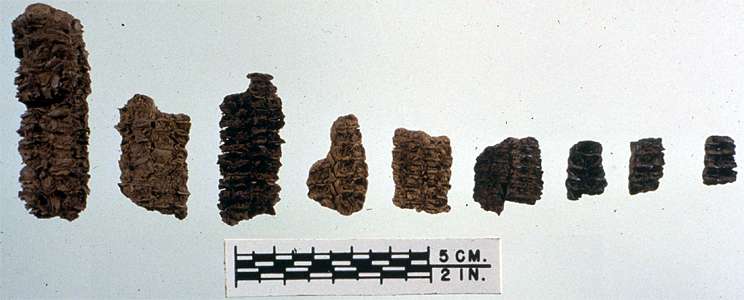
Corn Cob Fragments from Meadowcroft Rockshelter
Photo source : Meadowcroft a pre-Clovis site15 (Original source Meadowcroft Rockshelter and Historic Village Collection. Heinz History Centre).


Bone Artifacts from Meadowcroft Rockshelter
A good number of bone artifacts were recovered at Meadowcroft. These were made from the bones of animals the occupants killed for food. The awl far left has been grooved at one end to accept a cord, so that it could be placed around the neck, ready for use in sewing tasks.
Photo source : Meadowcroft a pre-Clovis site15 (Original source Meadowcroft Rockshelter and Historic Village Collection. Heinz History Centre).

A summary of the finds per stratum were included in Adovasio’s table 21:
Note the reference to Ash/Charcoal lenses (2) AND Lithic Concentrations (1) for stratum I


Later in the report Adovasio produces a table (table 3) showing the radiocarbon dates obtained from the Charcoal for most of the early (lower) strata:
 

The shocking part was that FIVE of the radiocarbon ages pre-dated the accepted age for Clovis of about 11500BC! At first reaction was muted, but as Adovasio continued to publish on Meadowcroft7,8 serious objections began to be raised about the site’s dating. The main objections raised were by Vance Haynes7 and centred around the possible contamination of the charcoal samples used to date the site by lignite or coal. Adovasio calmly and consistently rebutted these claims of contamination9 and published greater deatil10. However the attacks just kept on coming. Particularly prominent were the criticisms by Dincauze (1981)11, Kelly (1987)12 and Tankersley, Munson and Smith (1987)13 to name but three. In fact the situation became so bad and relations within the archaeological community so fraught that Adovasio coined the phrase ‘Clovis Mafia’ to describe those constantly making, what he saw as, unwarranted and baseless criticisms. In 1990, Adovasio2  attempted to firmly and finally quash the contamination, paleoenvironmental and stratigraphic issues raise by his critics by publishing new AMS radiometric dates obtained by four different laboratories. The dates are shown in his 1990 figure 1 below:


Original caption reads:
Plot of 52 Meadowcroft Rockshelter radiocarbon dates showing one standard deviation. Four reversals (asterisks) are noted: SI-2056 is actually from the lowest one-third of stratum IIb; SI-2363 is from the upper one-third of stratum IV; SI-2363 is from the upper one-third of stratum IX. Both SI-1681 and 2056 respectively were small heavily diluted samples. Adapted and and expanded from Stuckenrath et al. (1982: Figure 2).


Of particular note are that the dates for the lowest stratum, stratum I are confirmed and retained.


Having dealt with the stratigraphic and paleoenvironmental objections in separate publications16-18 he turned his attention to the contamination of the radiocarbon samples issue. Adovasio has this to say:

“With regard to particulate contamination, we repeat that there is no coal seam in or near the rockshelter. ..There are small, isolated, discontinuous fragments of vitrinized Pennsylvania-age wood west of the back (north) wall of the rockshelter, but these in situ fragments are circumscribed occurrences and are not represented en bloc within 7m of the hearths that produced the earlies Meadowcroft dates. ..Every radiometric sample from the Pleistocene-age levels was examined for coal particles using both optical and scanning-electron microscopy. No coal particles were ever identified by four radiocarbon laboratories or by independent researchers.. We forcefully reiterate that during these scrutinies, selected lower and middle stratum IIa samples underwent not only reflectance analysis but also paleobotanical examination for Densosporites and other commonly occurring spores of Pennsylvanian-age coal. In all cases, the results were negative..”

Adovasio goes on, acidly, at length about the absurdness of the claims of particulate coal contamination. Given all he had put up with it is worth seeing what he had to say:

“For criticisms about particulate contamination (or stratigraphic perturbation) to beto be credible, the mechanical introduction of vitrinized Pennsylvanian-age wood into earlier Meadowcroft fire pits would have required some unknown (and unspecified) mechanism so precise and of such duration that it nevertheless resulted in consistent stratigraphic order among the early dates. Then about 12,800 years ago, any mechanism that was making the early dates too early would have to have discontinued so that all the successive younger (more recent) dates were valid.. The absence ofany objective evidence for the lack of particulate contamination and lack of any mechanism for the selective injection of contaminants solely into the pre-12,800-year-old samples renders the argument for particulate contamination unconvincing.”
 
In other words, to his critics “You are making fools of yourselves making weak criticisms. Shut up!”.
 
With regard to non-particulate contamination of the charcoal samples, Adovasio says this:

“1. Vitrinized wood cannot be dissolved in ground water..

2. If vitrinite is not the source of any dissolved contaminent, there are no other candidates as the underlying shale (stratum I) that is the basal unit is not carbonaceous.”
 
Here Adovasio is making a direct jibe at Vance Haynes who famously kept a piece of vitrinized wood in a beaker of water on his desk for months.. nothing happened!
 
Adovasio continues:

“3. Assuming the presence of an as-yet-undiscovered potential source of contamination, there is no viable mechanism for its transport as the present water table lies nearly 5m below the deepest occupation surface at the site and it was never higher prehistorically..

4. Most basic to all questions of nonparticulate contamination is a misreading of the available data..”
 
Adovasio explains his detractor’s confusion to them. Tellingly, this matter is never raised again.

 
 Adovasio disavows his earliest 32000 year old cultural materials

Now we come to an extremely important passage regarding the charcoal with associated lithic assemblage, dated to 32000 year ago, obtained from stratum I. Regarding this Adovasio says:

“The last, diminutive sample from the pre-cultural levels at the site was sent for processing in the Oxford AMS system. The sample already had been scrutinized for particulates and Densosporites spores, but the Oxford lab also examined it and detected no contaminants. The solid fraction was extracted with no need to arrest the reaction and subsequently date, as was the soluble fraction. The results for the solid fraction was 31,400 +/- 1.200 years, 29450 BC (OxA-363). The soluble fraction was dated at 30,900 +/- 1,100 years, 28,950 (OxA-364) (see Gillespie et al. 1985:241). These dates conform very closely to the previously calculated Smithsonian lab date of 30,710 +/- 1,140 years 28,760 B.C. for this level, which to repeat, is not associated with any artifacts and apparently dates to well before the initial occupation of the site by humans (Adovasio 1975: 16, Table 3).” See below for more on this issue.
 
Adovasio, then sets out his preferred date for the site, rather tentatively, thus:

“The Meadowcroft dates suggest, rather conservatively, that humans were present at the site perhaps 2,000-3,00 years earlier than the well-established 11,500-year horizon marker”

In other words: My site is proven pre-Clovis beyond reasonable doubt! He continues:

“The frequently cited eighteenth millennium B>C> dates (SI-2060 and SI-2062) were both very small, diluted samples, one of which, SI-2060, has a very high standard deviation of 2,400 years. If the younger range of both of these dates is averaged, then the earliest possible occupation of the site may have occurred ca. 16,770 years ago.”

This date has become the accepted date for site. It seems that the weight of continued criticism had finally worn Adovasio down. He was prepared to be conservative to silence his critics.
 
Unfortunately it wasn’t to be criticisms were STILL raised throughout the 1990’s19.

It wasn’t until 1999 that an independent study20 finally laid to rest the sceptics last shreds of dissent. Meadowcroft WAS inhabited by pre-Clovis humans 16,770 years ago.

Dissent of a different kind
Mark McConaughy, a member of the field crew that carried out the excavations during 1974 on the earliest levels and who personally collected many of the samples that produced the earliest dates has made some extremely persuasive comments to the effect that Meadowcroft is most likely older than current accepted age14.


Archaeologist Mark McConaughey excavates on the Rockshelter’s east wall, July 1974.
Photo source : Meadowcroft a pre-Clovis site15 (Original source Meadowcroft Rockshelter and Historic Village Collection. Heinz History Centre)


Here is what he had to say:
“The early radiocarbon dates from Meadowcroft have been criticized by Haynes (1980, 1991), Kelly (1987), Mead (1980), Tankersley, Munson and Smith (1987), Tankersley and Munson (1992) and others as being the result of various types of coal contamination or incongruities concerning floral and faunal associations. According to these people, either particulate coal or soluable humates and carbon ions from coal percolated through the clays in ground water at the shelter and were embedded in the charcoal collected and radiocarbon dated. This contamination supposedly resulted in the samples producing anomalous dates. These criticisms have also been addressed by Adovasio et al. (1980), Adovasio, Donahue and Stuckenrath (1990) and Adovasio, Donahue and Stuckenrath (1992). Generally, they disagree with the view that coal contamination of the samples resulted in dates that are too old or that the floral and faunal associations do not indicate a Pleistocene occupation at the site.
I personally do not believe any of the radiocarbon dates from the early levels at Meadowcroft are erroneous. I think they properly date the samples submitted and are not contaminated by coal. However, I am hardly an unbiased observer.
The earliest remains from Meadowcroft did not come from excavations within the drip-line of the rockshelter. Most came from an area excavated beside the Old Roof Fall (an immense rock that fell from the top of the shelter prior to anyone living at the site).
Two samples I recovered were dated to ca. 19,000 years ago. Unfortunately, the two 19,000 B.P. samples were not directly associated with stone tools. ..It is for this reason that the bark was only tentatively identified as a basket fragment in Meadowcroft reports, and the dates questioned as being associated with a Paleoindian occupation.”
 
With regard to the very oldest materials recovered from stratum I McConaughy says this:
“Most other charcoal samples taken and dated from the earliest levels, (and dated as 33000 years old) or the "Deep Hole" as it was named by the crew, consisted of pieces of charcoal found with ash and burned earth. These were interpreted as surface hearths that had been put out (i.e., kicked out, spreading some of the ash and charcoal around). Stone tools were found in association with these samples lending support to the interpretation of them being extinguished hearths.”
 
This directly contradicts Adovasio 1990, but is supported by Adovasio 1975. One can only, therefore, conclude that Meadowcroft is probably older than ca. 16,000 years old as currently quoted and most probably 33000 years old.
 
One can only assume that Adovasio chose in 1990 to take the road more travelled by at last, just to get Meadowcroft within the mainstream of accepted sites.
 
One final thought from Adovasio 19751: Stratum I consists of badly decomposed, foliated sandstones (possibly roof fall?) - perhaps this indicates that the bedrock was not actually reached and further unexcavated levels remain below…
 
References
1. Excavations at Meadowcroft Rockshelter, 1973-1974: A Progress Report
By J. M. Adovasio, J. D. Gunn, J. Donahue, and R. Stuckenrath
1975. Archaeologist 45(3), pp.1-30.
2. The Meadowcroft Rockshelter Radiocarbon Chronology 1975-1990
J. M. Adovasio, J. Donahue and R. Stuckenrath
American Antiquity Vol. 55, No. 2 (Apr., 1990), pp. 348-354
3. Dr. Richard Shutler, Department of Archaeology, Simon Fraser University. Retrieved 07/12/15 from http://www.sfu.museum/journey/an-en/postsecondaire-postsecondary/meadowcroft
4. Quoted in Tom Imerito   Pittsburgh Quarterly Fall 2012 online
“Ancient dig discovering man in America: Archaeological finds at Meadowcroft Rockshelter turned back the clock on humankind’s first migration to the new world
5. In Albert Miller: Renaissance Man April 27, 2015 by Mark Kelly
6. The First Americans: In Pursuit of Archaeology's Greatest Mystery
by James M. Adovasio with  Jake Page. 2002. Random House.
7. Haynes, C. V.1980 Paleoindian Charcoal from Meadowcroft Rockshelter: Is Contamination a Problem? American Antiquity 45:582-587.
8. Mead, J. I. 1980 Is It Really that Old? A Comment about the Meadowcroft Rockshelter "Overview." American Antiquity 45:579-582.
9. Adovasio, J. M., J. D. Gunn, J. Donahue, R. Stuckenrath, J. E. Guilday and K. Volman1980 Yes Virginia, It Really is that Old: a Reply to Haynes and Mead.
American Antiquity 45:588-595.
10. Carlisle, R. C. and J. M. Adovasio, eds. 1982. Meadowcroft: Collected Papers on the Archaeology of Meadowcroft Rockshelter and the Cross Creek Drainage. Department of Anthropology, University of Pittsburgh, Pittsburgh.
11. Dincauze D. F 1981. The Meadowcroft Papers. Quarterly Review of Archaeology :3-4
12. Kelly, R.L. 1987 A Comment on Pre-Clovis Deposits at Meadowcroft Rockshelter. QuaternaryResearch 27:332-334
13. Tankersley, K. B., C. A. Munson and D. Smith. 1987 Recognition of Bituminous Coal Contaminants in Radiocarbon Samples. American Antiquity 52:318-330.
14. Mark McConaughy. Retrieved from:
16. Meadowcroft Rockshelter: A 16000 Year Chronicle. In Amerinds and Their Paleoenvironments in Northeastern North America, edited by W. S. Newman and B. Salwen, pp. 137-159. Annals of the New York Academy of Sciences 288. New York.
17. Adovasio et al. 1984. Meadowcroft Rockshelter and the Pleistocene/Holocene Transition in Southwestern Pennsylvania. In Contributions in Quaternary Vertebrate Paleontology: A Volume in Memorial to John E. Guilday, edited by H.H. Genoways and M. R. Dawson pp. 347-369. Special Publications No. 8. Carnegie Museum of Natural History, Pittsburg.
18. Adovasio et al. 1985 Paleoenvironmental Reconstruction at Meadowcroft Rockshelter, Washington County, Pennsylvania. In Environments and Extinctions: Man in Late Glacial North America edited by J. I. Mead and D. J. Meltzer, pp 73-110. Peopling of the Americas Edited Volume Series, Centre for the Study of Early Man, Orono, Maine.
19. Tankersley, K. B. and C. A. Munson 1993 .Comments on the Meadowcroft Rockshelter Radiocarbon Chronology and the Recognition of Coal Contaminants. American Antiquity 57: 321-326.
20. Goldberg, P and Arpin, T. L. 1999. Micromorphological Analysis of Sediments from Meadowcroft Rockshelter, Pennsylvania: Implications for Radiocarbon Dating
Journal of Field Archaeology Vol. 26, No. 3 (Autumn, 1999), pp. 325-342